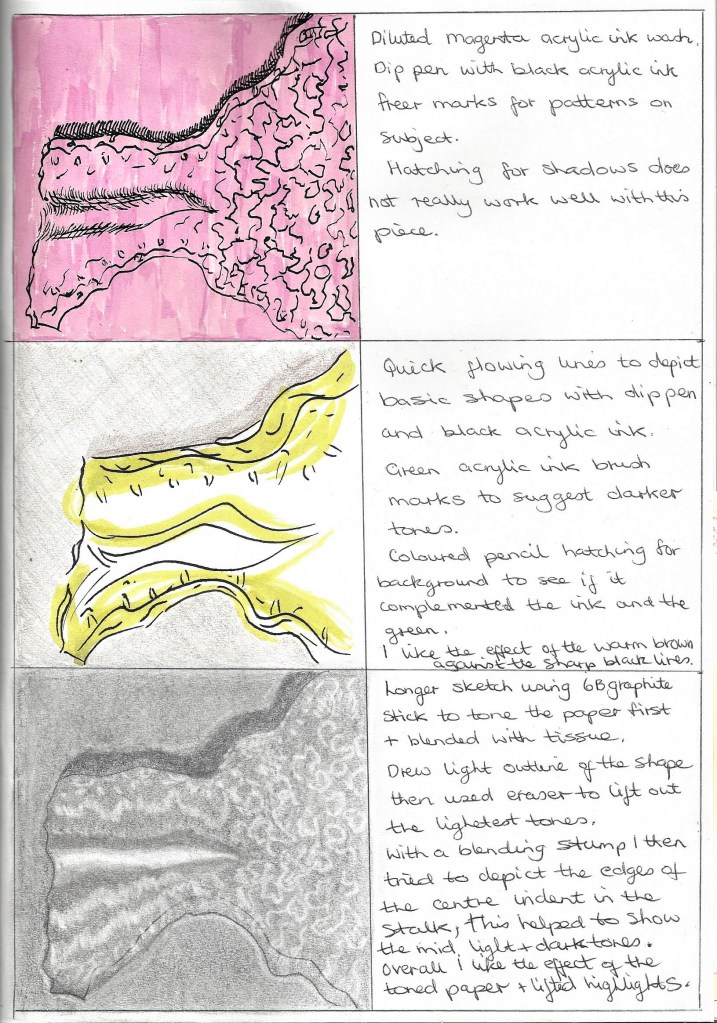
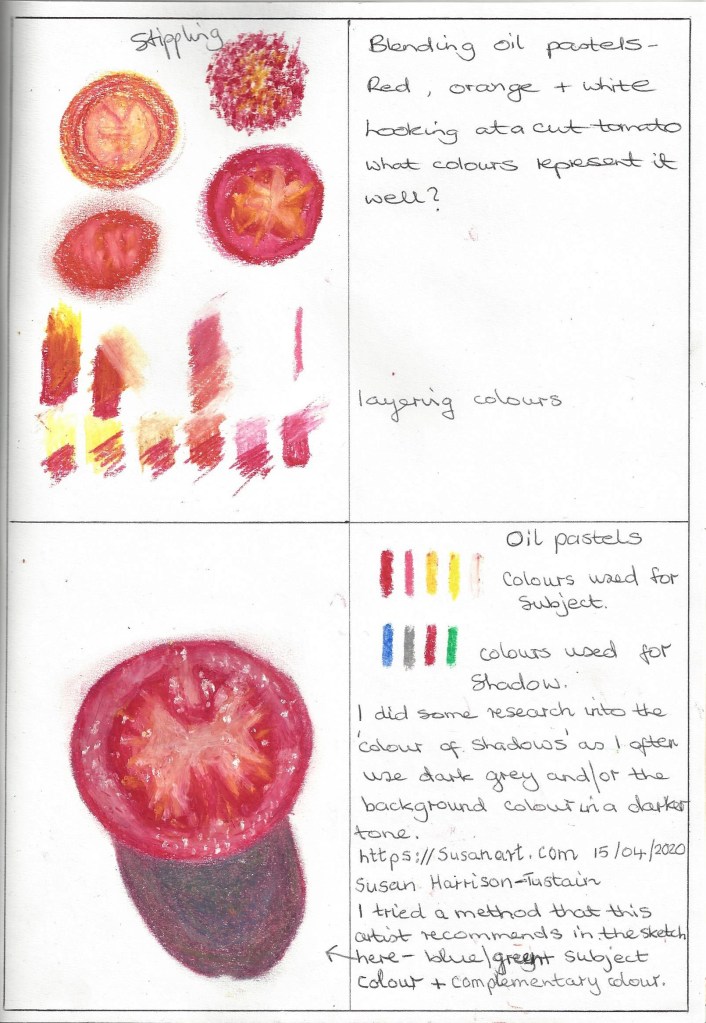
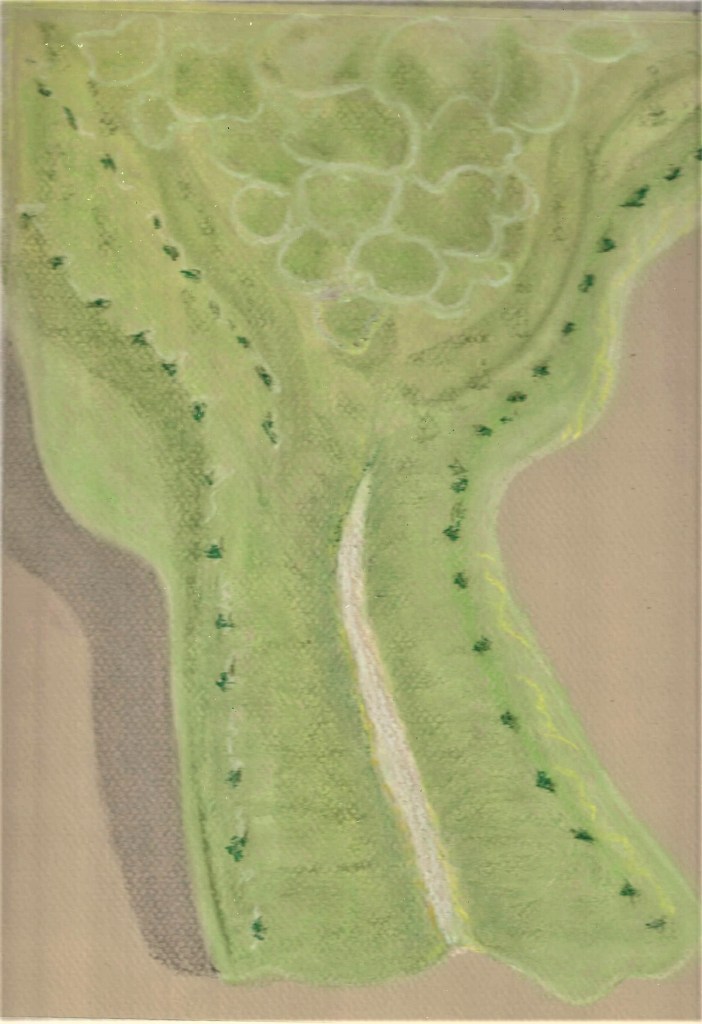
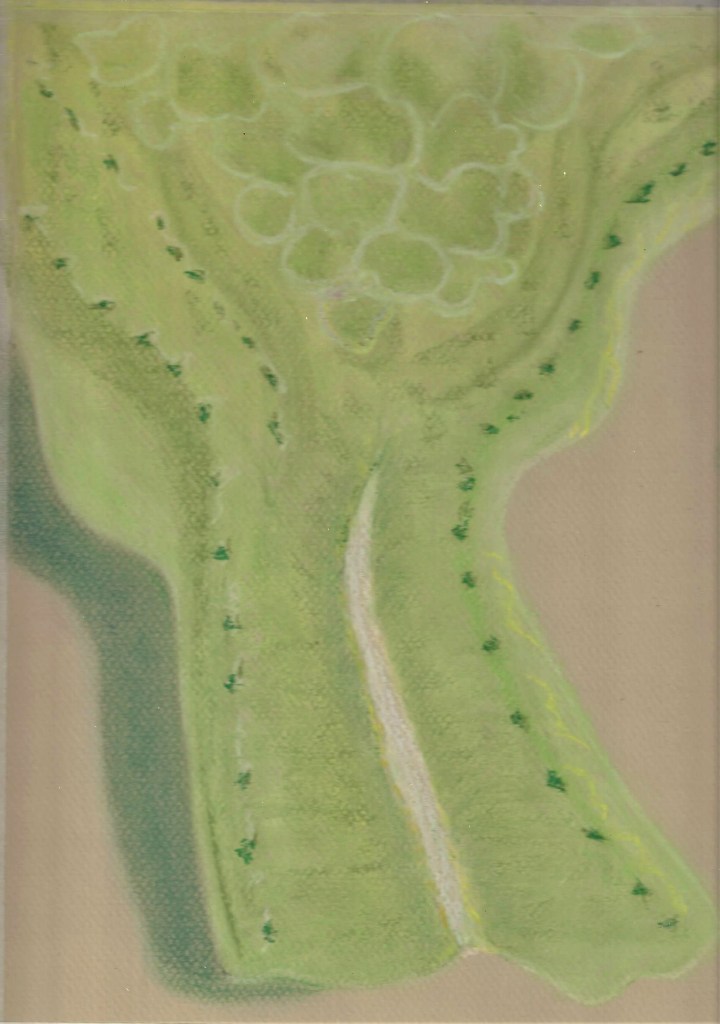
Part 5 re-working of final piece

As recommended by my tutor I have re-worked the final drawing for part 5.

It appears that after preparing several experiments and preliminary drawings in my first attempt I then moved slightly off course from my initial idea of observing patterns in vegetables close-up, and my final drawing became more of a ‘Still life’ composition.

I have now revisited the practice sketches/thumbnails and used these as a notes for the final piece. I have also found inspiration from looking at the work of carol Sowden who is an environmental artist and in this particular body of work she focuses on the patterns of leaves – encouraging us to see the beauty in our everyday surroundings her drawings show a meticulous method of depicting natures markmaking – http://www.carolsowden.com/needleprick-drawing-skeletal-leaf.html

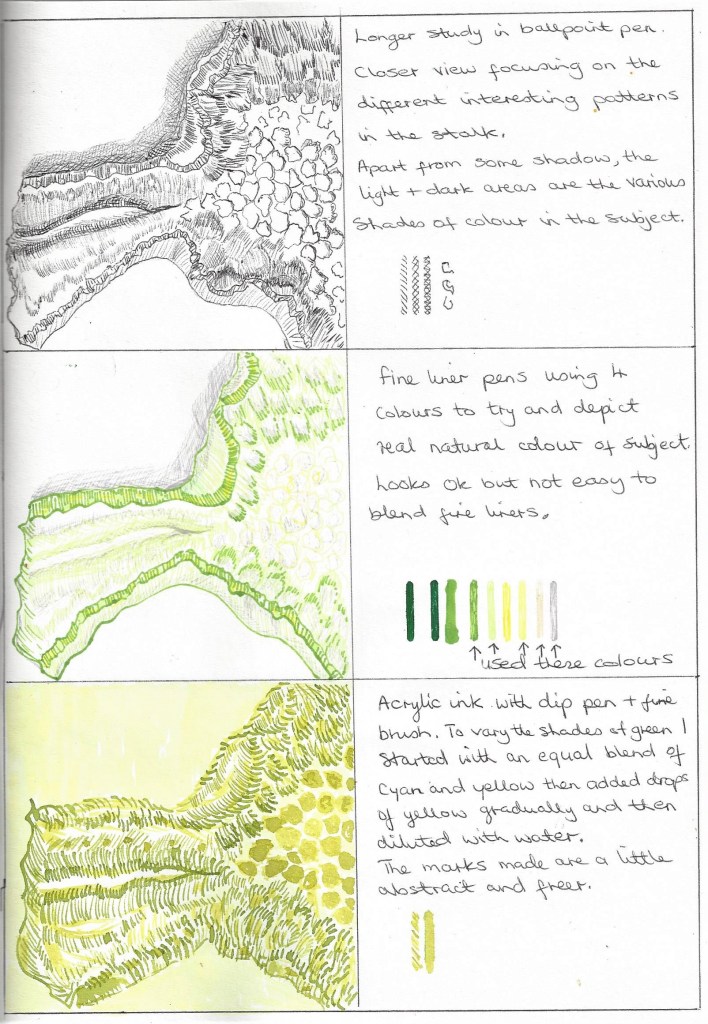
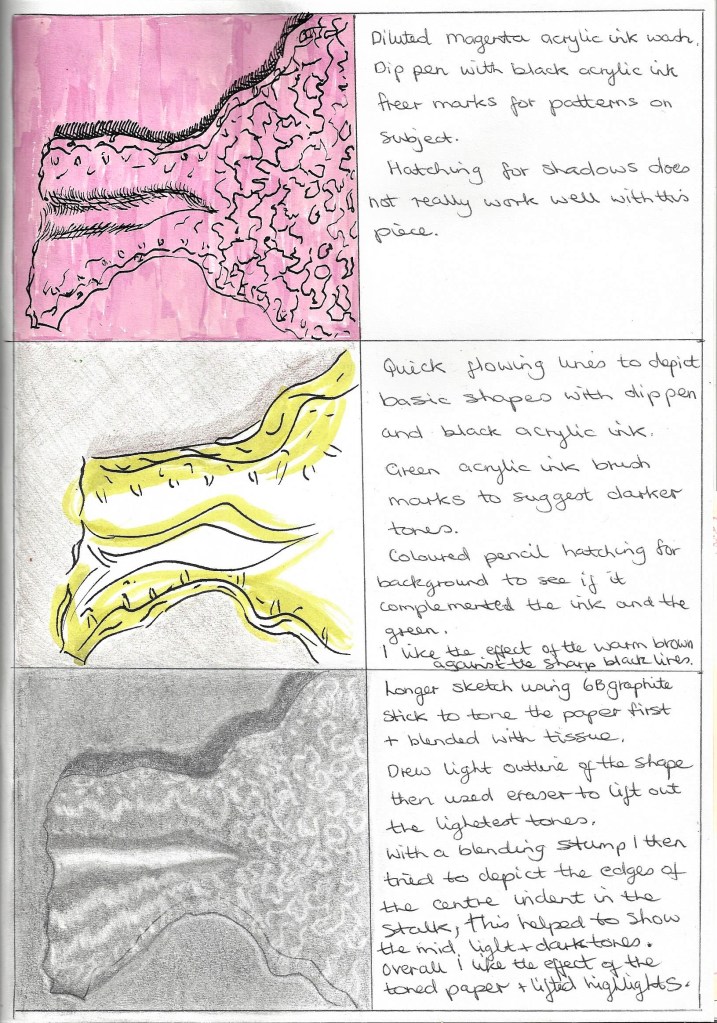
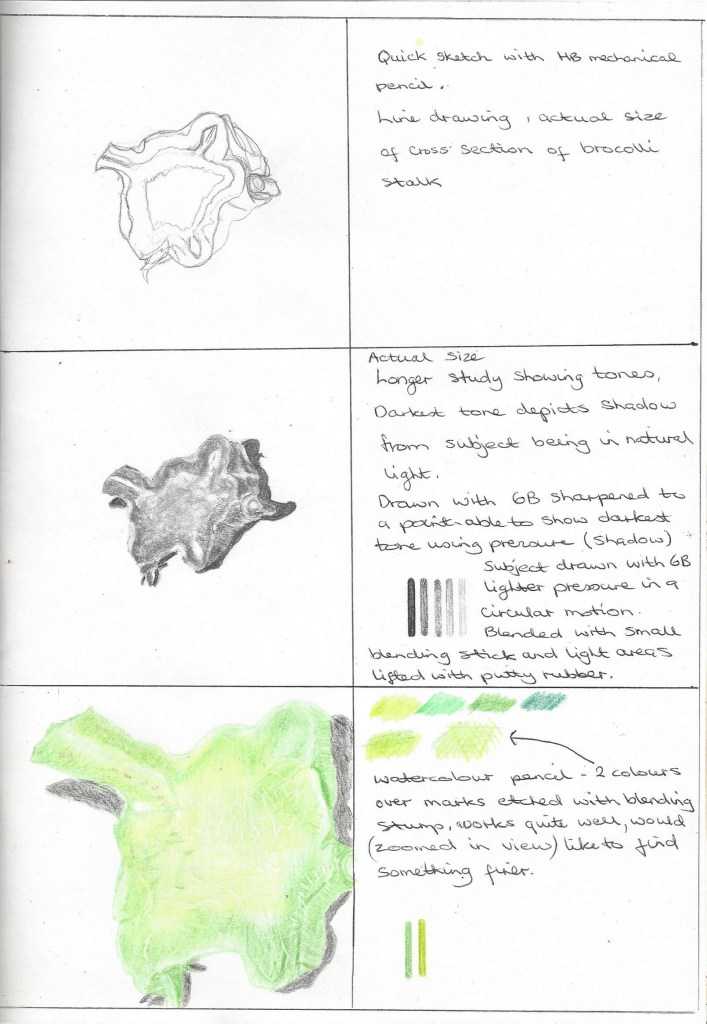
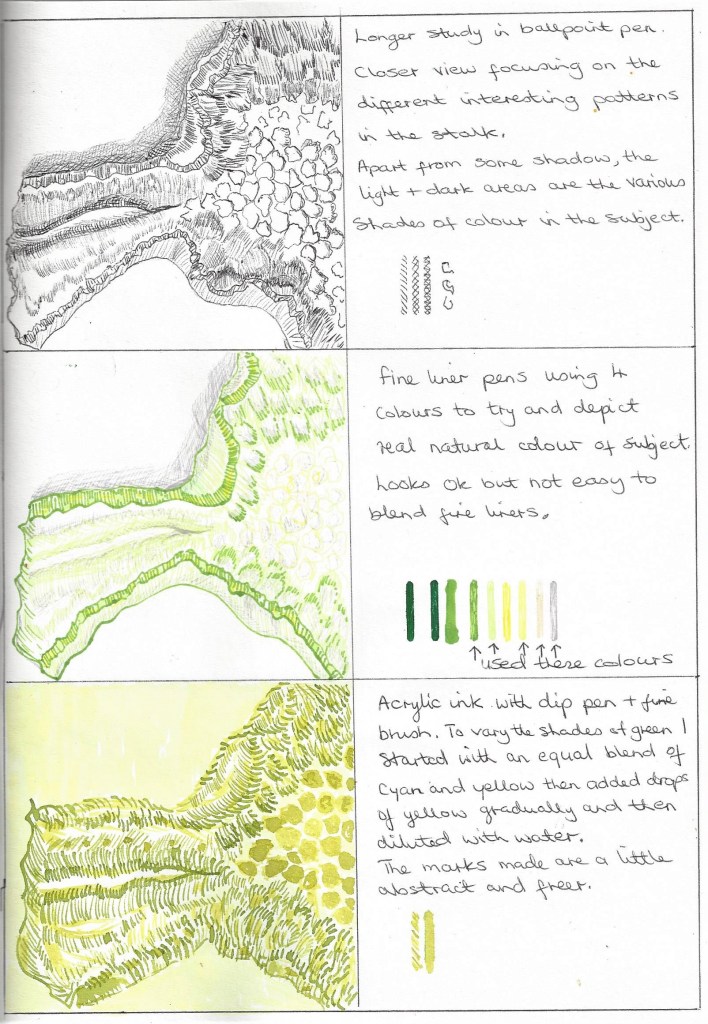
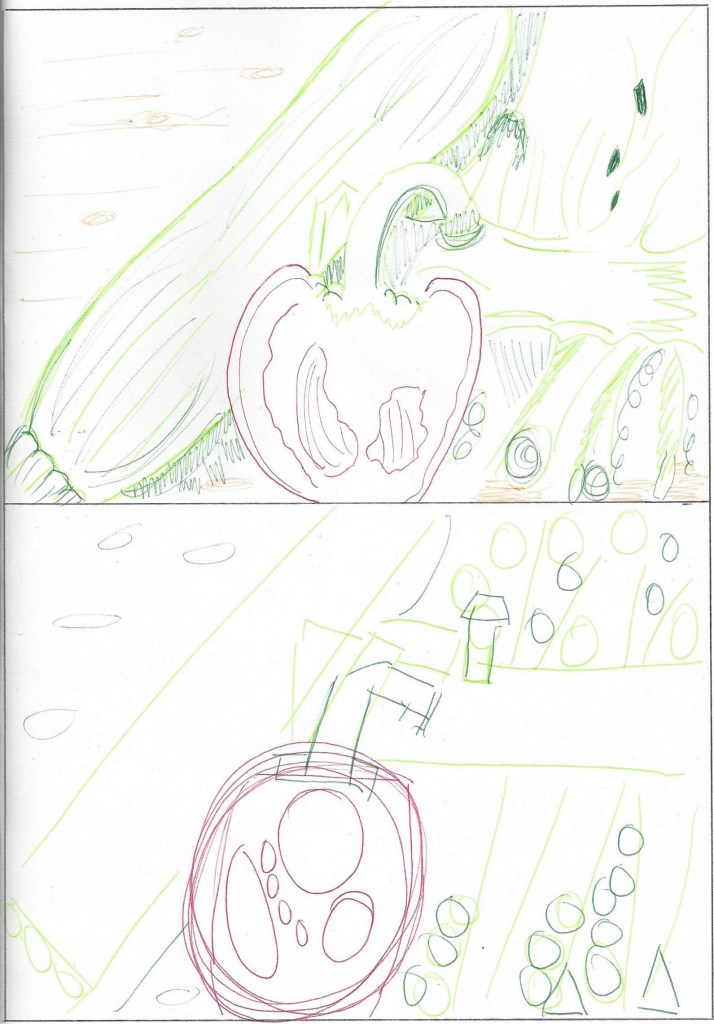
Thumbnails

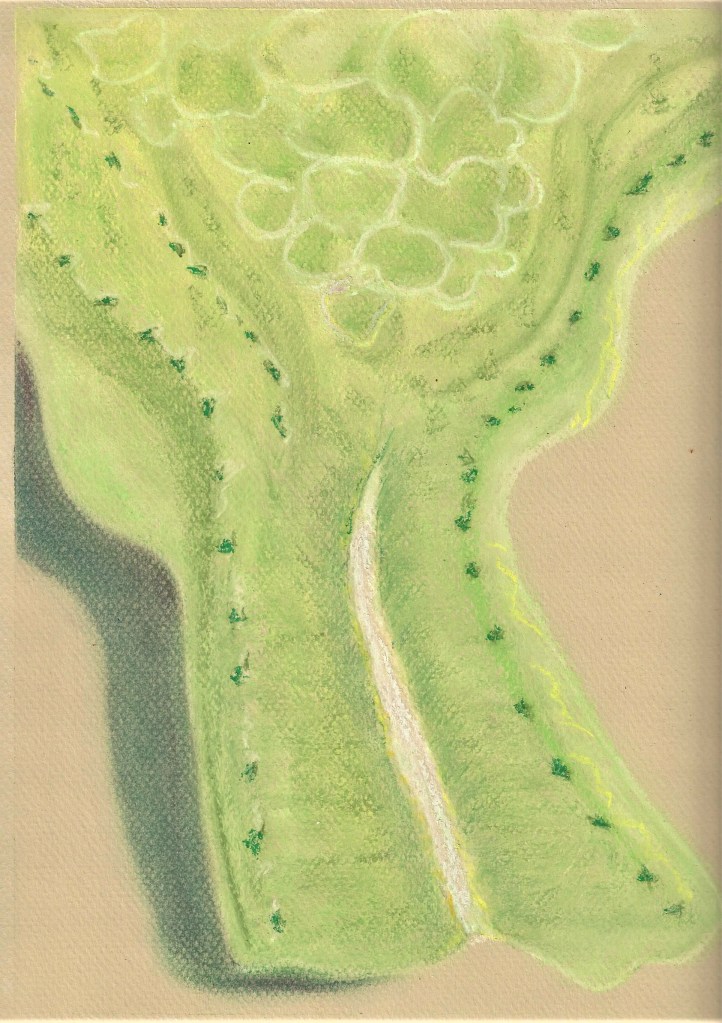
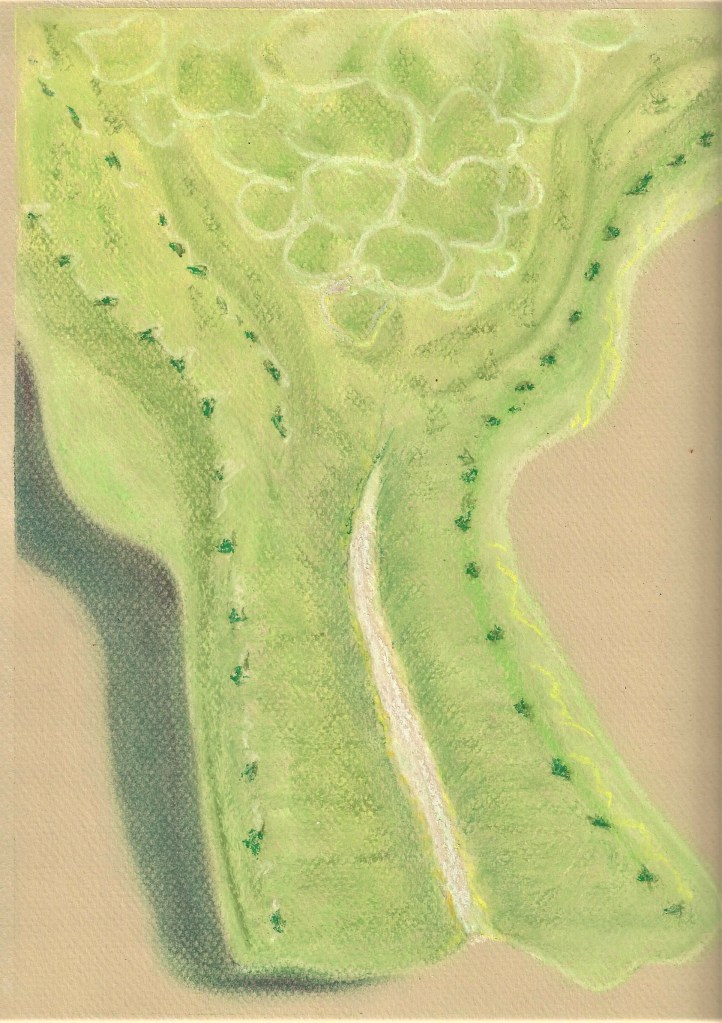
Pastel drawing on A4 pastel paper– I built up the layers gradually, using the side of the pastel, blending each layer with tissue. Then added marks with the tip of the pastel crayon at the end.
Pastel drawing on A3 black paper – this view of the subject reminds me of a map/piece of land with rivulets and crevices. I want to use a close up view similar to this but maybe from a different angle.
Close up of the above pastel drawing showing marks made with the side and the tip of the pastel crayon.
On A4 drawing paper in my sketchbook using several weights of waterproof fine liner pens. – Testing out whether to use black and white or colour. The black ink is effective in outlining the many different patterns and marks and gives a bold, crisp look. Here I used fine liners which has a more controlled feel when drawing. I chose the thicker pens for the shadow side and gradually lightened the marks towards the right of the drawing to depict the light falling on the subject.

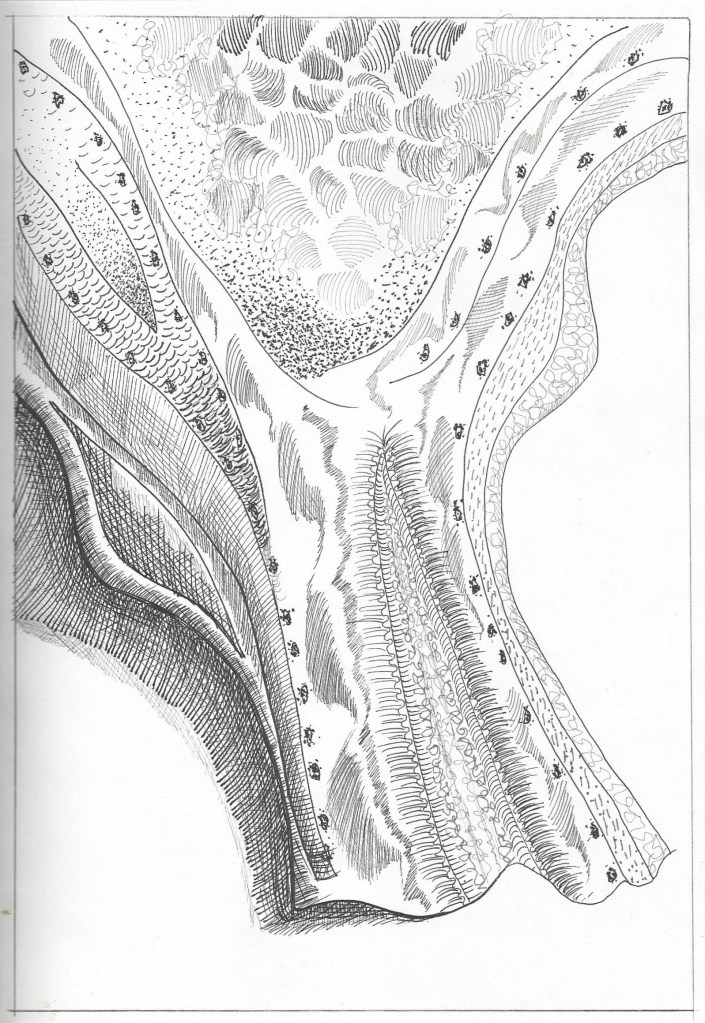
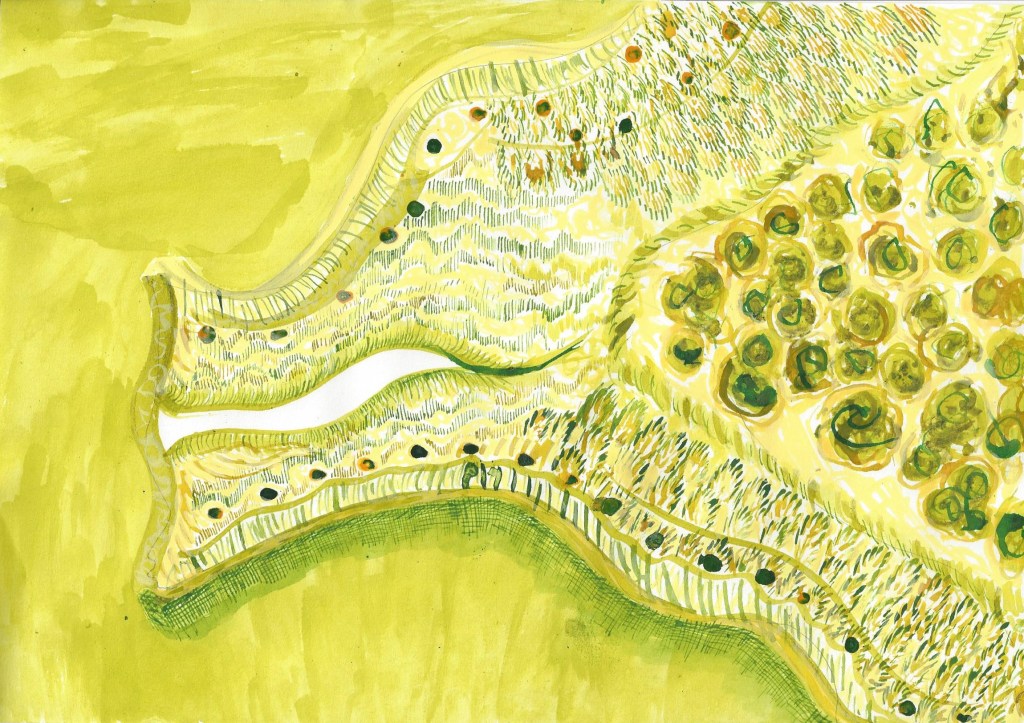
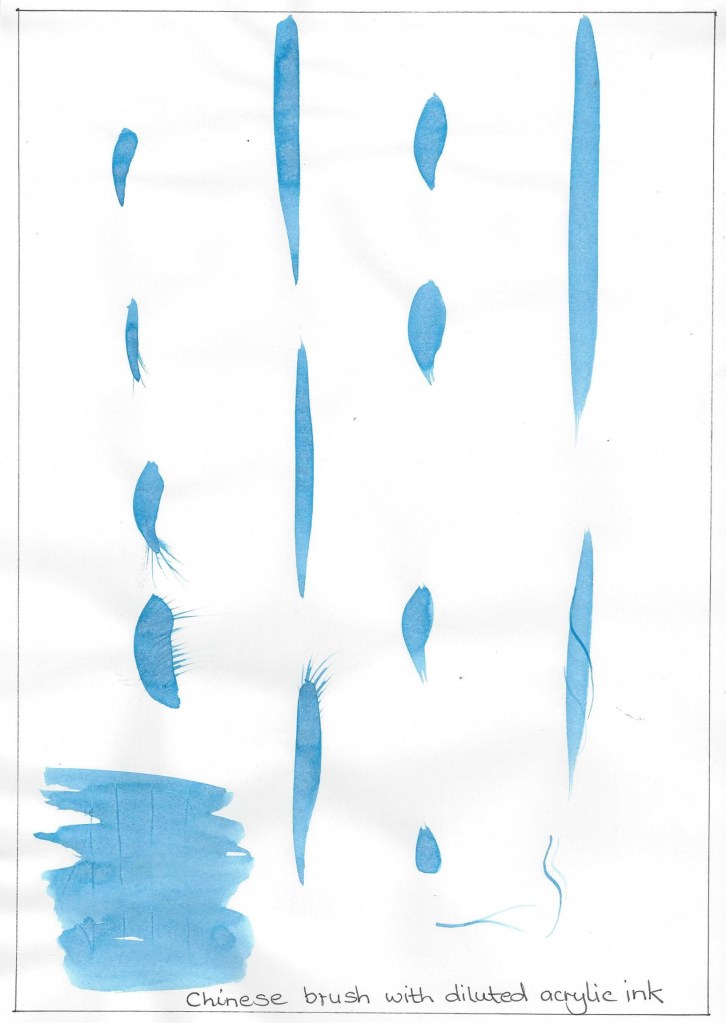
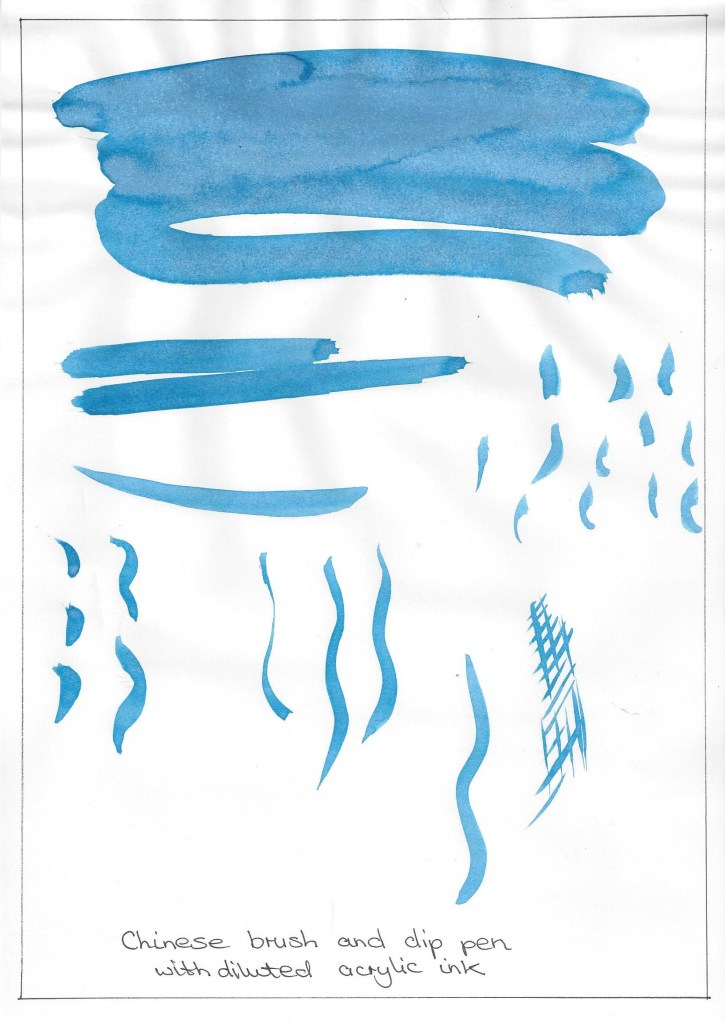
The last 2 drawings have helped me to decide that I will use fine liner ink pens and dip pens with acrylic ink. I have also chosen to use a stick to draw some of the lines and marks to help me keep the drawing loose and not too controlled. I am going to use A3 Bristol board paper as this holds the ink well and absorbs any wetter areas when ink is diluted. I want to frame the drawing close -up in portrait orientation as I think this suits the subject best as it shows that the area of my interest is in the stalk. I started with a light pencil sketch for the basic shape and then mixed various shades of green to yellow inks sometimes adding only 1 drop at a time to lighten or darken the shade. I began with the shadow area on the left with the darkest, heaviest lines drawn with a stick and dip pen.

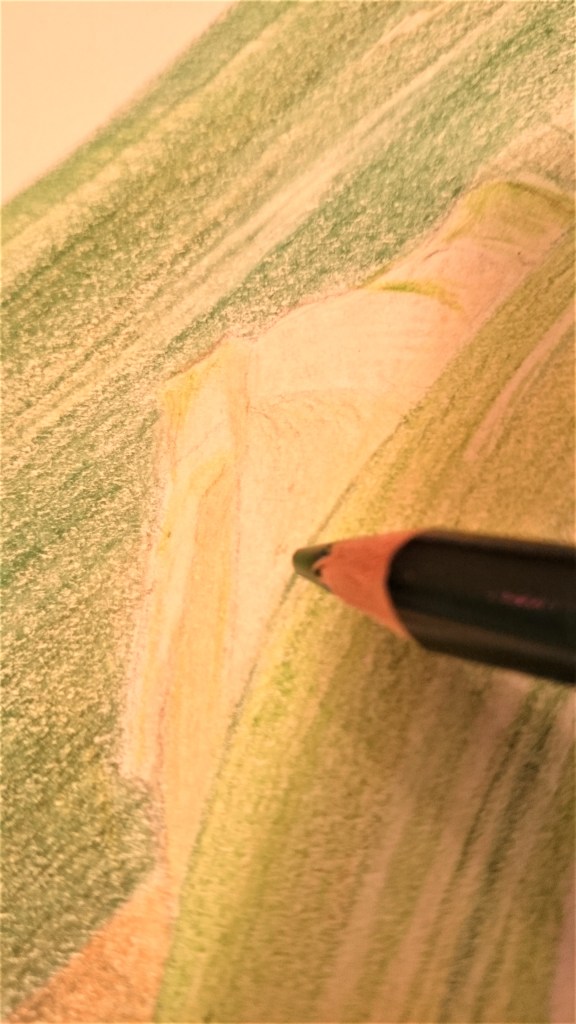
In the zoomed images above it can be seen that I have used scribbling, hatching, speckling with a toothbrush, drops on ink splashed onto the page, brushwork, dip pen, stick and fine liner.

In this close up it is seen that the scribbling in between the green lines goes from dark to light to show the direction of the light on the subject.

Bibliography

Bridgeman https://www.bridgemaneducation.com/en/slideshow/private/1a80ae6a4ad381d8efb432d547d422e2a3958bd9

Hendry, C.J. https://cjhendry.live/

Kaupelis, R (1980) Experimental Drawing: (30th Anniversary edition). U.S.A : Watson-Guptill.

Sowden, C. (2020) Skeletal leaf. At: http://www.carolsowden.com/ accessed 24.04.2020

Part 5 Personal project

Self assessment

Reflections As I begin part 5 I am going to revisit my earlier notes on each assignment and I will add some new thoughts in italics. Any notes in bold are where I have taken on board the advice from my tutor.

Assignment 1

. During this assignment I used a range of materials and some for the first time. My techniques are developing and need to be practised more thoroughly. Observation is rising with each exercise. Visual awareness needs to be increased as sometimes I miss things. I need to be more confident in design and composition.

. The content needs to be more varied. My application of knowledge is somewhat limited particularly in organising my log/blog and coursework using WordPress. Discernment and conceptualisation of thoughts and ideas are emerging with each exercise but I have felt I’m only at the tip of the iceberg.

.I have begun to express creativity in a small way and experimenting with different papers and materials is helping to see what it means to develop a personal voice. I need to use my imagination much more and not feel bound by what I feel safe with.

. Research and critical thinking have been limited and I want to progress in these areas and reflect far more on their value in art. I often look at the art of others but neglect to reflect on what is being said.

It is very obvious to me now that apart from the required exercises, and work in my sketchbook, I didn’t do any planning drawings for this assignment. It was’t obvious at the time and I’m not even sure why. What I do know is that now I always plan a sketch and experiment with format, composition, materials,subject matter etc. this makes me realise that I have learned a lot so far in this course that will be a foundation for future work.

Feedback from my tutor for Assignment 1 suggested making a note when I come across a new idea or technique that will inform my future work, so this is my aim as I progress.

Assignment 2

During this assignment I have increased the range of materials used and explored some new techniques which I an beginning to use with more confidence. My observational skills are strengthening as I put more planning and preliminary experimentation into my work (as advised in tutor feedback). Visual awareness is increasing and became evident when working on interiors. I am becoming more confident in design and compositional skills.

Content is becoming more varied as the exercises pushed me to try new subjects. My application of knowledge is increasing. Presentation of work in a coherent manner is getting much better as I chose to write and draw in this A3 coursebook, keeping the work together in chronological order. Discernment is increasing with each project. Conceptualisation of thoughts and communication of ideas is a challenge which I welcome and seek to take forward.

Imagination and experimentation are emerging and I have sought to be more confident in making decisions which is sometimes a weakness when choosing a subject. Invention is emerging throughout the projects. I still lack confidence in developing a personal voice but I am excited about the journey of discovery.

I have enjoyed the research for this project and used the inspiration gained to inform some decisions in my work. Handwriting my learning log alongside the work has helped it to flow better and be more consistent. Critical thinking is developing and reading other artist’s blogs/diaries is helpful. Visiting galleries and engaging in conversations with other artists is a valuable learning experience. I often ask others to critique my work and I welcome their feedback.

This part of the course was so enjoyable when experimenting with different media and trying out what works and doesn’t. It widened my knowledge of materials and I was excited about colours and textures e.g Project 3, exercise 3 – Experiment with mixed media. I try now not to worry too much about the final outcome when beginning a project and I now benefit from experimenting, being inventive and gaining inspiration from others. As stated above * I hand wrote my learning log which I later regretted as I neglected to keep up with the online log already started in Part 1. This made it difficult to catch up when it came to submitting work to the tutor.I have since factored time into my week to update the log and be consistent in storing my work digitally.

This is one reflection on the tutors feedback for assignment 2 – Looking at the artist Kindah Kalidy – as recommended by my tutor. I’ve been encouraged to explore mark making and materials in a free way and consider whether I could build elements into my finished work to help tell a story or convey atmosphere. Words of wisdom here which have I am building into the work I do.

Assignment 3

Throughout this assignment I have constantly felt challenged and pushed to explore new skills in drawing. It has been the most difficult work so far and I have learned so much. Working with linear and angular perspective is something I need to work on, my rooftop drawings conveyed in some way the urban beauty I was attempting to show but the accuracy has weaknesses I feel.

I have been experimenting with using mixed media in my work and trying different supports but I need to do this more. My observational skills and visual awareness are improving although I am aware of sometimes drawing what I think I see rather than what is actually there. I have noticed that my design and compositional skills are increasing slowly as I work through the exercises and look at other artists work. I also am realising that the exercises are a guide and that I can use them to do further sketches beyond what is being asked.

The exercises with aerial perspective felt more enjoyable and I was able to demonstrate this more easily in the final drawing.

I can see that the quality of my work is improving and especially as I focused on using preliminary drawings to inform the final piece and present the work in a coherent way. This is especially evident in the assignment final drawing of rooftops. I also found the sketchbook walks exercise improved the quality of the outcome for the composition I did with acrylic inks. Discernment is developing with each project and conceptualisation of thoughts is something I want to develop as I become more confident and not worry about my drawings being carefully composed. I am seeking to communicate my ideas in a small way and this course is aiding that process.

I sought to demonstrate creativity particularly in project 3, ex 1, with experimenting in mark making to inform future drawings some of which I used for landscape drawings but not so much for townscapes. I tried to use imagination by recreating other artists work in my own style which I enjoyed and found helpful. The work for project 3 was my most creative and I experimented more with different media.

I have gained knowledge of other artists techniques through the research in these projects and made notes when finding a new technique that I want to try in the future (this was recommended by my tutor in the previous assignment feedback).

I am developing critical thinking and meeting up with local art groups, attending an OCA study event has been invaluable.

It became clearer during these projects that perspective was a great challenge to me and I researched many other artists and watched lots of tutorials to find answers. Doing this part of the course during the winter months was not easy as daylight was shortened and the opportunity to draw outdoors was limited. I tried to look at what was around me and use this in the work.

After receiving feedback for assignment 3 my aim is to take on board the tutors advice to use colour in the planning process of a drawing instead of leaving it until the final piece, this I tried in e.g ‘reclining figure’ assignment 4 Also the suggestion to explore the range of ways that one type of medium can be used to bring visual interest. As suggested in the tutors feedback I looked at some of the work of Julie Mehretu I especially like the large paintings of American politicised landscapes https://art21.org/artist/julie-mehretu/

Assignment 4

I have learned so much throughout part 4 and this assignment. I continually feel pushed to explore new skills and techniques. Drawing on A1 has been a great challenge physically and I want to find more opportunity to do this perhaps by working outside in the warmer weather. Looking at the figure has caused me to be much more observant of bone structure and facial features. I especially like the technique for drawing a face using tone which I have tried in my final portrait. Observing figures – still and moving is an emerging skill which I want to develop. I have tried to keep in mind design and composition in some of the exercises and to use a viewfinder or grid was helpful in drawing the larger sketches.

I can see that the quality of my work gradually improved as I went along. I began to realise what a vast subject the figure and head really could become and felt I could spend years studying this part alone.It was helpful to keep a visual diary with drawings of different body features to inform the 3 assignment pieces and present the work in a coherent way. The quality of the outcome for the figure drawings has need for improvement , this has been my first experience of life drawing and I see the benefit of the opportunity to draw living beings in real time. Discernment is improving with each project and conceptualisation of thoughts is something I am seeking to develop as I learn from other artists. In this part of the course I didn’t focus a lot on communicating ideas as I was very taken up with learning the technical skills I needed to produce a believable likeness of figure or face.

For this part of the course I worked through the exercises in a different way to all the other parts due to waiting for availability of models and then the cancellation of Life classes due to social distancing. I used imagination and invention such as collecting old magazines and drawing over the photos of people or copying them e.g in the collage for project 5 – exercise 2 and also in using collage for assignment 4 ,1 figure study using line. I enjoyed experimenting with teabags to depict a crowd in an audience (also project 5 , ex.2). When thinking about developing a personal voice I look forward to it emerging and becoming recognisable in the future.
I have been informed by the techniques of other artists throughout this part of the course particularly as I reached out for help and information due to my lack of experience and knowledge in figure drawing. I regret only being able to attend 1 Life drawing class but was able to watch a virtual class (although I think nothing can replace attending in person) My learning log has become invaluable in helping me keep track of my thoughts and organise my work whilst completing the exercises in a different order. Critical thinking is something I need to develop more. I looked at some artists views whilst researching for project 1 and this provoked many thoughts on my feelings about figure drawing. I didn’t write as much about my research as in previous parts of the course because my time was taken up in finding models/opportunities in different poses, and I consider photographs/videos of lesser value. Many things to think about and consider from these projects that have sparked my imagination.
During this part of he course I became more relaxed about writing my learning log and adding to it regularly (as stated earlier) is the best advice I would give to someone just starting this course. At times I felt overwhelmed and under skilled in this assignment but I know I would not have attempted some of these suggested projects had I not been studying the course.

Looking at the feedback from my tutor for part 4 gives me lots of suggestions to work on and I would like to begin Part 5 with her recommendation to test materials on a larger scale other than thumbnails. I have been advised to revisit Project 3 Form- Ex.1 – foreshortening and do more research and make practical works.

Artist’s statement

My chosen option for this project is from part 2 – Intimacy. projects 2 and 3

The title is – Observing detail in vegetables through a range of patterns and marks, line and tone, using inks and coloured pencil and pastel. looking at the work of the young contemporary artist CJ Hendry –https://www.instagram.com/p/BgJqEsXlDu4/ and carol Sowden http://www.carolsowden.com/

Looking back at the work I did for Part 2, projects 2 and 3 makes me feel happy as I know this was the most enjoyable part of the course for me in terms of the success of the exercises and finished drawings but more importantly my development in observational skills. I do know now that the other parts were successful in that I pushed myself to attempt projects I would naturally avoid. After discussing this choice with my tutor I realised how timely it is to be looking at objects around my environment during this time of ‘lock-down’ and working from home. I have had time to focus on ordinary things we use everyday and I am particularly wanting to explore the patterns and markings we see in vegetables. As a developing artist I have begun to see the importance of looking more closely at things around me to help to communicate this through my work. Throughout this project I would like to experiment with several mediums which I used in part 2. I particularly want to use coloured pencil as the main medium for the final piece. My choice was partly influenced by the artist C.J Hendry and also from my work in part 2 which I wanted to explore further and attempt a more detailed work. I am aiming to use A3 size paper for the final piece as this is more manageable physically for me at the moment but I will use other sizes for experiments. I want to show a close-up/zoomed in view of the subject as I feel this will enable me to work in detail and depict the beauty of the patterns in a clearer way. This is seen in the work of both my chosen artists and I can learn from their example of taking time to observe and focus on my work, whilst also enjoying the process and sometimes being led by that process to develop a work further. I intend to make use of photographs taken from several angles alongside sketches that I make as a reference to use whilst working and also to touch and handle the subjects to really get to know them. I am interested in testing different viewpoints that maybe I haven’t done before e.g the subject not being in the middle of the page as is often the case in traditional drawing. I am also interested in testing out ways of interpreting some work in more abstract ways or even mixing this with some realistic features. Although my intention is to focus on vegetables, I don’t want to rule out other natural objects that I have in my everyday surroundings and I will try out ways of focusing on some that are appealing. I will also look at other artists work as I work through the project and I am keen to learn from others examples. Looking back through the previous parts of this course and my tutors feedback as a reminder of methods and skills I have learned will be valuable in this project.

Line drawing with ink from Part 2 , project 3 , exercise 1– I feel this was my most successful drawing in this part of project 3. I would like to adapt this drawing into something with colour whilst focusing on the patterns which here are depicted well in the use of various marks, dark and light lines.
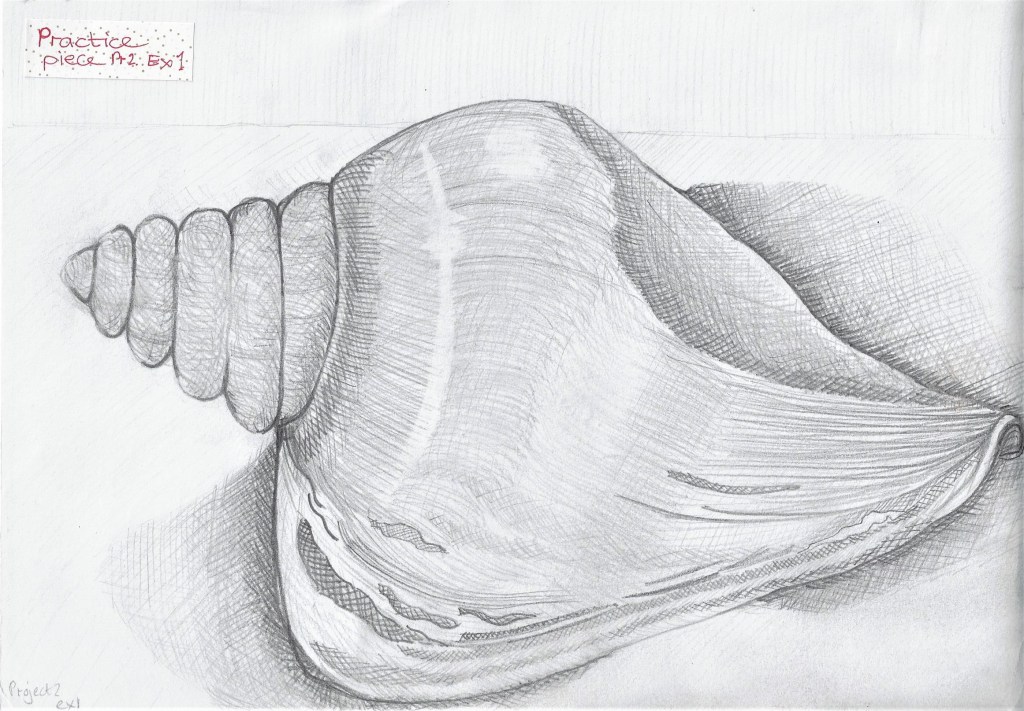
Another successful drawing from part 2, project 3 – I feel the shape is good and the highlights show the sense of it being 3 dimensional. If I were to develop this I might try adding other shells with different shapes.
From my sketchbook- several studies of broccoli which are so interesting to look at when fresh. having time and head-space to observe in more detail makes us appreciate the goodness and beauty in some parts of nature that often get overlooked in our usually busy lives.

Fig.1 Squash (1924) I like the way the artist depicts the shape and form of the squash. Using ink and watercolour to make soft edges, we can sense the smooth, roundness of the vegetable at the same time giving an aura of beauty and regality. I am trying to decide which medium to use for my final piece – I like the effects of ink to show line as in the drawing I did for part 2 see below – but I also want use colour to add warmth and show the variation in hues in nature.

Also tried this shadow method with a larger scale pastel drawing of the broccoli I had drawn previously to see how it enhanced the drawing and gave it a more depth.
sketch of a tomato in ink on A4 page of my sketchbook – really enjoy drawing these patterns I am considering the composition of the final piece and perhaps zooming in on the subject to give an interesting view.
limited edition giclee prints
Fig.2 Peach tree (2016) In this drawing the contemporary artist Becky Blair shows leaves in an abstract way which bursts with colour and life. I am undecided at this point whether to draw realism or abstract or a mixture of both.
Fig.3 Vegetables in a Basket (2012) This drawing shows a more realistic style than the one above. Both are appealing and colourful, I particularly like the patterns on the red cabbage which catch the eye as the white pops out against the deep red/purple. So which style suits what I am trying to convey through my work is my question to my self?
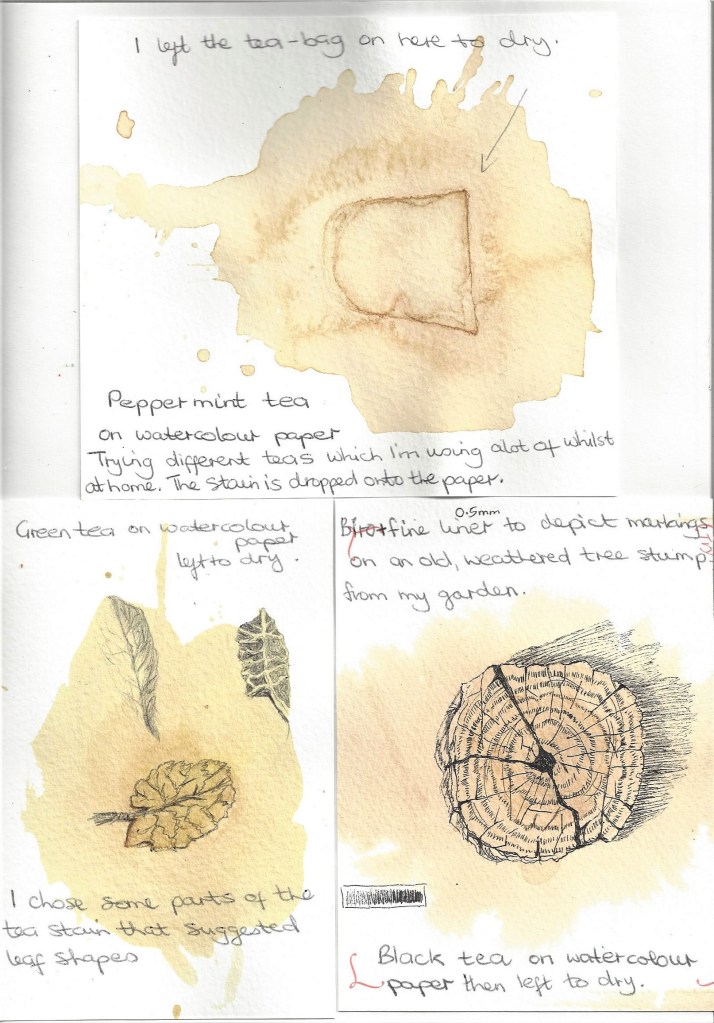
Tea has been a great feature in my life since working from home and I became interested in using what was around me as a medium. Wondering if it could be used as a background wash so I tried it on watercolour paper (cold pressed) wet on dry. I used the results of the process of these experiments to help depict a subject and looked at the possible shapes that I could outline. Looking at the veins in leaves is fascinating.

Research pointhttp://www.carolsowden.com/needleprick-drawing-skeletal-leaf.html I researched contemporary artists who draw nature as part of their work and came across the artist from Yorkshire – Carol Sowden. The skeletal leaf works are very detailed and precise and we get the sense of her dedication to observation and attention to detail.

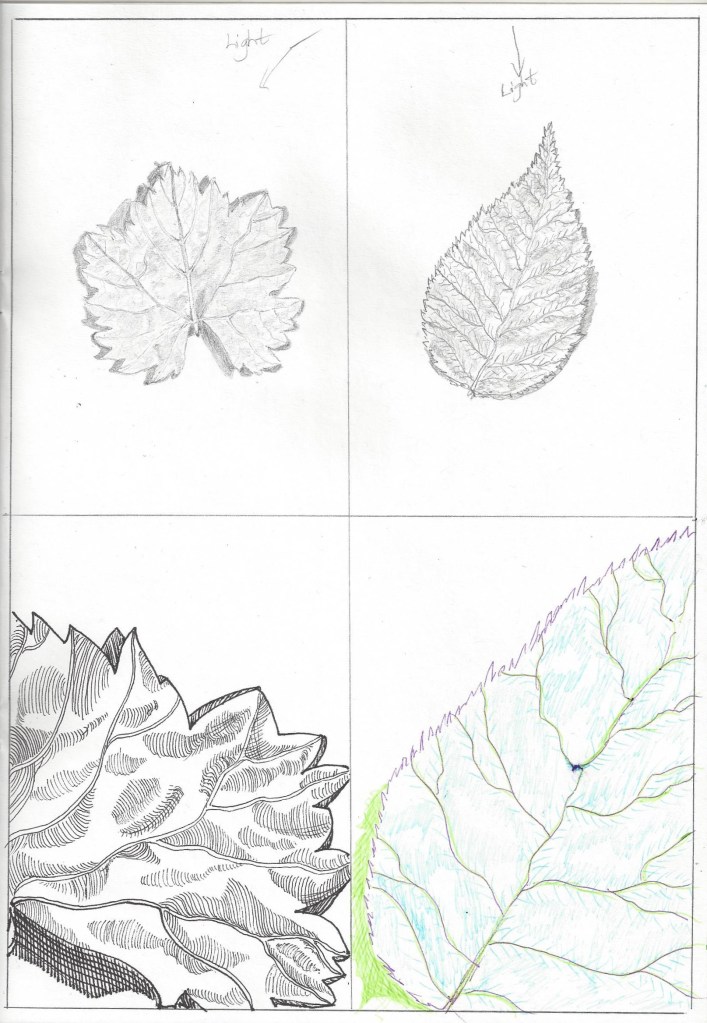
I drew the 2 leaves in the top 2 sketches true to scale and life-like in pencil. Then below I interpreted each leaf zoomed in and in a more abstract way. The leaf on the left in with fine liners o.8 and 0.5mm. I wanted to show the veins as open canals that are the life-line of the plant. The hatching is used to depict the small undulations on the surface of the leaf which reflect light. The drawing on the right is with coloured fine -liner and unrealistic colours, I’n not too happy with the result of the marks I used but I do like the zoomed in view.
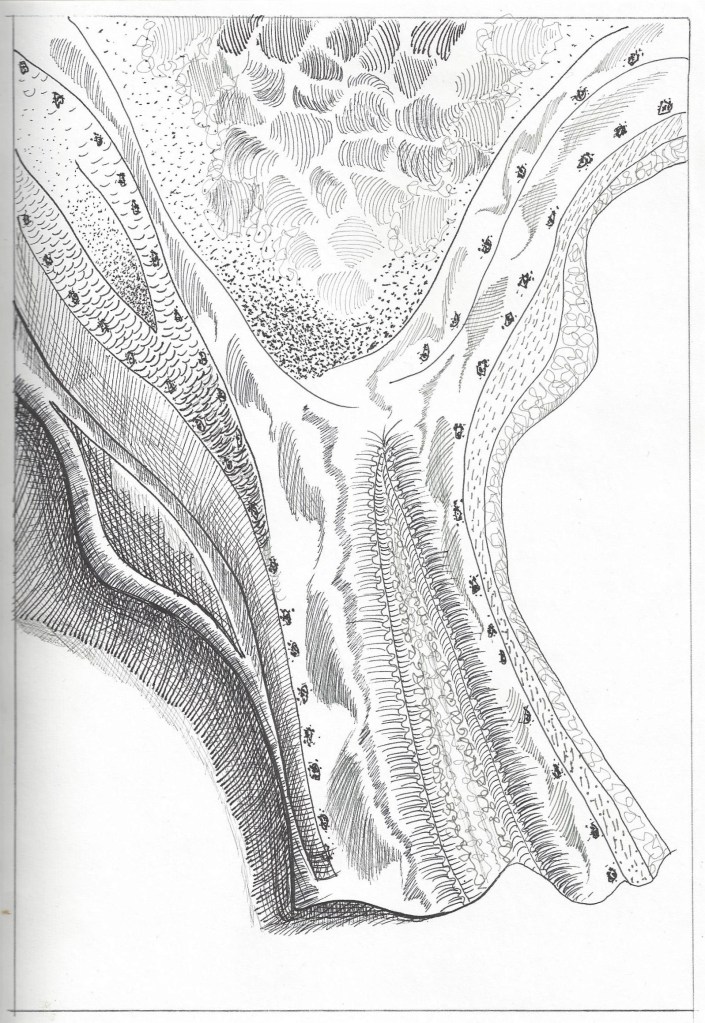
After the previous sketch I feel inclined to choose a close- up of my subject. This drawing is done on A4 paper with fine-liners in black and grey and various sizes as suggested in the feedback from my tutor for assignment 4 – the darker, thicker marks show the edges of the shadow and the lighter marks describe the highlights/lighter tones.
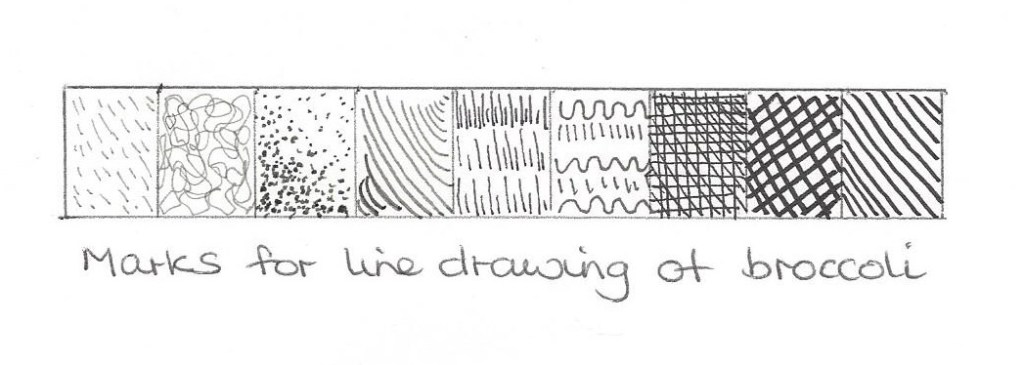
This image has an empty alt attribute; its file name is mark-grid-for-broccoli-final.jpeg
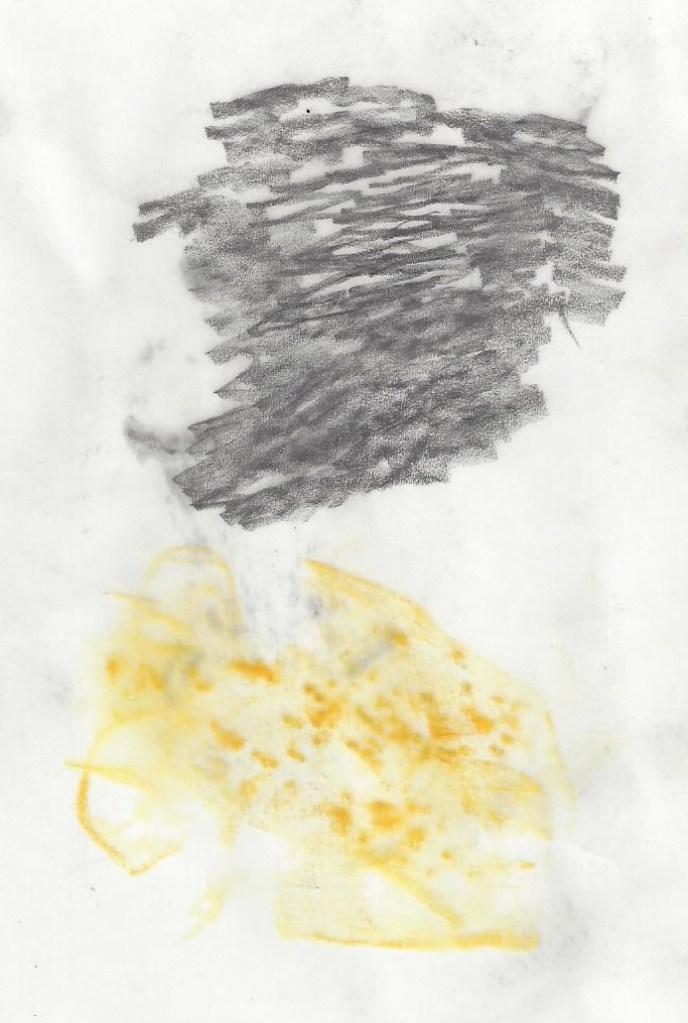
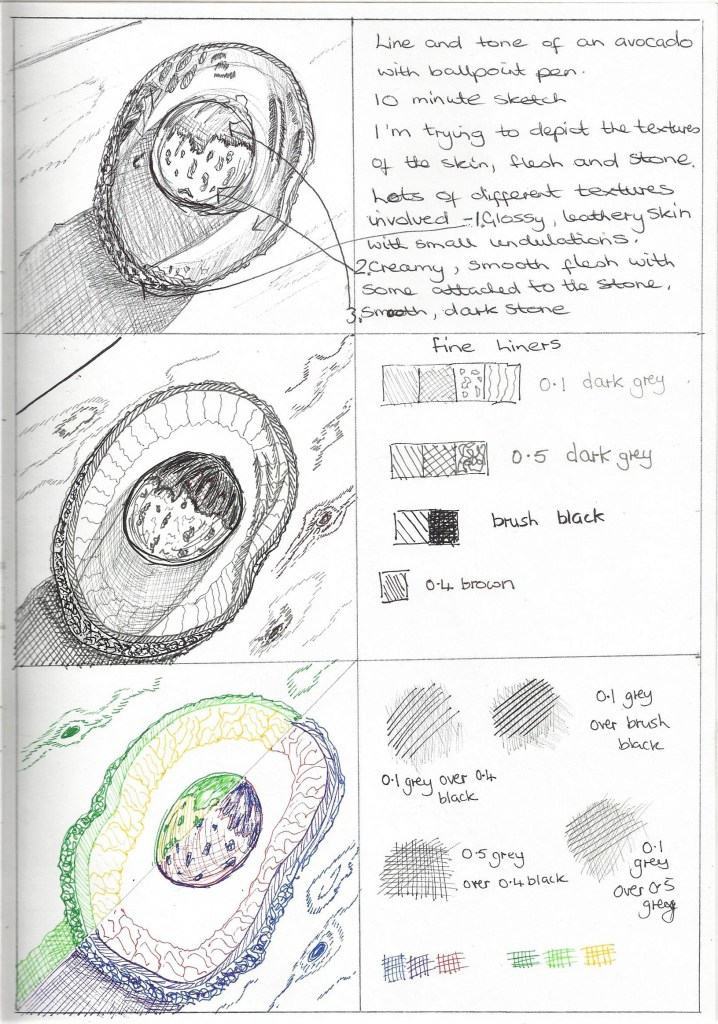
Exploring other vegetables and focusing on their unique shapes and patterns-below is a frottage of the avocado skin which is something I did in Part 1,project 1, exercise 2 and I enjoyed re-visiting this exercise although I’m don’t think the avocado frottage is something I will use in this project.
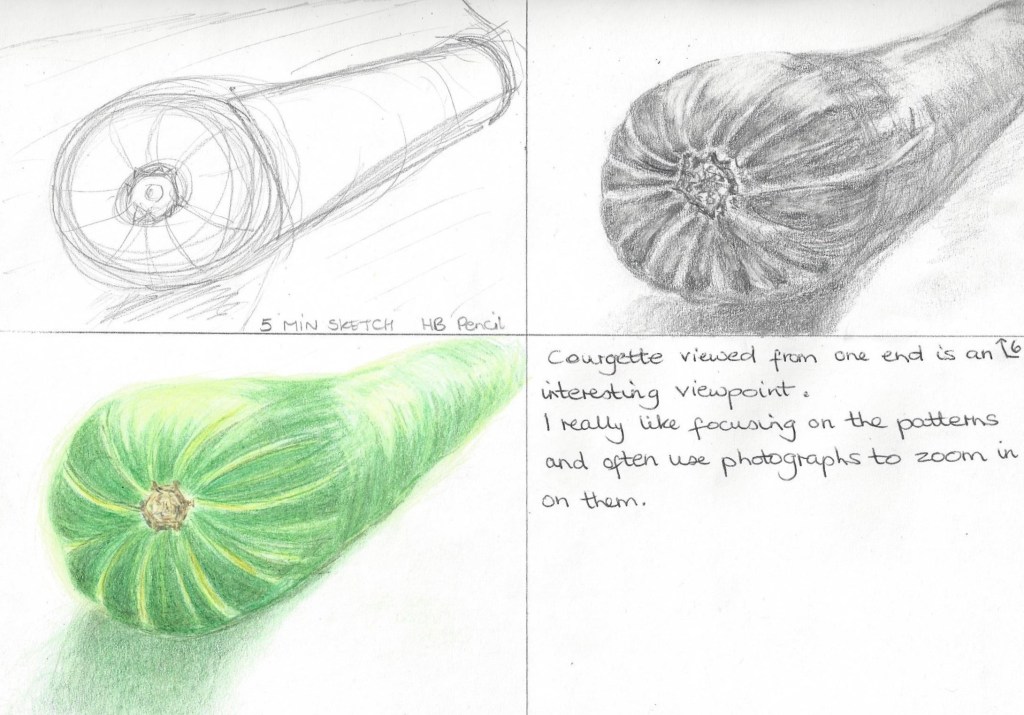
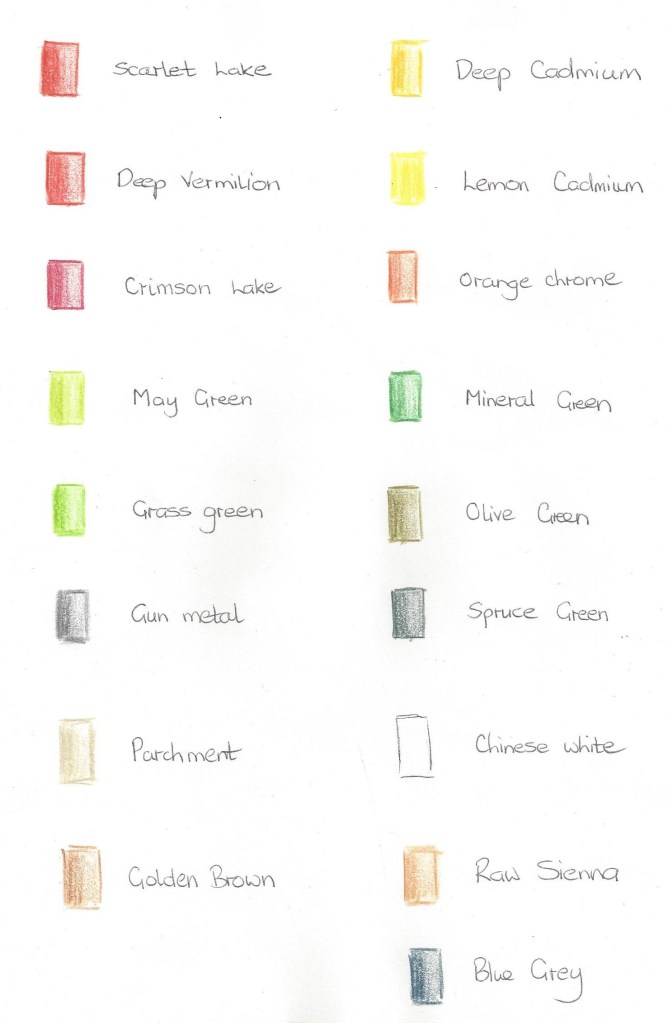
Sketches of this vegetable on A4 paper to show the patterns from an interesting viewpoint which I often overlook. Using a lamp for lighting on the subject I began by drawing the basic shapes and then i sketched in tone using HB , 2B and 4B pencil and a putty rubber to add highlights. I then used coloured pencils in several shades of green and yellow adding layer upon layer blending each one in.
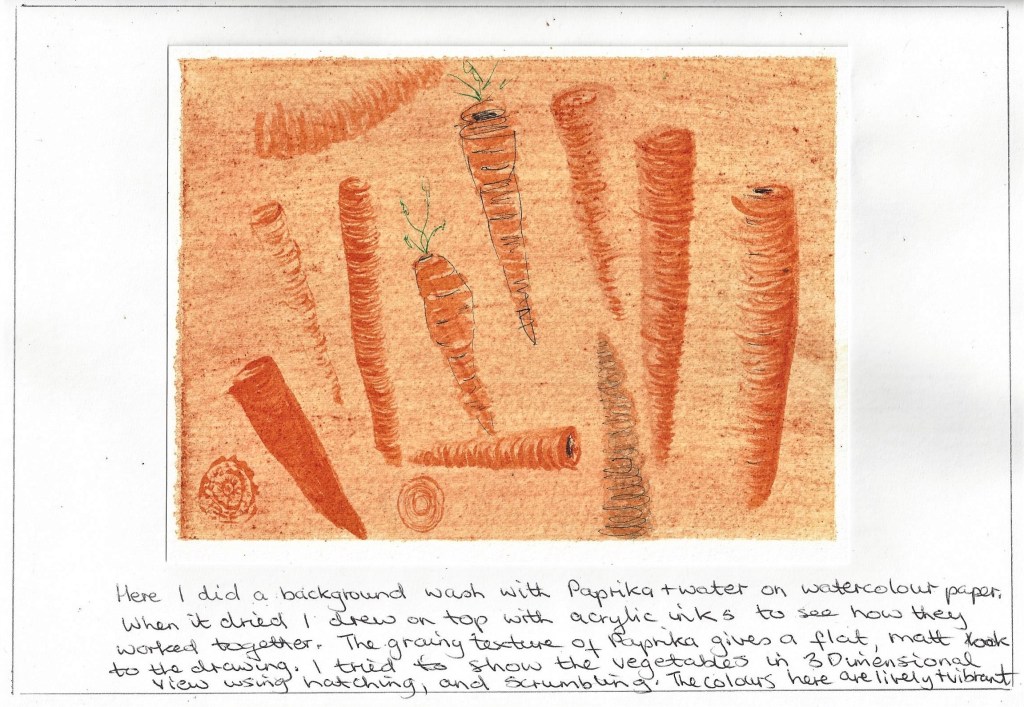
Fig.4 Beresford, J. (2020) My workspace. [Photograph, painting] In possession of : the author: Northampton. Whilst clearing out a cupboard I discovered a large amount of ground Paprika which had been there a while. I mixed it to a paste with water and painted with a brush- first as a wash on watercolour paper and then I drew shapes that perhaps could be used to depict vegetables or wood in an abstract way.

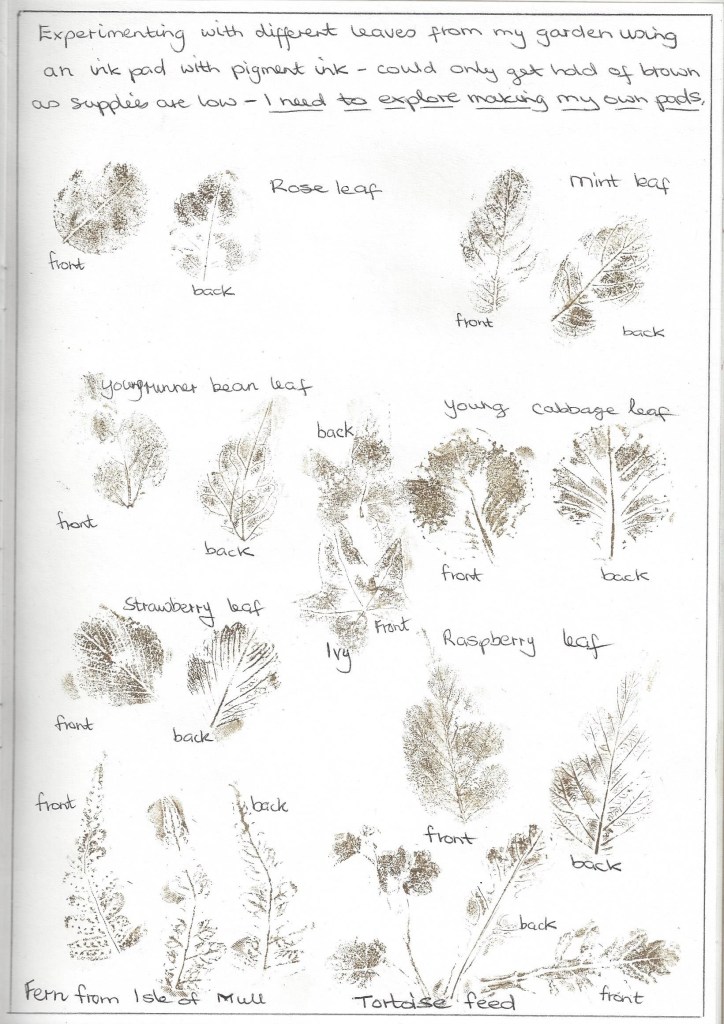
I drew an imaginary garden on A4 watercolour paper in mixed-media – charcoal, ink, graphite, wax resist and leaf stencils using dip pen, fine liner pen, candle and twig from the garden. experimenting using things around me, the leaves were from my garden and I painted ink onto them and printed them onto the paper. L like the wildness of this picture and I added the yellow to depict a sense of hope coming through in a dark place. I drew this in mid April at the peak of the Covid 19 virus.
Fig. 5 Out of the darkness (2020) After drawing the previous sketch I researched contemporary artists who draw nature and came across Jo Starkey- ” As a nature lover, I try to depict the essence of nature and its magic, into my paintings.” (Starkey, 2020 ) I like the effect of the highlighted flowers coming out of the darker background and drawing our eyes around the picture.
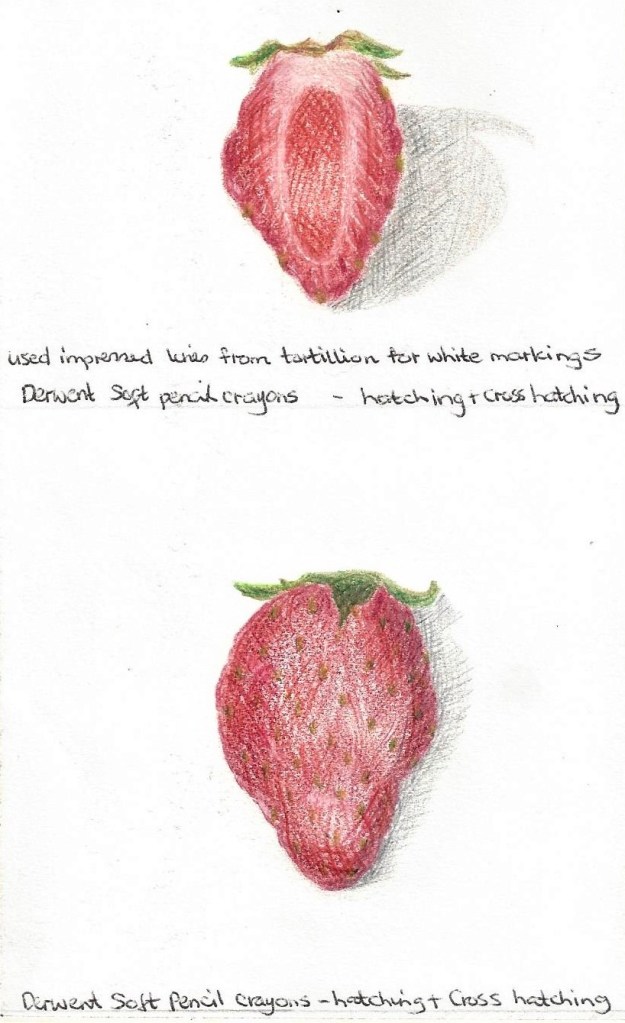
I remember when I drew this that I enjoyed the way the pencils could be blended to make other colours and how they could be applied to show shape and form. This drawing is quite good at depicting the shape and form of the fruit and the highlights give a sense of depth.
Fig.6 Bamboo Shoots, from an album of vegetables (s.d.) I researched historical artists who had drawn vegetables and came across this piece in the Bridgman Library. I like the simplicity of the marks that carefully depict the head of the shoots and the close up view makes them look almost like landscape, very grand and majestic, reaching for the heights.

Research point – I looked at some images in the Bridgman library where artists had used coloured pencil and added them to a slideshow (first time I’ve done a slideshow) see link below -https://www.bridgemaneducation.com/en/slideshow/private/1a80ae6a4ad381d8efb432d547d422e2a3958bd9 I also came across a young contemporary artist who works mostly in coloured pencil and draws her subjects in great detail https://cjhendry.live/

Final drawing Now I am starting the final piece, having chosen to use a cut pepper (prompted by project 3 shown earlier and the brightness of its colour) a courgette because it is a completely different shape to the pepper and a cut through stem of broccoli because I really want to showcase the patterns,shapes,negative spaces and colours. I feel the contrast of red and green together will be interesting and add energy to the drawing.

Now that I have chosen which vegetables to draw I want to look at the composition and see what suits the subject framing. I feel the bottom 2 arrangements are overcrowded and too busy, I want to create an atmosphere of calm and slowing down, having time to observe.
I sketched out the basic shape after deciding on the arrangement in the top sketch. Landscape orientation suits the layout of the subject giving space to each vegetable whilst also showing the pattern of the wooden surface as the ground. I benefited from organising my work space to have easy access to materials and to pin to the wall some sketches, post-it notes, helpful methods that I came across which I could see everyday.

Whilst working my way through this drawing it reminded me of doing a jigsaw, taking time, finding the right pieces and putting them together to from a whole. It was extremely therapeutic in a worrying time to have something lovely to focus on.

Final piece – I grouped the vegetables together like this to show how different each shape is and yet they have a relationship to each other, i chose to view them from above, close-up and place them off centre so our eyes are drawn around the composition. At first i wasn’t sure about leaving a space empty to the left and toyed with the idea of adding another vegetable but I wanted to show the patterns of the wood which was also a living thing. I also remember from the course that still life works better with an odd number in the arrangement.
I am pleased with the result here and especially have enjoyed focusing on the negative spaces.
Finished work – A3 Graphite pencil, coloured pencil and fine liner on heavy drawing paper.

Reflection – After completion and as I was about to email my tutor, I read the guidance in the course book which recommended a final self-assessment check against the criteria. So I went back over this whole project and made several adjustments. I am glad I remembered to read it!

List of illustrations

Fig.1 Kuniyoshi,Y. (1924) Squash. [pencil,ink and watercolour on white paper] At: IMAGE numberIMA207270 TitleSquash, 1924 (pencil, pen, ink & w/c on white paper)CreatorKuniyoshi, Yasuo (1889/94-1953)NationalityAmericanLocationIndianapolis Museum of Art at Newfields, USAMediumpencil, pen, ink and watercolour on white paperDimensions38.7×56.5 cmsCreditSquash, 1924 (pencil, pen, ink & w/c on white paper), Kuniyoshi, Yasuo (1889/94-1953) / Indianapolis Museum of Art at Newfields, USA / The Robert and Traude Hensel Collection / Bridgeman Images (Accessed 04.2020)

Fig.2 Blair, B. (2016) Peach Tree. [Giclee print] http://www.beckyblairartist.co.uk/collaborations/limited-edition-giclee-prints/ At: (Accessed 17.04.2020 )

Fig.3 Thewsey,J. (2012)Vegetables in a Basket.[pencil and watercolour on handmade paper] At: THE1449321:  (pencil and water colour on handmade paper), Thewsey, Joan / Private Collection / Bridgeman Images: Vegetables in a Basket, 2012, (pencil and water colour on handmade paper), Thewsey, Joan / Private Collection / Bridgeman Images (Accessed 04.2020)

Fig.4 Beresford, J. (2020) My workspace. [Photograph, painting] In possession of : the author: Northampton.

Fig.5 Starkey, J. (s.d.) Out of the darkness. [ mixed media on silk ] At: https://jostarkey.co.uk/index.html (accessed 17.04.2020)

Fig.6 Pien,S. (s.d.) Bamboo shoots, from an album of vegetables [ink on paper]At: MNS881091: Bamboo Shoots, from an album of vegetables (ink on paper), Pien, Shou-min (1684-1752) / Minneapolis Institute of Arts, MN, USA / Bridgeman Images (Accessed 04.2020)

Bibliography

Bridgeman https://www.bridgemaneducation.com/en/slideshow/private/1a80ae6a4ad381d8efb432d547d422e2a3958bd9

Hendry, C.J. https://cjhendry.live/

Kaupelis, R (1980) Experimental Drawing: (30th Anniversary edition). U.S.A : Watson-Guptill.

Sowden, C. (2020) Skeletal leaf. At: http://www.carolsowden.com/ accessed 24.04.2020

Assignment 4

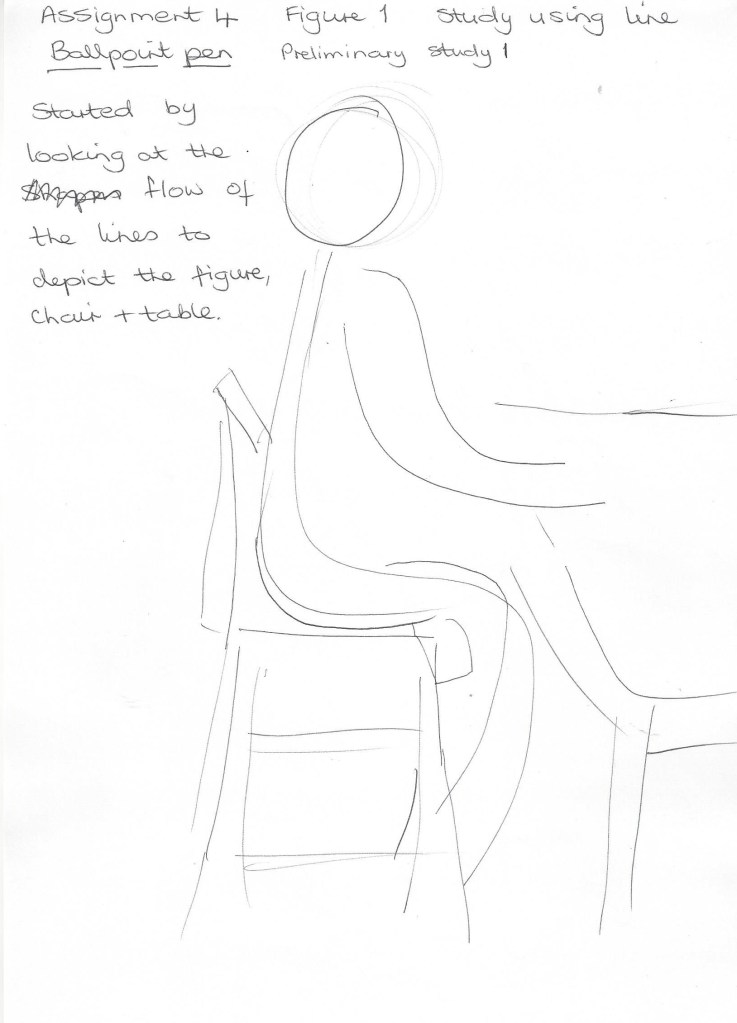
  1. Figure study using line

Seated model in an upright chair.

I sketched the model in a real life situation. She had just finished some studying and was looking thoughtful and pensive. I plan to use a portrait orientation as I feel it suits the shape of the whole composition. I would like to include some colour and/or collage as I have been inspired by the use of collage in some of the work of Picasso and Braque when researching for Part 2 Intimacy.

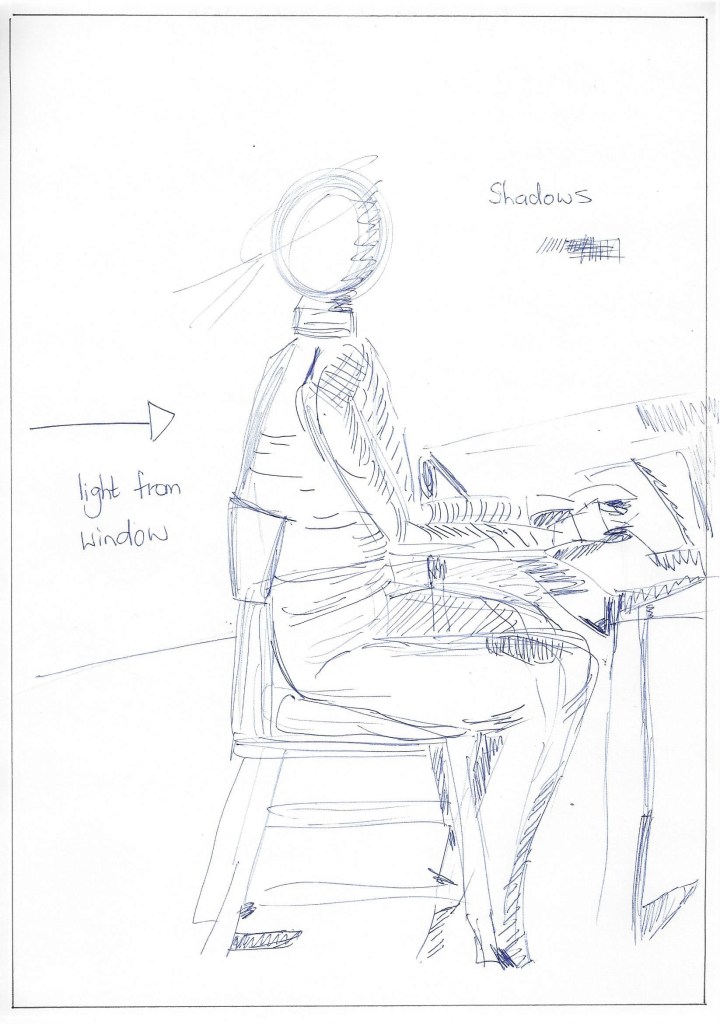
A quick sketch to note position of figure in relation to the chair and table. Light is coming from a window from the left onto the back of the model.
Fig,17 Saskia sitting by a window (c.1638) I found this drawing by Rembrandt and was struck by the simplicity of the lines for the figure and yet they would be informative for the artist if used for a painting.
A quick sketch to highlight shadows ,on A4 paper using biro.
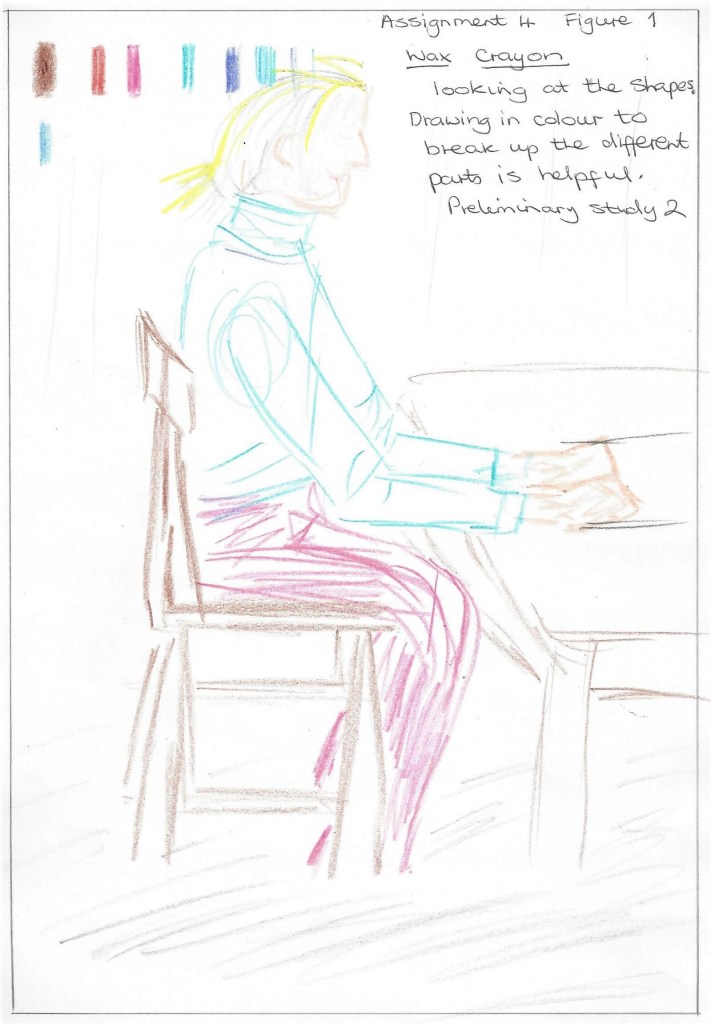
I sketched this on A4 drawing paper using wax crayon. I wanted to see how these colours went together. The wax crayon flowed well across the paper and shows some of the paper texture which depicts the matt surface of the wood and table.
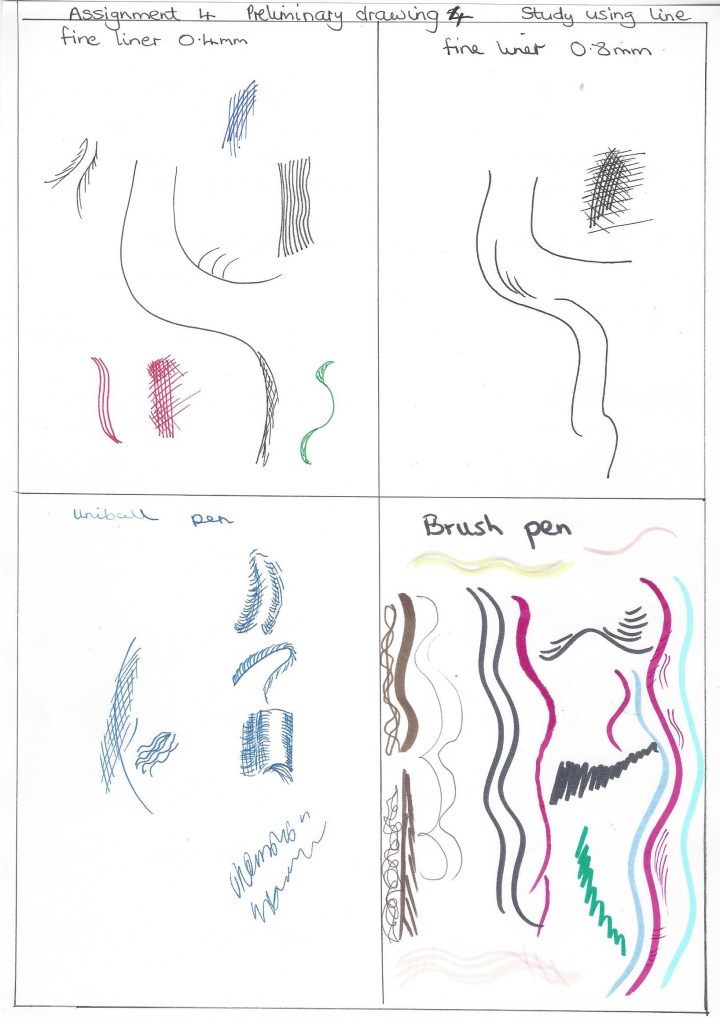
Fig.18 Sushi bar (2017) I like the work of Charlotte Orr who uses brush pens in a lot of her work. The bold bright colours capture our attention, the figures are simple yet their actions are believable. I have wanted to try brush pens as it is not my usual medium and I would like to be expressive in this assignment.
A longer sketch on A4 using pencil. Here I have added more detail and noted how the clothing describes the shape of the figure.
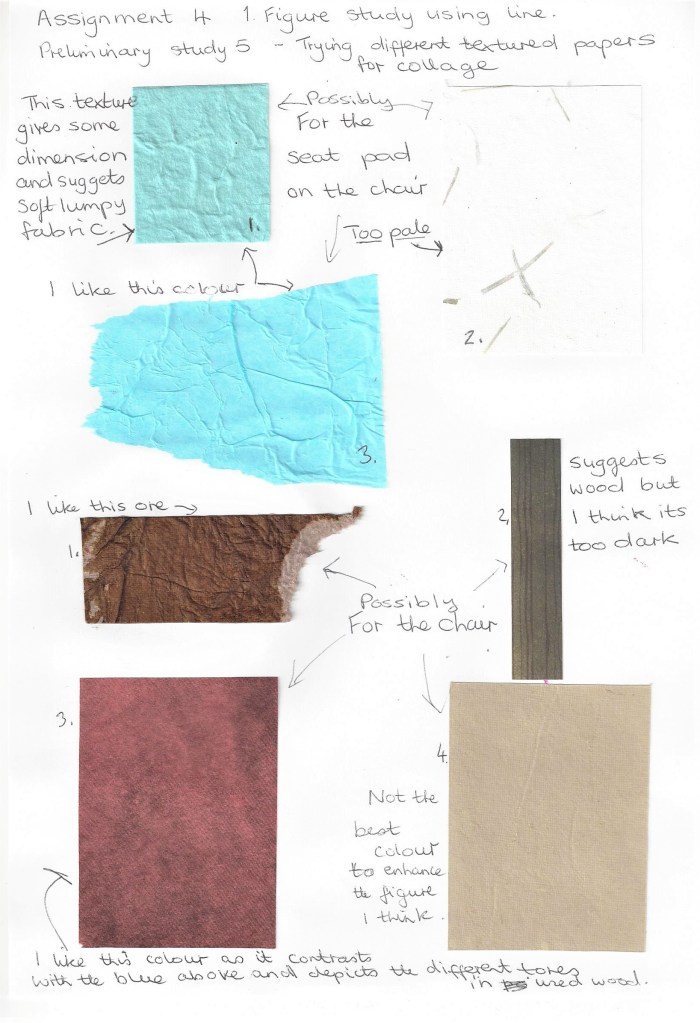
A1 drawing paper. For this final piece I have used brush pens over light pencil sketch and collage using found papers. I don’t often use brush pens and although this drawing probably isn’t technically skilful I wanted to be experimental and free with the pens on a large scale drawing. I was apprehensive about using the brush pens as they cannot be erased once they are applied and so I lacked confidence at first. I like the addition of collage which I wanted to try alongside the pens to show texture and boldness. I have used thick and thin lines, straight and curved.
Final for figure study using line. A1 drawing paper, HB pencil, acrylic ink, brush pen and collage. The background marks are made with a Chinese brush using acrylic ink to depict the wallpaper pattern, I also added some marks to the jumper to define the creases around the shoulder and arms. This drawing has developed as I went along and I made decisions based on each outcome although always referring to the preliminary drawings. It is not my favourite drawing and several times I wondered if I should start again. As I had spent a lot of time on it I decided to keep it and look at what I had experimented with and learned .

2. Figure study using tone

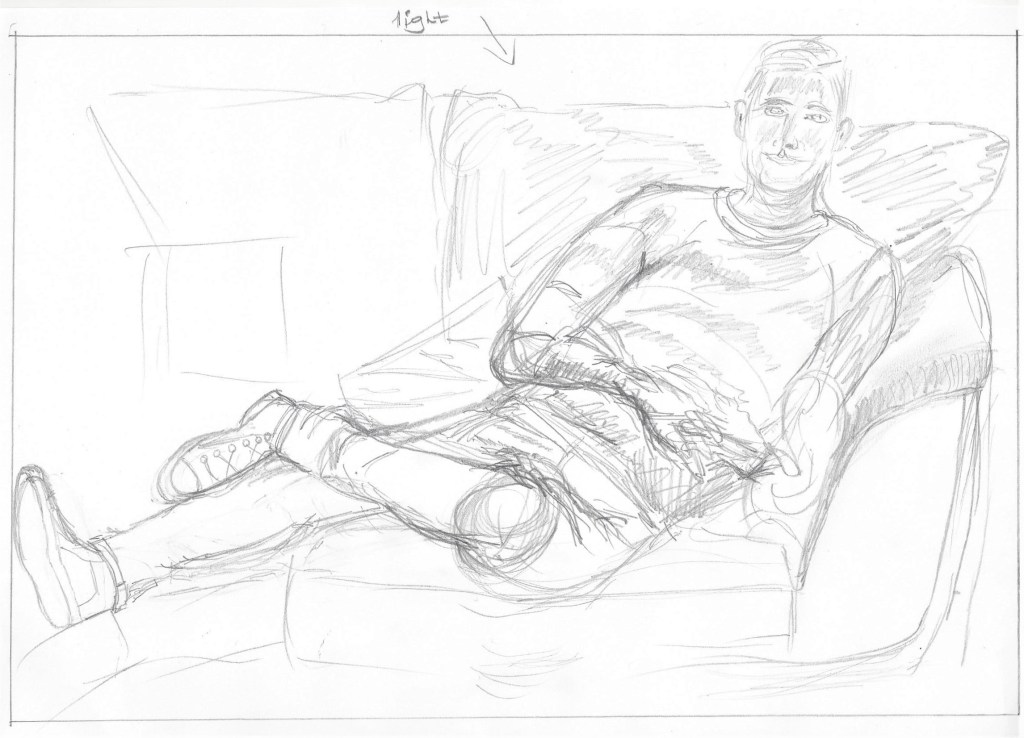
5 minute sketch to look at the shapes of the figure and surroundings.
20 minute sketch to see if this pose works which I feel it does, also to focus on the proportion. Light was coming from a window behind the model.
Hb pencil to mark out subject, Soft pastels, charcoal pencil on A4 brown sugar paper. The paper here is a bit too smooth and doesn’t hold the charcoal well. I like the colour of the paper as it brings warmth to the drawing as opposed to the stark black and white.
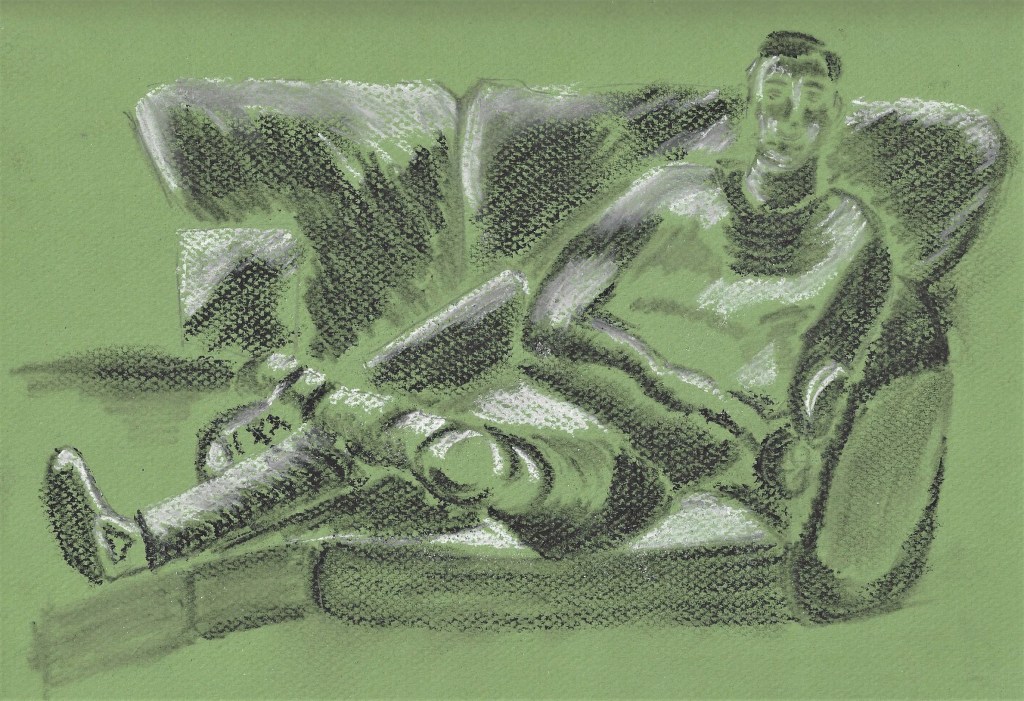
Hb pencil to mark out subject, black and white soft pastel on A4 green pastel paper. I wanted to try this drawing without using any lines , I started with the black pastel then added lightest areas with white. Then I used a blending stump to smooth out the pastel. I like this pastel paper as it is quite textured and holds the pastel but also leaves some of the surface of the support showing through. I think I may have added too much pastel to the back of the sofa and it seems to overpower the figure.
Using the planning sketches I drew on A1 green sugar paper, sketching out first with black willow charcoal. I then built up some layers with black, white and grey conte stick. Drawing on A1 without an easel in a cramped space was a challenge and I spent a long time on this sketch.
Final drawing for figure study using tone. I wanted to add some background colour that harmonised with the striking background paper. I then coloured the rolled cushion to bring it together with the background. I darkened the negative spaces to make them more obvious. I added some more shading to the facial features but I think it looks a little cartoon like. The folds on the tee-shirt depict a leaning torso underneath. I am pleased with the way the settee cushions appear to mould/bend with the weight of the figure. I had difficulty in drawing the hands in this position and in proportion and tried several times to re-draw them. The paper then began to wear thin and I didn’t want to risk tearing a hole. This tells me several things – Choose the right quality of support, more practice drawing difficult features and re-draw sparingly.

3. A self portrait combining line and tone.

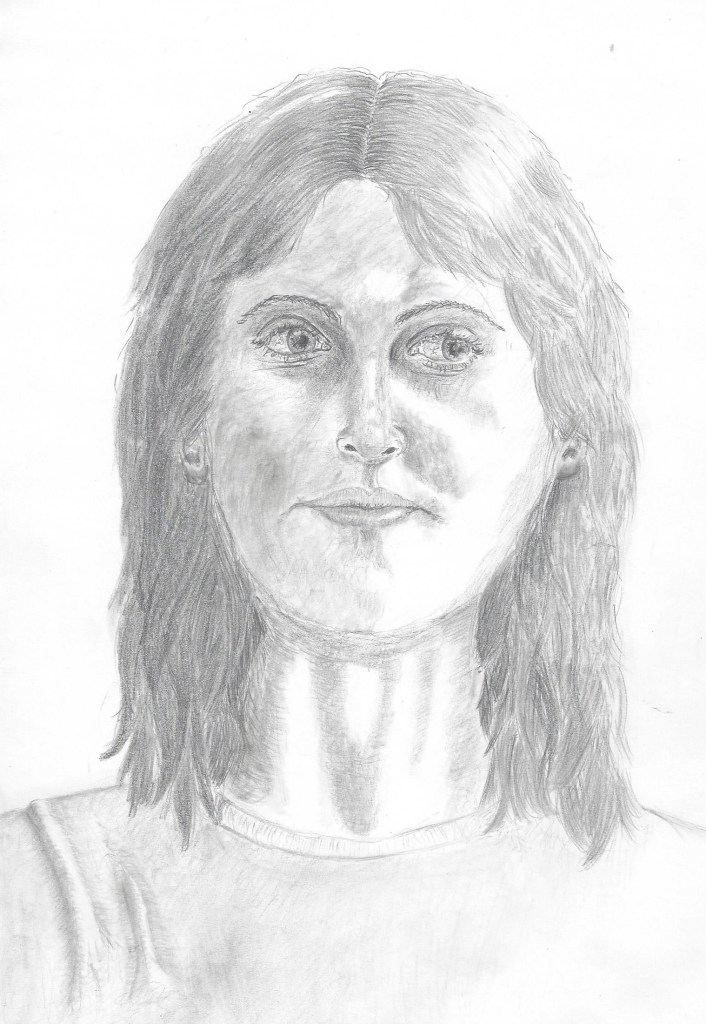
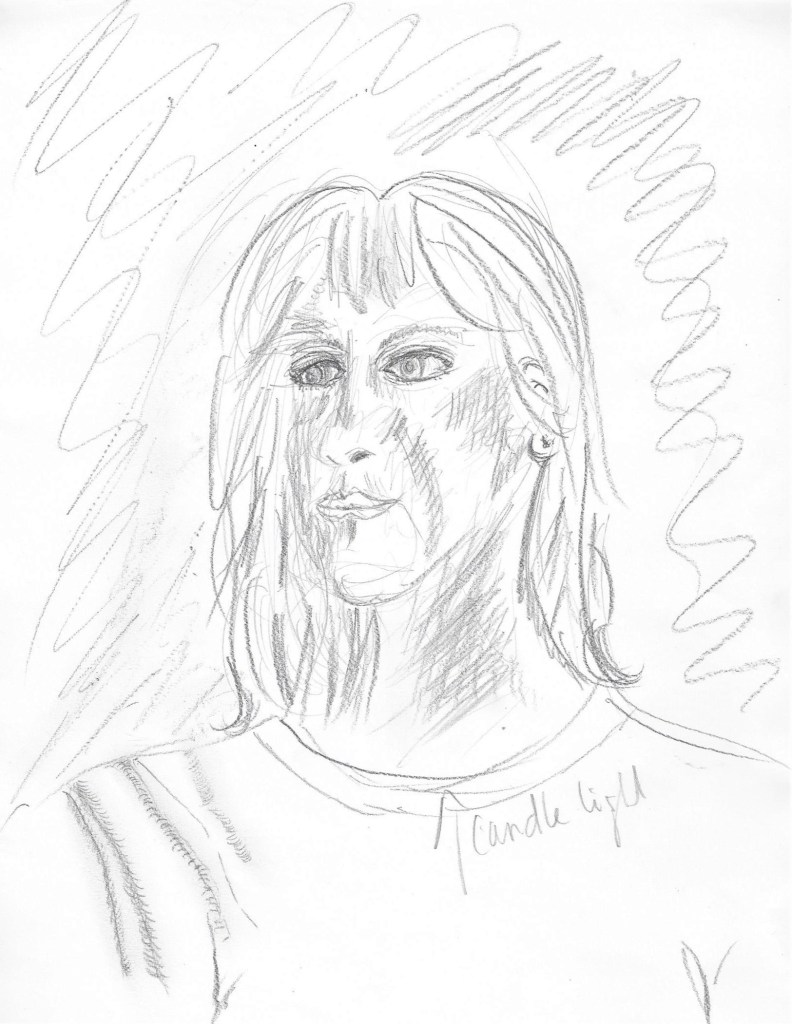
I used graphite and Hb pencil on A4 catridge paper to sketch out the form and identify the tones. I used candlelight in front of a mirror. hatching is used to show shadows on the face and neck. I’ve tried to show folds in the fabric on the shoulder but this needs working on. The head looks too small for the body here and this maybe because they were added later after the initial sketch.
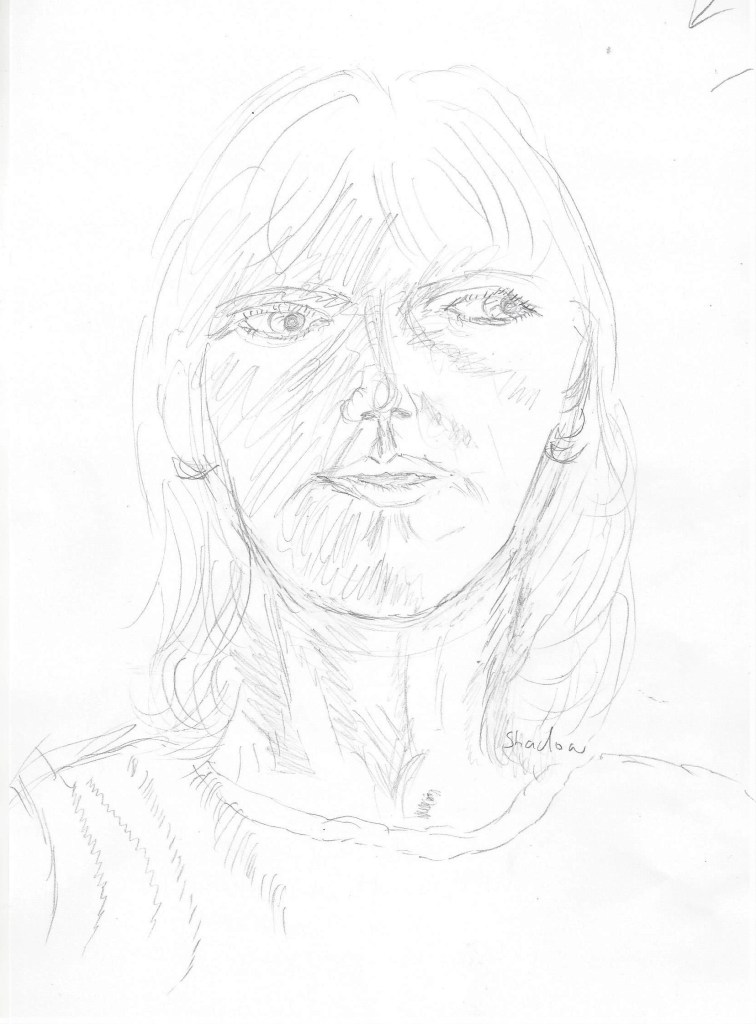
A longer sketch with more detail. Hb mechanical pencil on A4 paper.
I wanted to try light on dark so I have used white conte stick on dark blue pastel paper. First I completely covered the paper with the conte stick on its side. I then rubbed it in using a circular motion. The darker tones were then drawn in with a pencil top eraser which has a small edge and works like a calligraphy pen nib in that the line can be varied depending on the angle it is held to the paper. For the mid- tones I then smoothed between some of the light and dark tones. When I used spray fixative on this picture it darkened a lot of the white areas too much ans the sketch seemed to have faded. When it dried I worked in some more white with conte stick. I like the mysterious atmosphere depicted by this drawing.

Planning the final drawing –

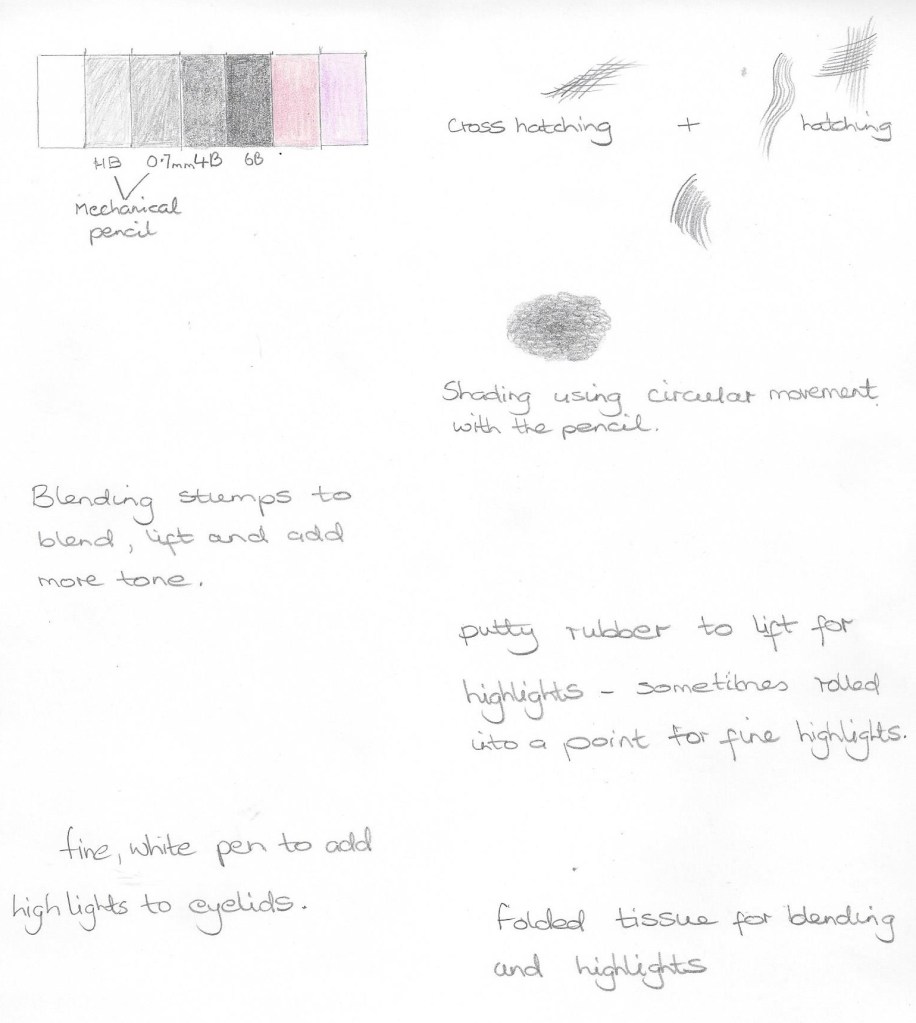
These are the techniques that I used to draw the final portrait. Looking back at some of the techniques I have tried in other parts of the course enabled me to be more informed when planning this portrait.
I drew this portrait on A4 cartridge paper. Light was coming from a candle placed on a shelf to my right. I decided to use sketching pencils as so far I have found this the most successful medium for me when drawing facial features that require detail. I began by lightly sketching with a HB mechanical pencil the overall shape and position of the features. I then used 4B and 6B to build up layers of tone and then go back in with the HB to darken the lines. Drawing the eyes took me the longest but this was the most enjoyable part. It seemed that even the slightest mark, highlight or tone had the most impact on what the eyes depicted.
I spent quite a lot of time on the hair to try and convey the thickness of the layers and the shadows made in between the strands. The most challenging part was the mouth and getting to look in proportion to the other features. When drawing the folds in the fabric on the shoulder I thought back to the first exercise in part 4 and recalled the methods I tried then to use tone to depict a fold.

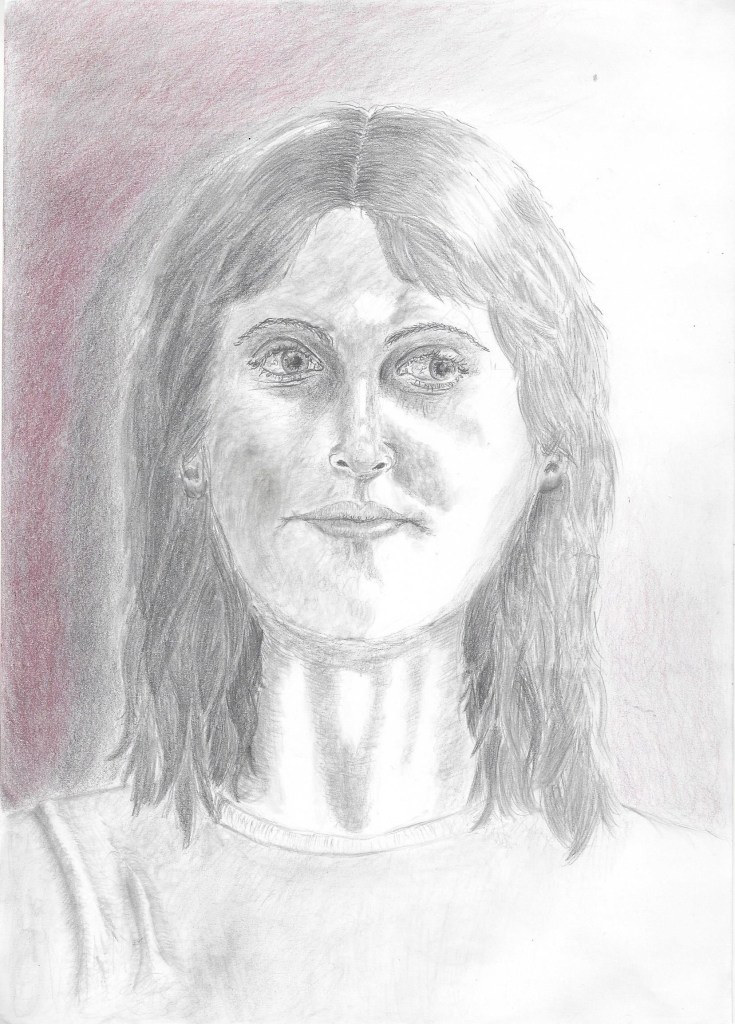
The final portrait for assignment 4

Finally I decided to add some background shading and a touch of colour to give the drawing a more interesting atmosphere. I added 2 shades of coloured pencil and placed them on top of 6B graphite to give a muted colour effect. I like the texture of the grain of the paper that shows in the background.

Reflection

Demonstration of technical and visual skills

I have learned so much throughout part 4 and this assignment. I continually feel pushed to explore new skills and techniques. Drawing on A1 has been a great challenge physically and I want to find more opportunity to do this perhaps by working outside in the warmer weather. Looking at the figure has caused me to be much more observant of bone structure and facial features. I especially like the technique for drawing a face using tone which I have tried in my final portrait. Observing figures – still and moving is an emerging skill which I want to develop. I have tried to keep in mind design and composition in some of the exercises and to use a viewfinder or grid was helpful in drawing the larger sketches.

Quality of outcome

I can see that the quality of my work gradually improved as I went along. I began realised what a vast subject the figure and head really could become and felt I could spend years studying this part alone.It was helpful to keep a visual diary with drawings of different body features to inform the 3 assignment pieces and present the work in a coherent way. The quality of the outcome for the figure drawings has need for improvement , this has been my first experience of life drawing and I see the benefit of the opportunity to draw living beings in real time. Discernment is improving with each project and conceptualisation of thoughts is something I am seeking to develop as I learn from other artists. In this part of the course I didn’t focus a lot on communicating ideas as I was very taken up with learning the technical skills I needed to produce a believable likeness of figure or face.

Demonstration of creativity

For this part of the course I worked through the exercises in a different way to all the other parts due to waiting for availability of models and then the cancellation of Life classes due to social distancing. I used imagination and invention such as collecting old magazines and drawing over the photos of people or copying them e.g in the collage for project 5 – exercise 2 and also in using collage for assignment 4 ,1 figure study using line. I enjoyed experimenting with teabags to depict a crowd in an audience (also project 5 , ex.2). When thinking about developing a personal voice I look forward to it emerging and becoming recognisable in the future.
Context reflection

I have been informed by the techniques of other artists throughout this part of the course particularly as I reached out for help and information due to my lack of experience and knowledge in figure drawing. I regret only being able to attend 1 Life drawing class but was able to watch a virtual class (although I think nothing can replace attending in person) My learning log has become invaluable in helping me keep track of my thoughts and organise my work whilst completing the exercises in a different order. Critical thinking is something I need to develop more. I looked at some artists views whilst researching for project 1 and this provoked many thoughts on my feelings about figure drawing. I didn’t write as much about my research as in previous parts of the course because my time was taken up in finding models/opportunities in different poses, and I consider photographs/videos of lesser value. Many things to think about and consider from these projects that have sparked my imagination.
 

Assignment 3

Draw an outside scene of your choice.

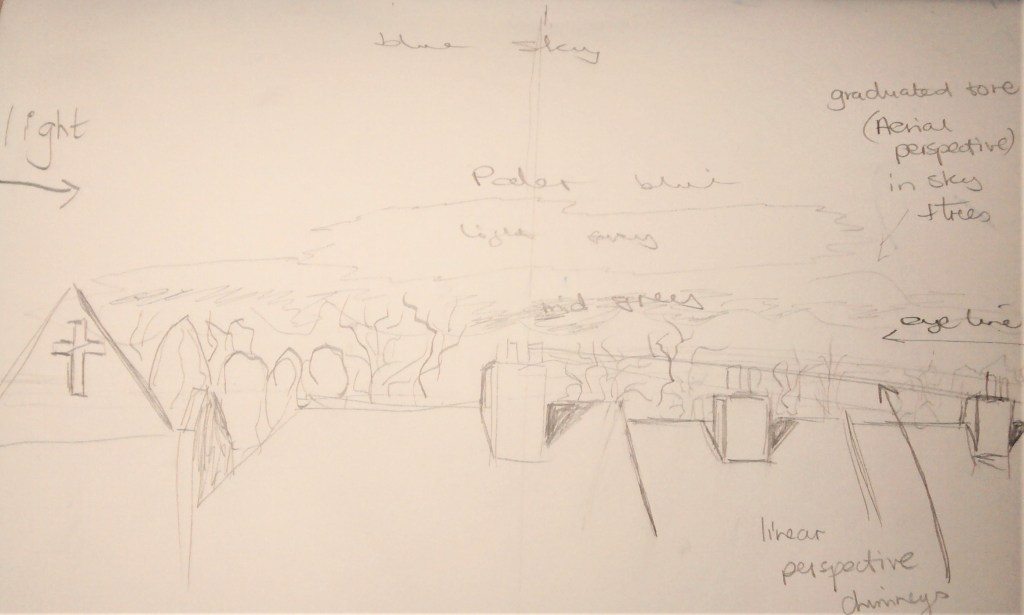
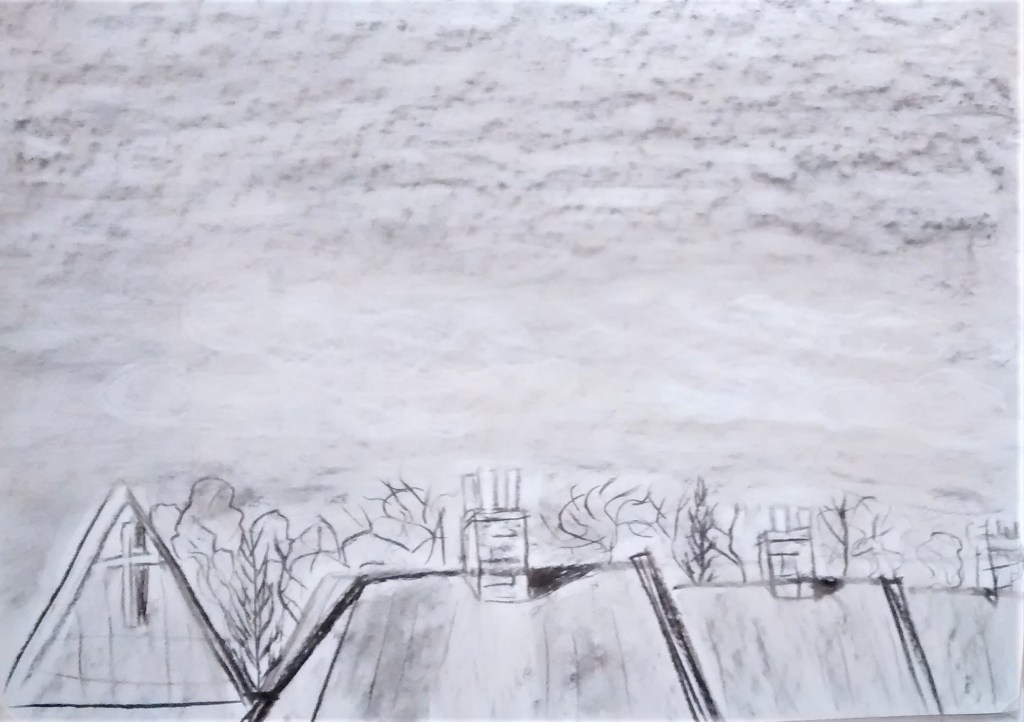
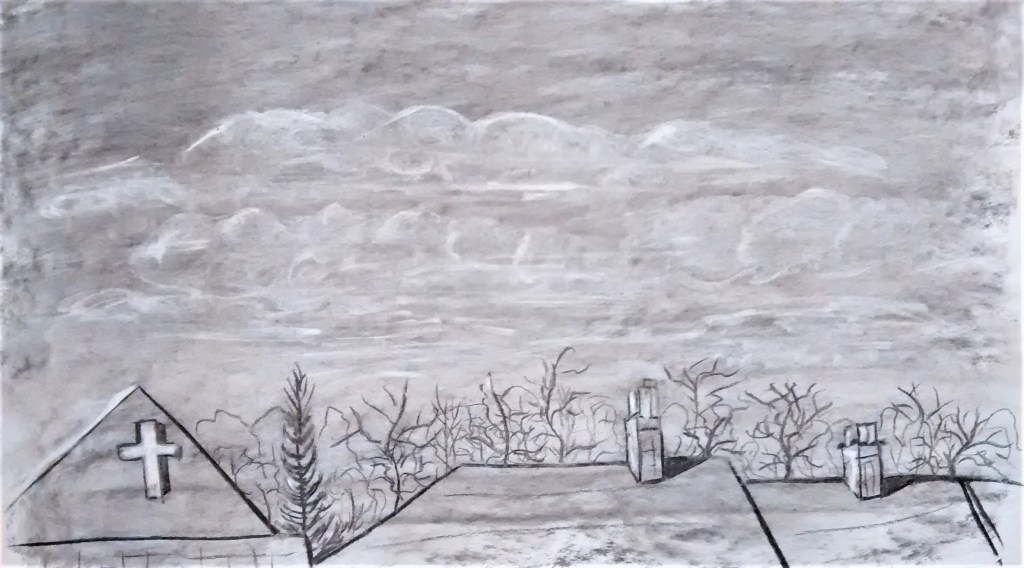
Preliminary drawings

Experimenting with the composition – view A
Experimenting with the composition – view B
Practising graduated tone ( aerial perspective )
Broad sketch in light charcoal
Broad sketch in dark charcoal
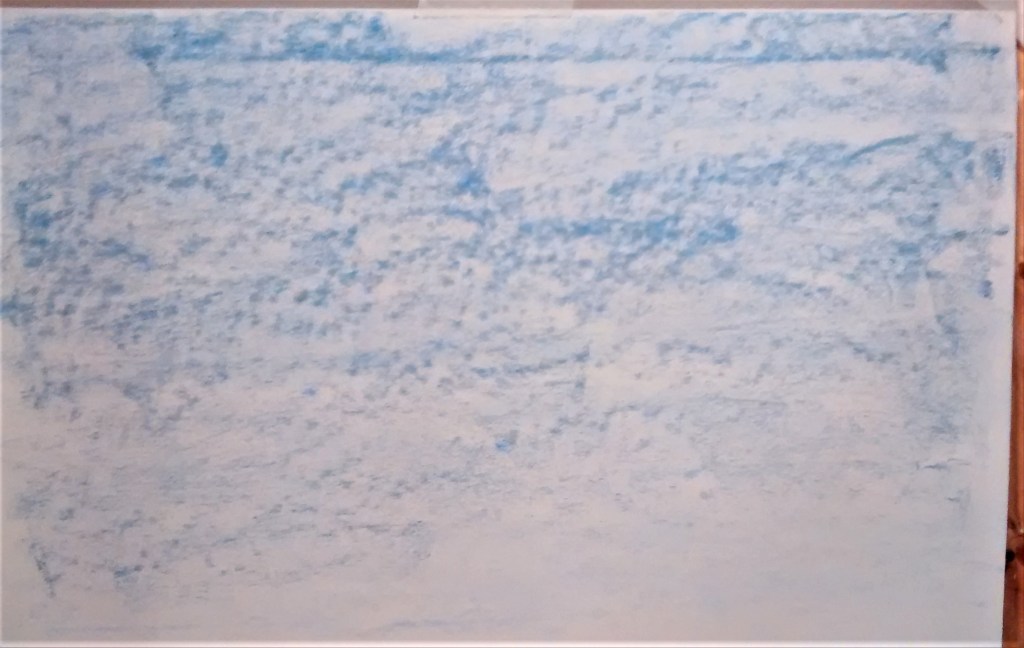
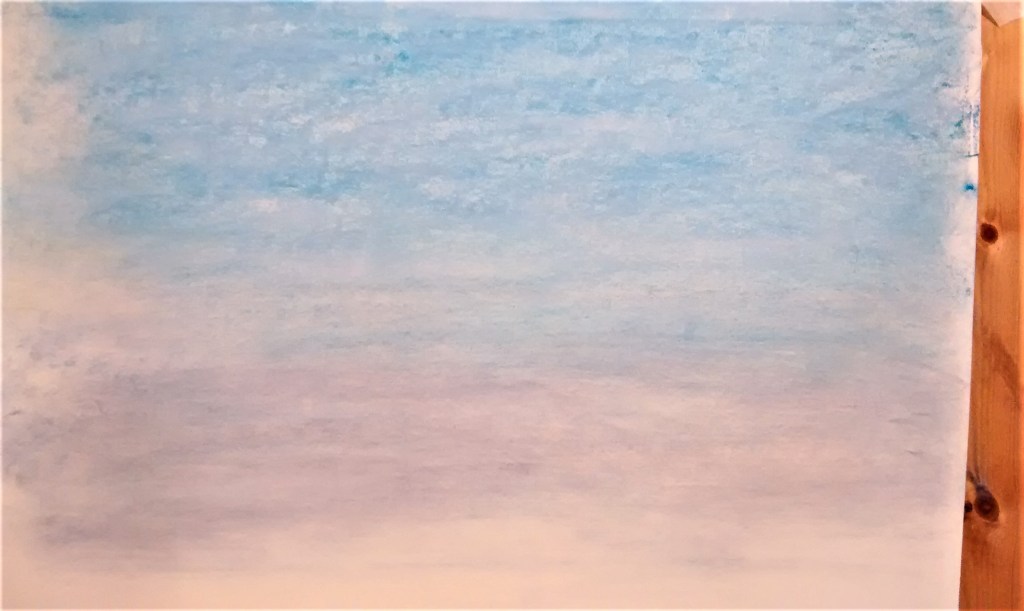
With my A2 heavy cartridge paper taped to a board and surrounded by my preliminary drawings I sketched lightly in pencil where the main shapes and eyeline would be . I began with a layer of two shades of blue soft pastel and blended it in with a cloth.
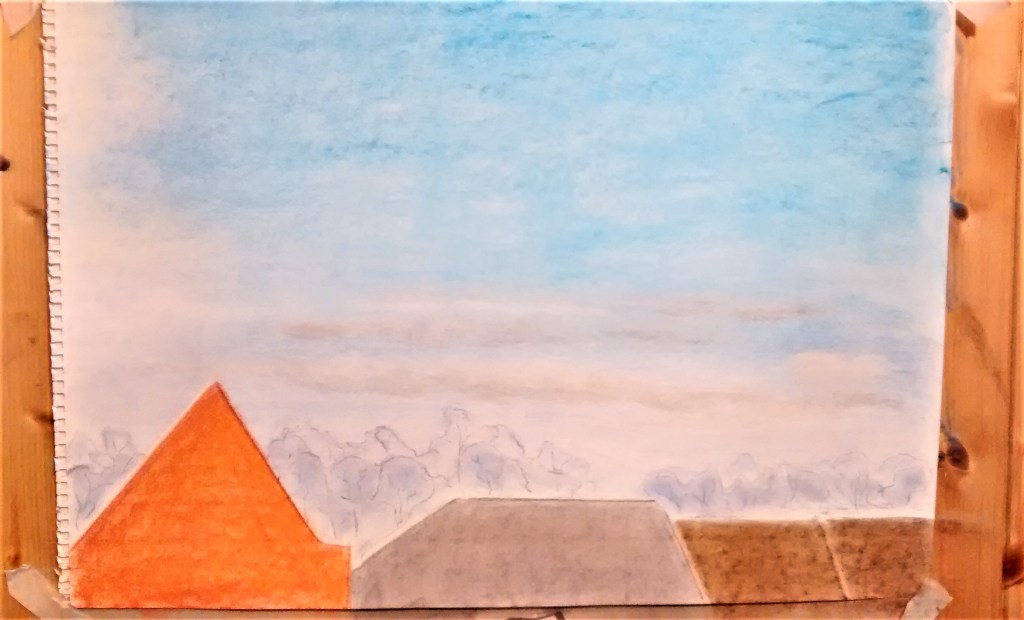
I then added layers of violet soft pastel and another shade of blue blended in with a cloth.
I added several layers of grey and white soft and hard pastels for the clouds , violet for the distance and middle trees. The rooftops to the left and right are orange, red and dark brown soft pastels, white pastel pencil, terracotta drawing pencil. black watersoluble pencil and violet and grey soft pastel for the middle rooftop. A putty rubber was used to lift some areas of the clouds.
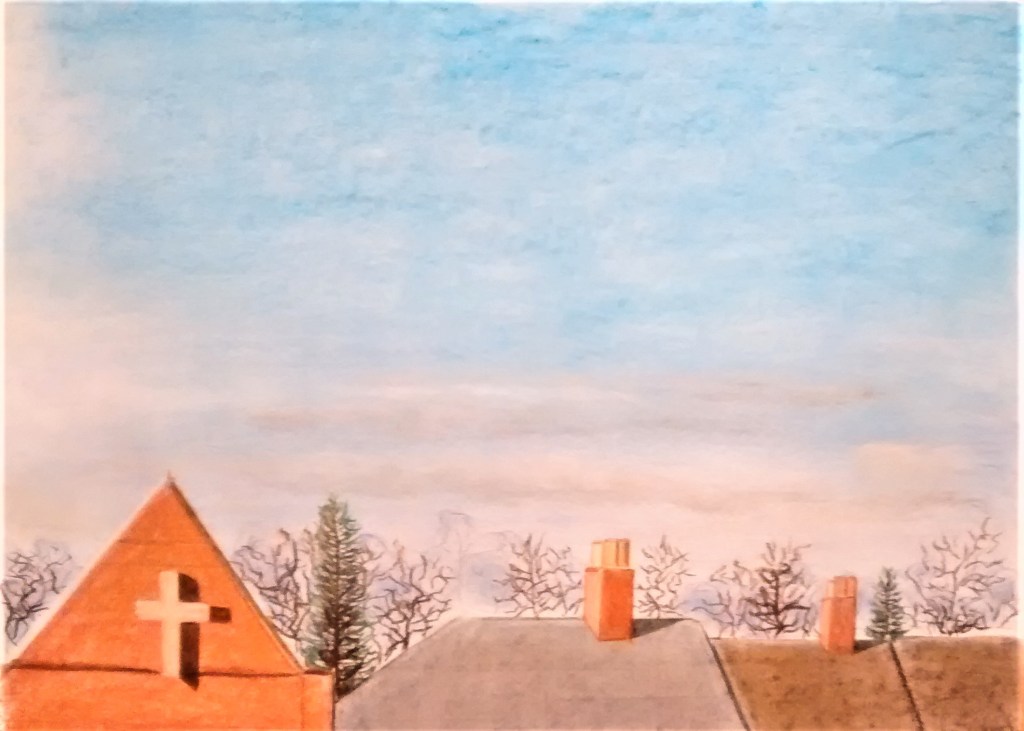
For the final layers I added the the straight lined objects . For the closer trees I used dark, mid brown, yellow and green soft pastels. The chimneys and cross are done with orange, red , cream and brown soft pastels and terracotta drawing pencil. I added the shadows last using black watersoluble pencil.

Assignment 3

Reflection

Demonstration of technical and visual skills

Throughout this assignment I have constantly felt challenged and pushed to explore new skills in drawing. It has been the most difficult work so far and I have learned so much. Working with linear and angular perspective is something I need to work on, my rooftop drawings conveyed in some way the urban beauty I was attempting to show but the accuracy has weaknesses I feel.

I have been experimenting with using mixed media in my work and trying different supports but I need to do this more. My observational skills and visual awareness are improving although I am aware of sometimes drawing what I think I see rather than what is actually there. I have noticed that my design and compositional skills are increasing slowly as I work through the exercises and look at other artists work. I also am realising that the exercises are a guide and that I can use them to do further sketches beyond what is being asked.

 The exercises with aerial perspective felt more enjoyable and I was able to demonstrate this more easily in the final drawing.

Quality of outcome

I can see that the quality of my work is improving and especially as I focused on using preliminary drawings to inform the final piece and present the work in a coherent way. This is especially evident in the assignment final drawing of rooftops. I also found the sketchbook walks exercise improved the quality of the outcome for the composition I did with acrylic inks. Discernment is developing with each project and conceptualisation of thoughts is something I want to develop as I become more confident and not worry about my drawings being carefully composed. I am seeking to communicate my ideas in a small way and this course is aiding that process.

Demonstration of creativity

I sought to demonstrate creativity particularly in project 3, ex 1, with experimenting in mark making to inform future drawings some of which I used for landscape drawings but not so much for townscapes. I tried to use imagination by recreating other artists work in my own style which I enjoyed and found helpful. The work for project 3 was my most creative and I experimented more with different media.

Context reflection

I have gained knowledge of other artists techniques through the research in these projects and made notes when finding a new technique that I want try in the future (this was recommended by my tutor in previous assignment feedback).

I am developing critical thinking and meeting up with local art groups, attending an OCA study event has been invaluable.

Assignment 1

Tutor – Please see coursework 1, Exhibitions and books, and Notes, for related content supporting this assignment.

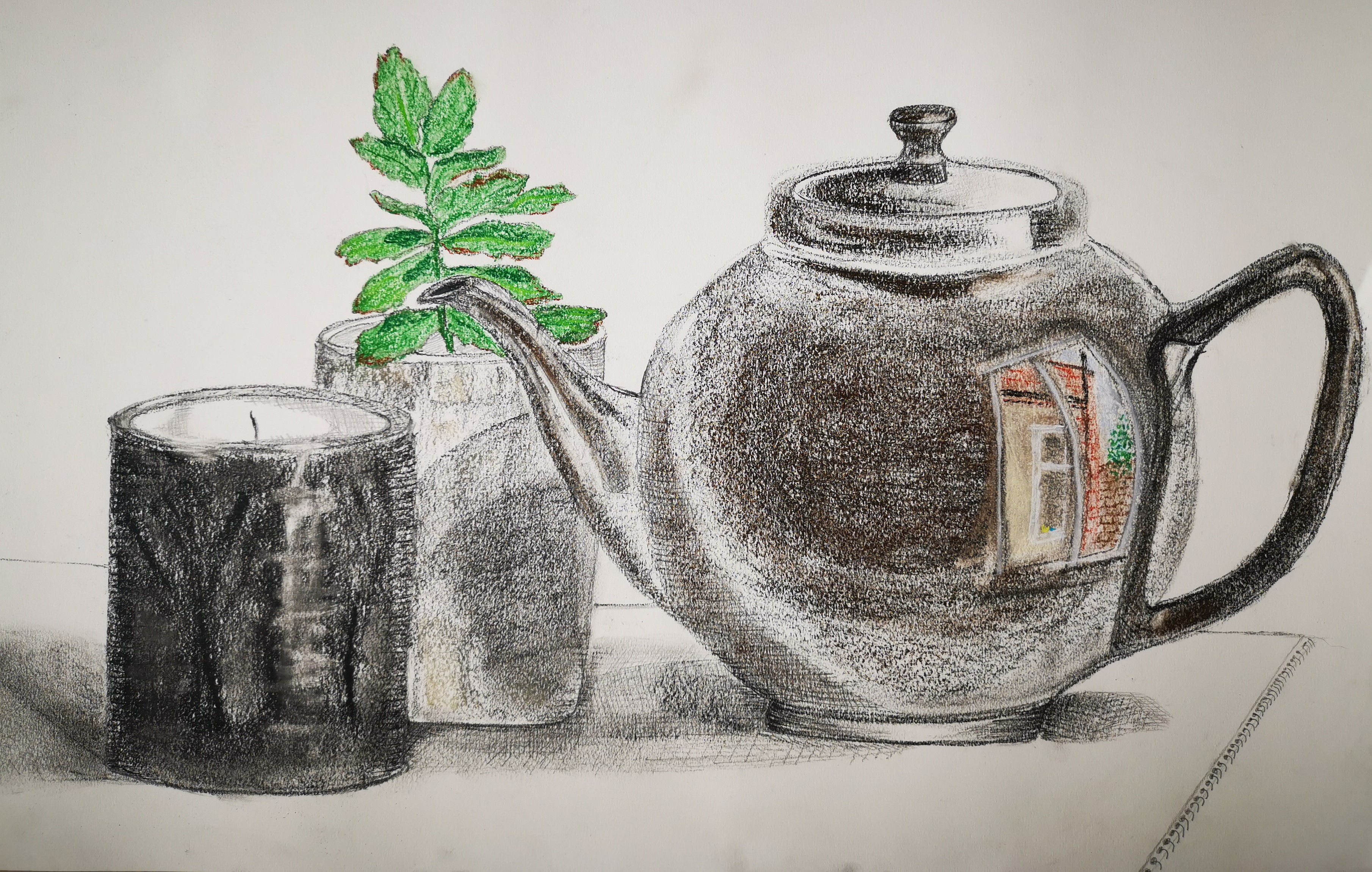
Before beginning this assignment I arranged a free weekend without interruptions and gathered all my previous coursework and sketchbooks together for reference. I chose a few objects that triggered a feeling of well-being and sense of thoughtfulness by friends and family. The objects seem ordinary to the viewer but have a particular value to the owner (me) as they were all gifts given by loved ones. I set them up by a window to access the natural light, it was a sunny day and this created interesting reflections particularly in the teapot. I chose willow charcoal which I’ve never used until starting this course and I am delighting in the boldness of the marks. Some touches of chalk pastel and graphite pencil were added towards then finish. I like the combination of broad, sweeping strokes and soft edges.

I feel that the teapot reflection went well in the end as I persisted in focusing on what was reflected in the smooth , glossy, curved surface. I was reluctant at first to even attempt to depict this reflection as I felt it was too challenging, then my adult daughter came in the room and said ” I think you should do it Mum”. I actually felt fascinated by this reflection and curious to look further into it. When I first placed the objects by the window I hadn’t even noticed the delightful other reflection of another window.

Because of the exploration involved in looking at shadows and reflection, I needed to focus and give attention to detail- particularly the way the objects are in relation to each other. The objects were resting on a pad of paper which I use in the watercolour class I attend each week ( a very happy place! ) so I wanted to suggest the edges of the pad without too much detail as a surface to bring the objects together.

I don’t think the candle went too well as is possibly too dark. I wanted to utilise the frottage experiment onto the surface, so rubbed I dried leaves, but with the charcoal it perhaps wasn’t the right medium. the candle looks too flat to me and the ellipse could be done better.

The plant leaves are coloured brightly to bring a feeling of hope as it is growing well and surviving amongst the man made objects.

Reflections

. During this assignment I have used a range of materials and some for the first time. My techniques are developing and need to be practised more thoroughly. Observation is rising with each exercise. Visual awareness needs to be increased as sometimes I miss things. I need to be more confident in design and composition.

. The content needs to be more varied. My application of knowledge is somewhat limited particularly in organising my log/blog and coursework using WordPress. Discernment and conceptualisation of thoughts and ideas are emerging with each exercise but I have felt I’m only at the tip of the iceberg.

.I have begun to express creativity in a small way and experimenting with different papers and materials is helping to see what it means to develop a personal voice. I need to use my imagination much more and not feel bound by what I feel safe with.

. Research and critical thinking have been limited and I want to progress in these areas and reflect far more on their value in art. I often look at the art of others but neglect to reflect on what is being said.

Feedback for Assignment 1

Formative feedback Student name Jennifer Berresford Student number 522488
Course/Unit
Drawing 1 Assignment number 1
Type of tutorial written Overall Comments Altogether this is a very good start to the course. You show a good ability in using a range of media and in depicting form accurately. In your assignment piece you also show a playfulness and inventiveness in your approach to drawing a composition.

As you move forwards, continue to integrate the knowledge from different exercises into larger drawings in order to help you to develop them and to work creatively whilst also accurately.

Allow yourself to experiment freely with materials and compositions, using your skecthbook development and also your artist research to help to inform the different possibilities in ways of working with drawing.

Feedback on assignment

Assignment 1 asked you to choose an interesting and personal selection of objects to make an A1 or A2 drawing from. You were asked to consider the light source, tone, surface and reflection; using a range of monochrome materials and expressive mark
making to give form and feeling to your composition You were then asked to reflect on the process.

You’re assignment piece does well to bring together the techniques from the exercises earlier in this piece to reveal a good understanding of using drawing to accurately represent form and to use tone to give a sense of shadow and light.

The pops of colour in the leaves and the inventive use of a coloured reflection in the teapot feel bold and work well.

As you move forwards, continue to look for ways to be playful and inventive in your assignment work.

In addition, continue to use your assignmnet pieces as a way to combine the various techniques learnt during the course.

You mention that these objects are meaningful to you – As you move forwards, try to consider how different drawing styles can help to convey these meanings, whether through giving dark and heavy tones, light and sensitive or fluid and expressive.

While your composition does work well, it would be good to see you using your sketchbook to plan your composition and to experiment a little more with materials or marks before you move onto the final drawing. This kind of preliminary experimentation is a great way to broaden your ideas and to make sure that you are able to work confidently once you embark on your final piece.

Sketchbooks / exercises: In Project 1, exercises focus on gesture and expression, encouraging your to explore a range of drawing materials in an experimental way.

Warmup Exercise: Temporary Drawings

Exercise 1: Experimenting with expressive lines and marks

Your drawings show a lovely range of mark making skills here and its great to see you incorporating a range of materials in order to explore this. The way that you reflect on how the marks can communicate emotion is good. As you move forwards, try to bring this fluid,
varied and expressive style of drawing to your work in order to help to tell a story or to give feeling to your images.

Explore how expressive marks can be used in combination with sensitive and accurate drawing in order to create and interesting contrast in your drawings and to give focus and narrative to them.

Exercise 2: Experimenting with texture

Again, you show a good ability to explore texture through frottage, controlled drawing and expressive marks. As you move forwards continue to consider the texture of different surfaces and to think about which method would work best to communicate this. The avocado skin texture is certainlyt interesting.

When you pick up on these things that feel particularly successful, or when you learn a new technique it might be worth writing them down in a list. You can then refer to this kind of list when working on assignments in order to give inspiration into ways that you could work.

In Project 2, the focus is on build obersvational and technical skills, learning how to give form to objects form through drawing with tone, shadow, reflection and texture.

Exercise 1: Drawing Groups of Objects: This exercise asks you select a group of objects with varying 3D forms to make an A2 or A1 sized drawing using monochrome materials. It asks you to accurately give form to the objects by considering light, form, materials and the relationships between objects.

In this exercise you do well to challenge yourself. The range of drawings here give a sense that you are really figuring out how to accurately draw form here and through the process of making these sketches, thinking and looking closely, you have produced some accurate drawings that feel well balanced.

Do continue to take on exercises that feel challenging by breaking them down and making multiple attempts as you have done here.

As you begin to make more complex compositions in your assignment works and further in the course it can often be useful to begin the process by using this technique to lightly sketch things out. If you start from an accurate position you are likely to find the rest of the drawing quite fluid.

Exercise 2: Observing Shadow using blocks of Tone: This exercise asks you to draw a group of objects, creating a strong light source with a lamp and drawing in a range of monochrome tones to give form to them.

You show a good ability to use blocks of tone to create a sense of light and shadow here. If you are using a rough / powdery materials such as charcoal, you might find that increasing the scale of the drawing will help you to gain more crispness and contrast, giving the material more space to move.

Exercise 3: Creating shadow using lines and marks: This exercise asks you to choose four objects to experiment with using a range of mark making; stipples, lines, hatches, to give form to the objects.

You show a good ability to use different lines and marks in order to give a sense of form here and your objects are also draw accurately. Your hatching and line work using pen shows a nice level of detail and sensitivity. It could be interesting to explore combining this with the expressive style of marks found in the ‘emotion’ excercise.

Exercise 4: Shadows and reflected Light: Choosing two objects with reflective surfaces, work at A1 or A2 with charcoal, conte and a putty rubber to draw the forms, drawing deep shadows and lifting out highlights paying close attention to the form and tone of reflections and shadows.

These drawings show that you have an awareness of the way that highlights and shadows can help to give form to an object. In your drawing on pink it might have been usefull to use a white in order to bring out these highlights a little more. Explore beggining these charcoal drawings with a pencil framework, following the exercise on shape and form earlier in this part of the course. This may help to give you a more accurate and stable framework and allow for you to then experiment a little more with the technique in the exercise (e.g. light and reflection)

Research

Study Two Trees by Odilon Redon, considering composition, tone, mark making and atmosphere. Use this and other artworks to analyse and discuss the use and impact of tone.

Your notes on the artworks of Odilon Redon show an understanding of the way that controlled use of tone can be used to add to a specific atmosphere or to tell a story. Also consider the way tone can help to guide the way that a viewer looks at the work. For instance in Redon’s ‘Trees’ The Darkness between the two trunks leads the viewers eye into the artwork

Suggested reading/ looking:

Anselm Kiefer Alter Und: inventive approaches to composition and still life.

Georges-Pierre Seurat – Stone Breaker: Approaches to using hatching to create tone

Jenny Saville: In the Realm of Others: Using charcoal on a large scale in both controlled and expressive ways.

Strengths
Ability to represent form through drawing
Use of a range of expressive and sensitive marks
Inventive approach to compositions Reflection on your learning process

Areas for development Use of sketchbook to develop final ideas. Fine analysis of artworks in your research Exploring reflection and shadow
Drawing at larger scales

Reflection on feedback Looking at my tutors suggestions on areas for development I will try to apply these recommendations in future work.

I have a growing understanding of all of the areas and particularly Use of sketchbook to develop final ideas has helped me throughout Assignment 2 – to plan and also to use as knowledge/reference for a final piece. I want to do this in a greater way as I am now seeing the value of this skill much more.

Fine analysis of artworks in your research I will use my reading time to look at how others analyse artworks and read reviews of exhibitions.

Exploring reflection and shadow

I need to be more aware and observant when working and also when outside to take note of how reflection and shadow are present.

Drawing at larger scales

Definitely an area where I don’t feel confident, I just have to do this !

Tutor name Natasha Russell Date 17/07/19 Next assignment due