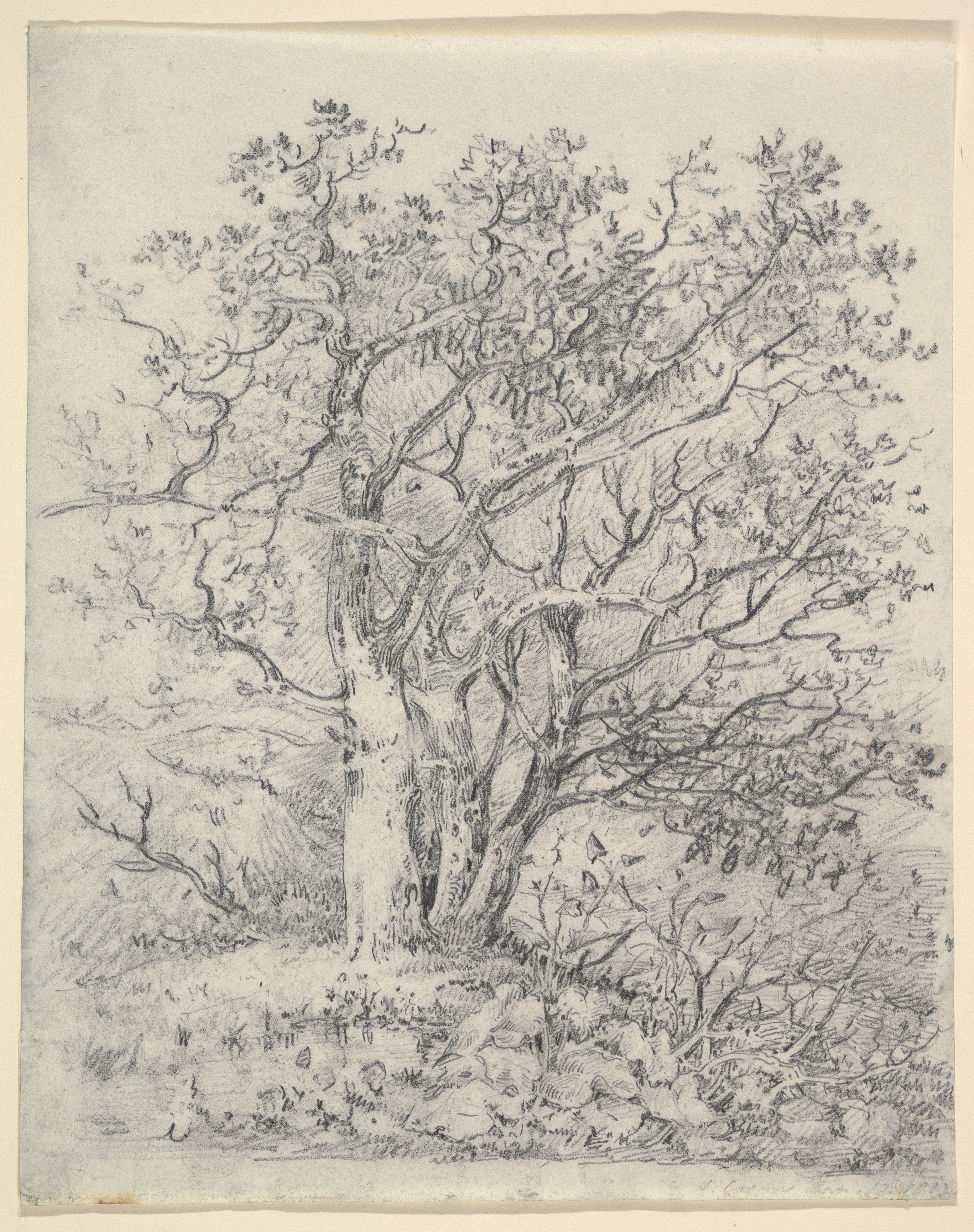
Project 1 Trees I am looking forward to this project as I feel trees will be such an interesting subject to look at and study. I Found this great drawing by the artist – J.Chrome which shows lots of mark making which I feel gives a sense of movement to the drawing.
Fig.1 Three trees (1812)
Exercise 1 – Sketching individual trees
We were asked to build up and sketch the overall shape and outline of the trees.This is a helpful way to start to observe the simple shape and will inform my future drawings of landscapes.


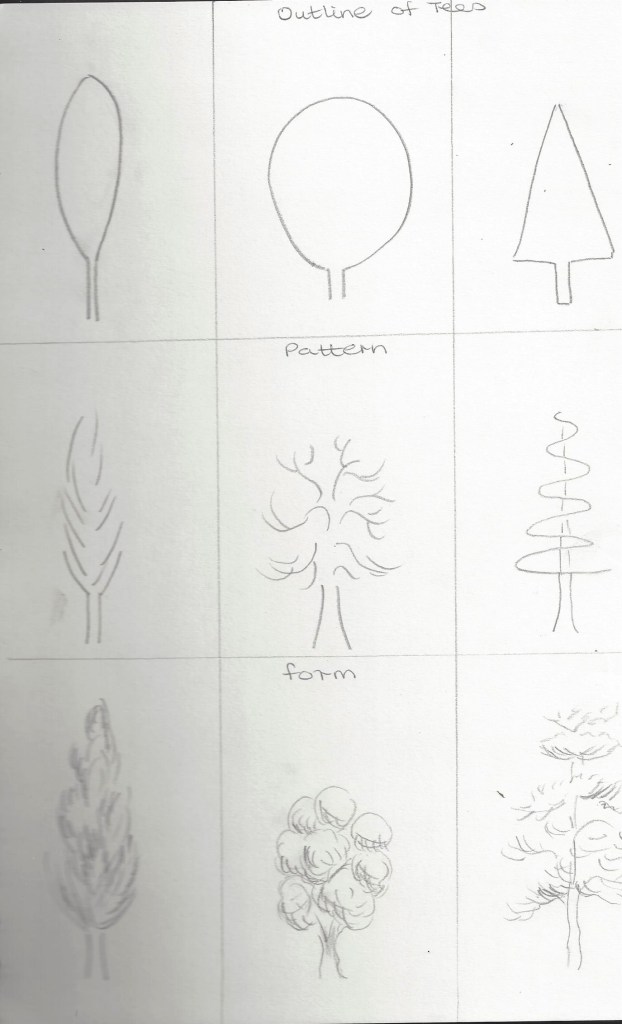
Charcoal pencil

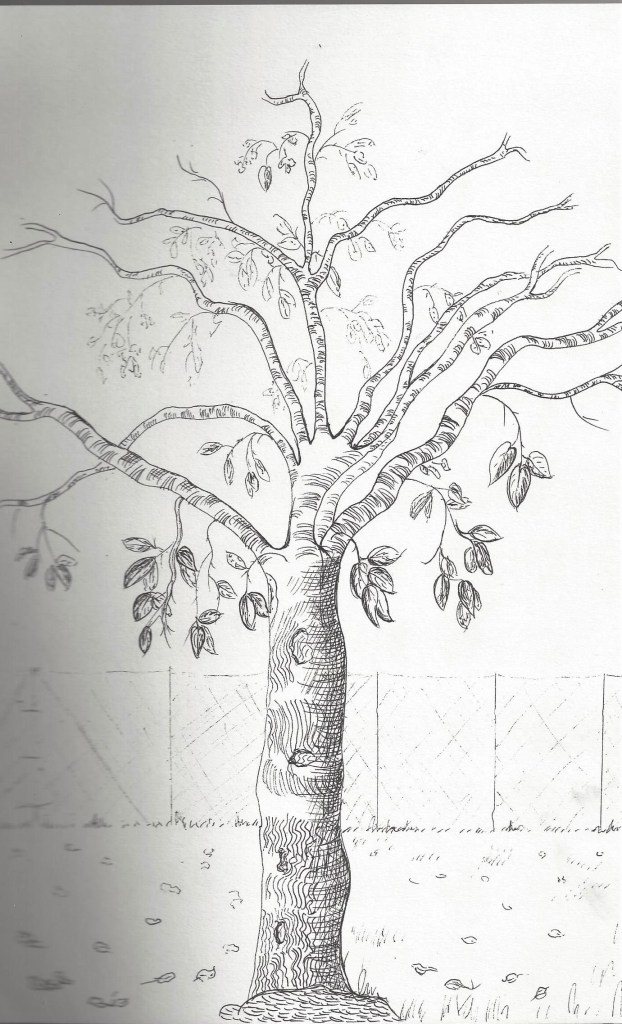
Exercise 2 – Larger observational study of an individual tree.
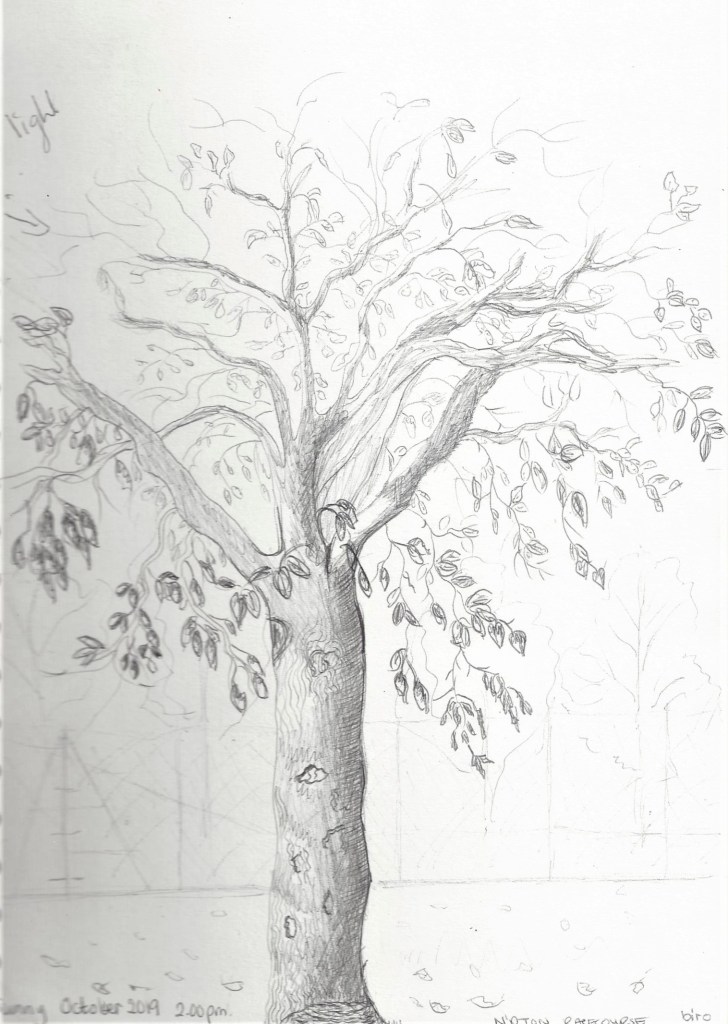
Large sketch– bottom- I drew this whilst sitting in the park on an Autumn day. A good season to be able to observe the branches without a lot of foliage. This was done in ballpoint pen. I enjoy the flow of the pen and smoothness of texture. Light was coming from the right – ballpoint is good for darkening shadow areas. I realise now that I forgot to note any shadow on the ground – must remember to look next time.
The top left sketch was done using fine liner pen and drawn back at home using the first sketch for reference. Fine liner gives more of an illustrative look which I think suits the subject.
The top right sketch was drawn from memory as an experiment, with charcoal pencil- I am pleased with the texture of the bark and even the abstract look of the branches.
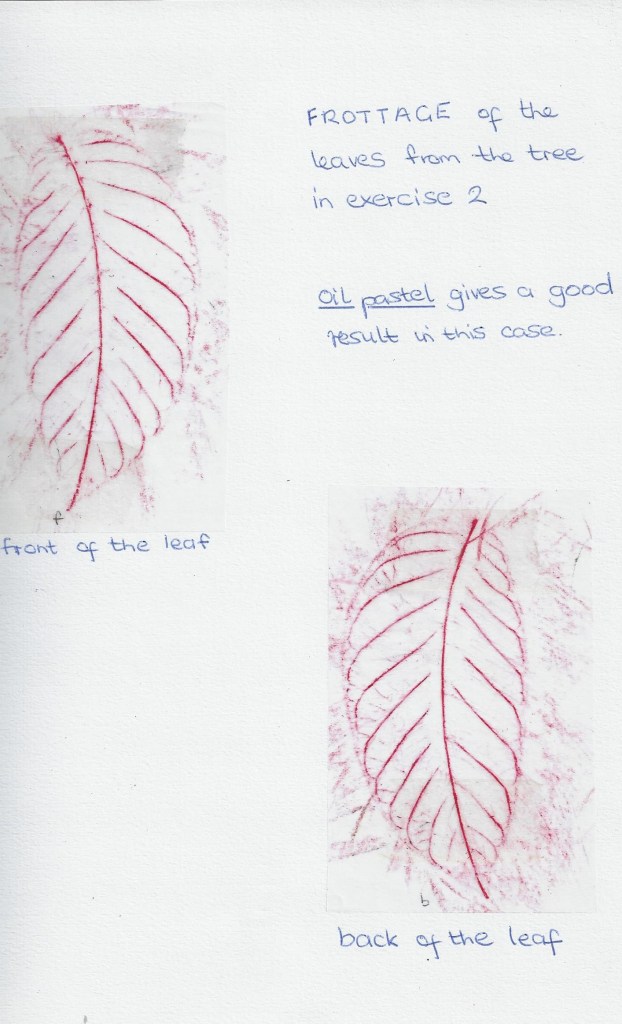
Frottage of the leaves 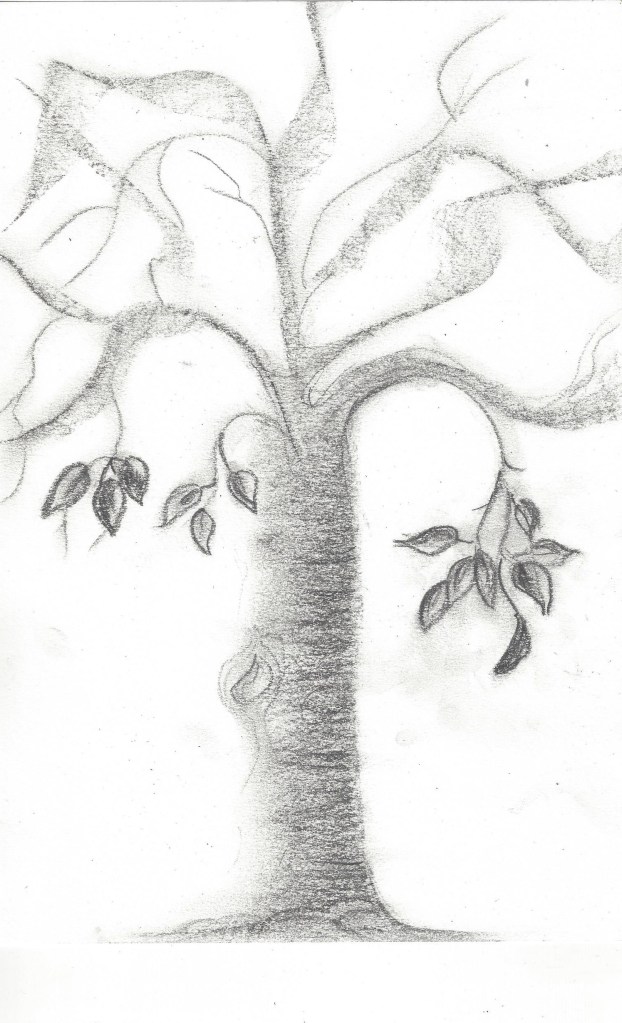
Exercise 3 Study of several trees
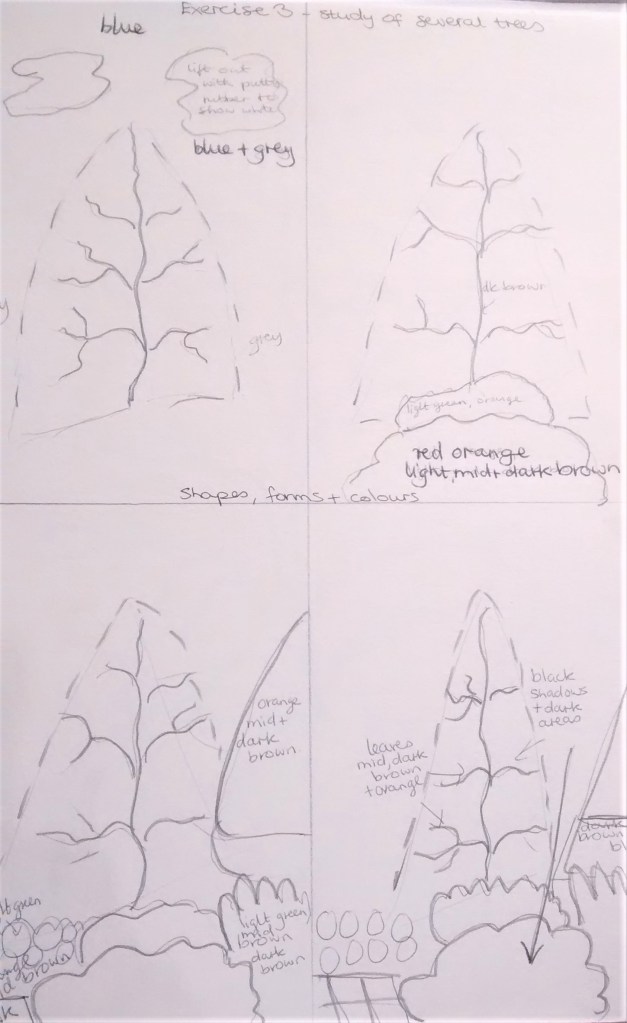

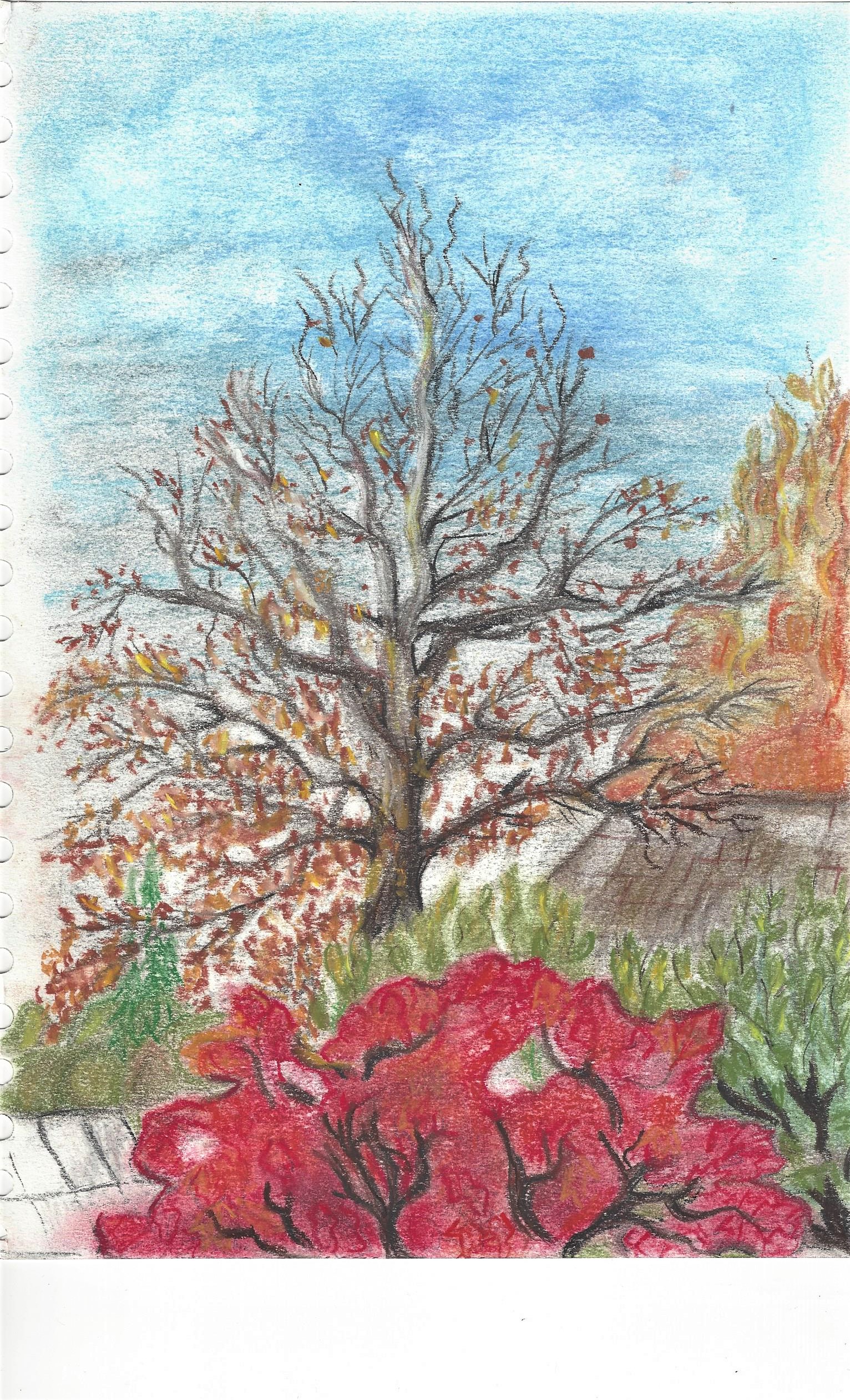
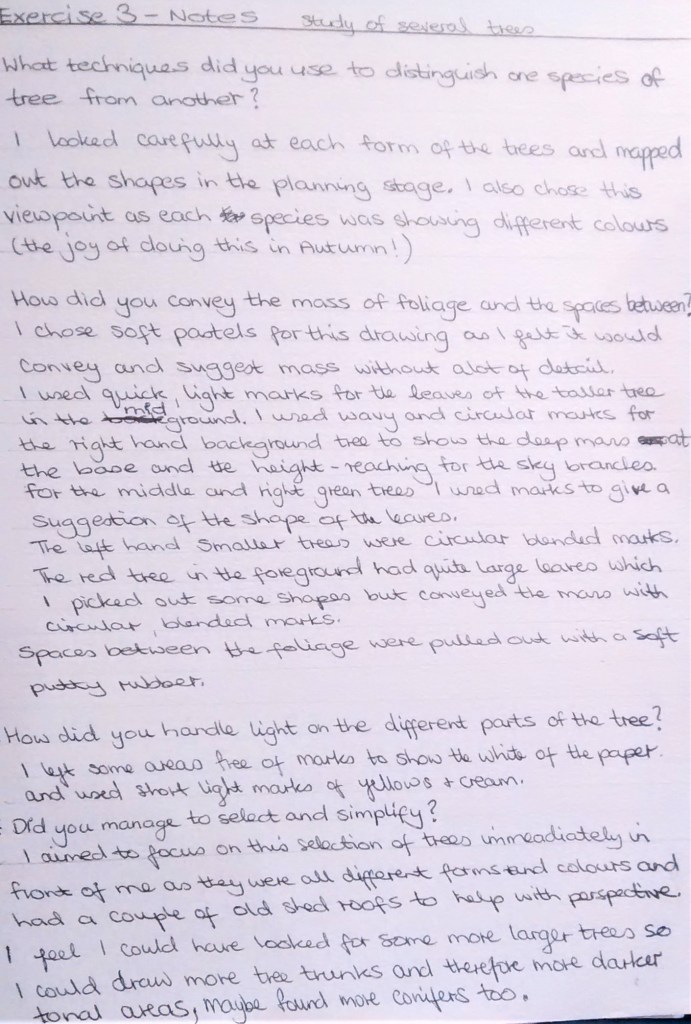
Tree experiments –
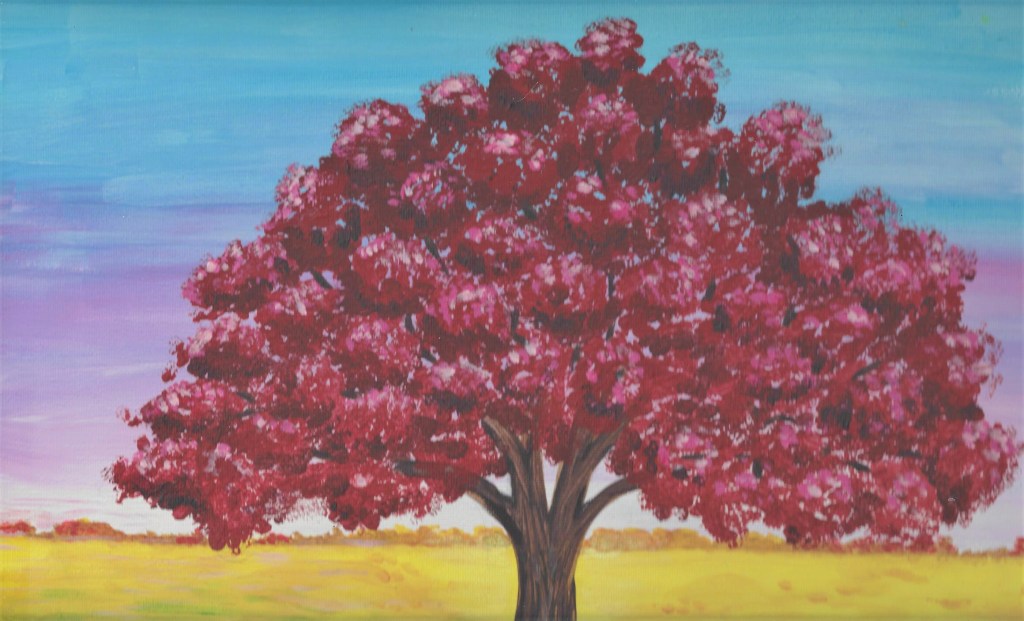

PROJECT 2 landscape
Research – Artists from different eras who use landscape as their main subject.

Fig.2 
Right – My own experiment on blue paper using brown coloured pencil- firstly to practice quick light sketches of trees and clouds and secondly to try brown on blue paper – as I like the dramatic effect it gives.

I like the shapes of the foliage on the tree in the forefront with the light falling on the tips of the branches giving life to the picture, also the dark storm clouds contrasting against the lighter sky below give an intense atmosphere to the scene.


I feel so happy to have come across this artists works which show urban landscapes and gives us a chance to observe what we may think of as ordinary.
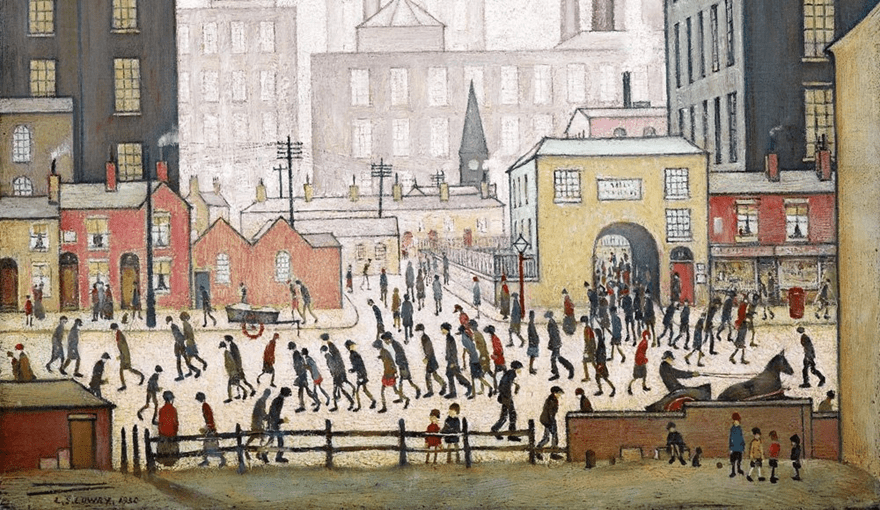
Fig.5 Coming from the mill (1930) I chose to look at this painting by Lowry as it clearly shows – foreground , middle ground and distance. This is something I haven’t been too aware of before until studying this course.

Fig. 7 Somewhere 2007
pencil on paper in perspex box, 20 x 60 x 20cm Sarah Woodfine
This is the first time I have looked at this artists work and I like the way she has used her drawings in a different way . I wouldn’t have thought of doing this kind of work but it has encouraged me to think ‘ bigger’ about using art to communicate to people. It also reminds me to observe in my drawings how to create 3D by using distance, middle and foreground.

Looking at some of the works of Turner I came across this painting and was struck by the glorious light in the sky and the way the tree in the foreground stands out against the light. I like the depth in this picture and the way the background seems to go on and on to another land.
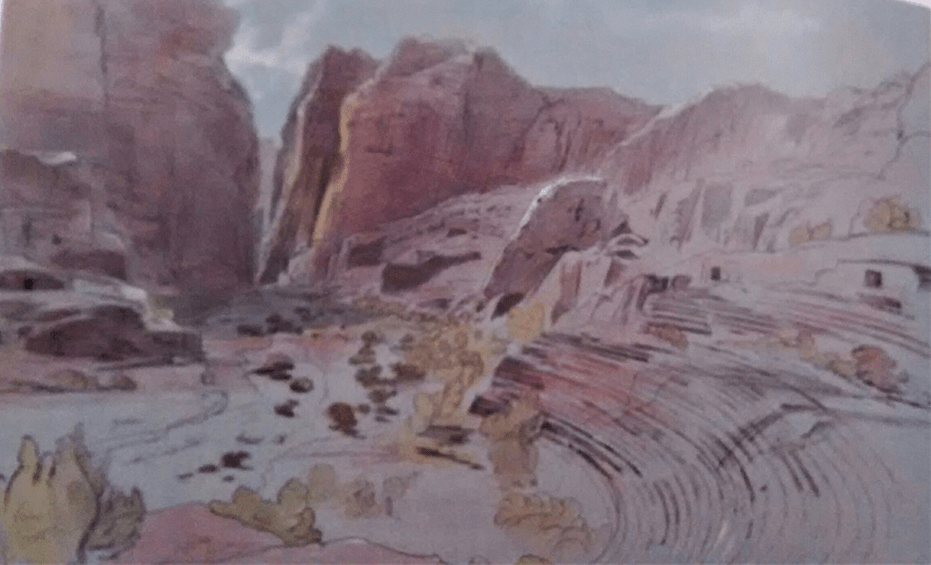
‘Edward Lear travelled widely and used pen sketches to record what he saw, at the end of his trips, back in the studio,he applies watercolour washes to the compositions based on colour notes. ( Julian Brooks, 2010, page 85 )
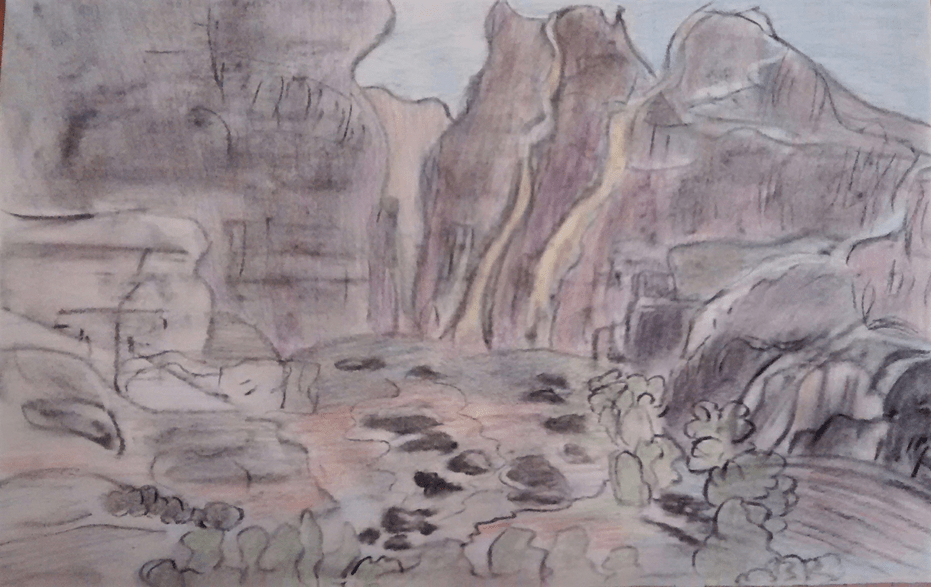
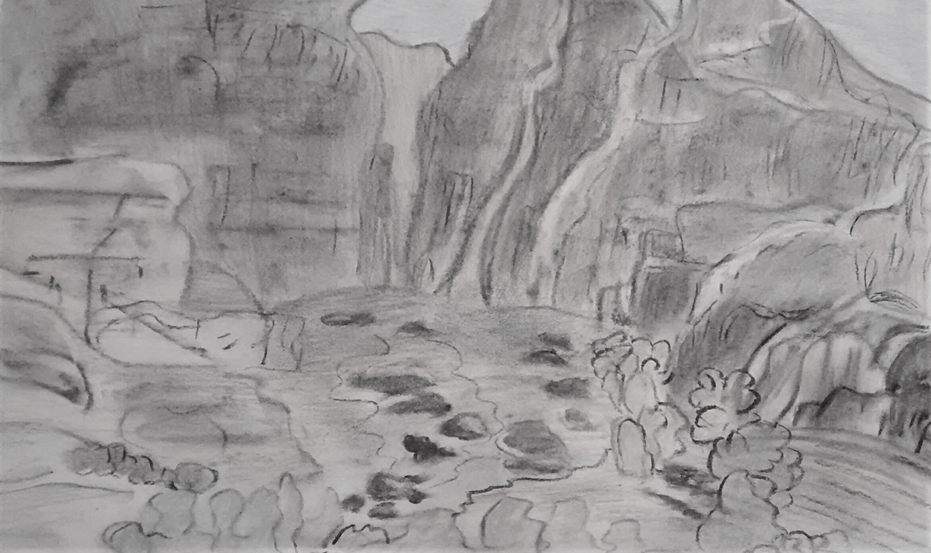
This one below is in black and white which helps me to focus on the tones
https://jennifers.art.blog/2019/11/23/593/ see link for further thoughts
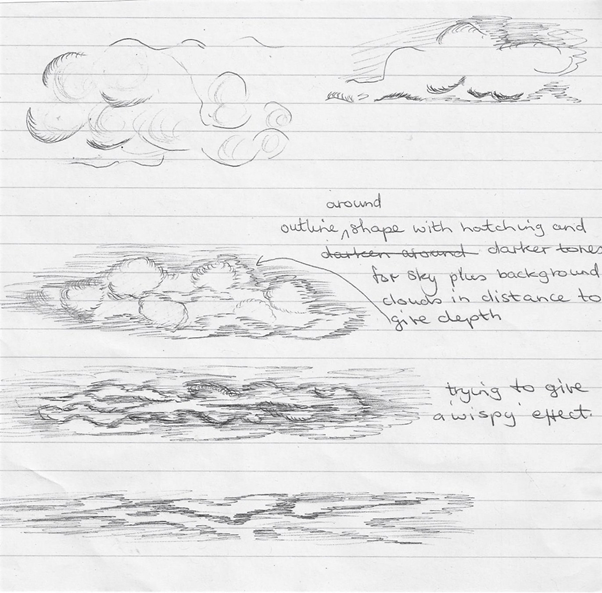
Exercise 1 – Cloud formations and tone
This is my version below –
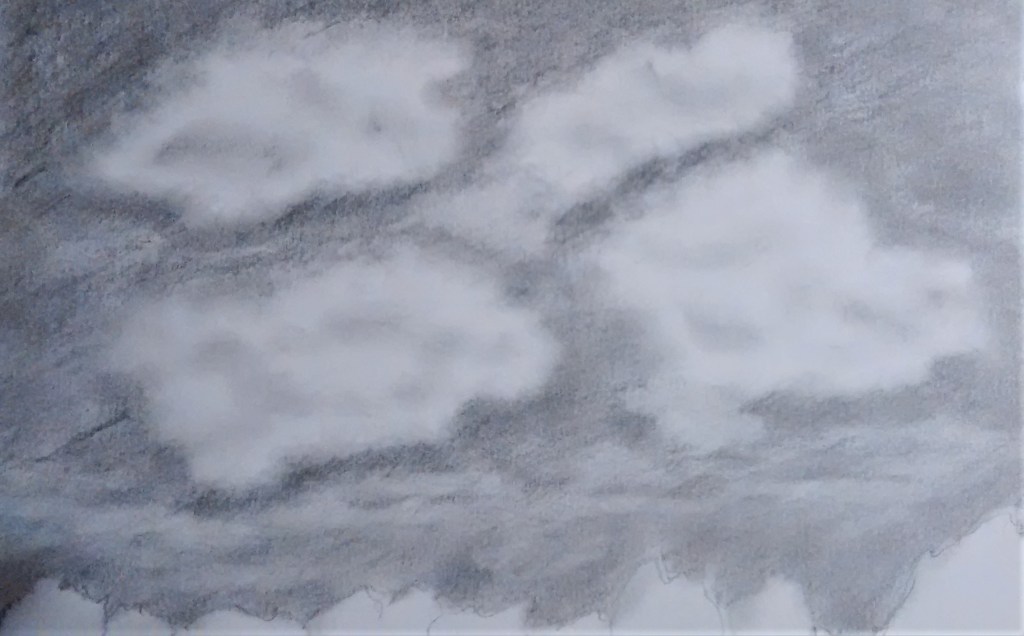
RESEARCH POINT http://www.vimeo.com/22299024 I watched this video of Vija Celmins describing one of her exhibitions. I like her approach to drawing as ” re describing ” what we see. I feel I could have this attitude with my cloud drawings and not try to produce an exact copy, particularly as clouds are moving and constantly changing. I take pleasure in the fact that art can be a way of telling a story. I looked at some images that she produced which show a great attention to detail – https://www.tate.org.uk/art/artworks/celmins-sky-p78334 we get the sense of a vast space with no beginning or end.
Cloud experiments from photographs –
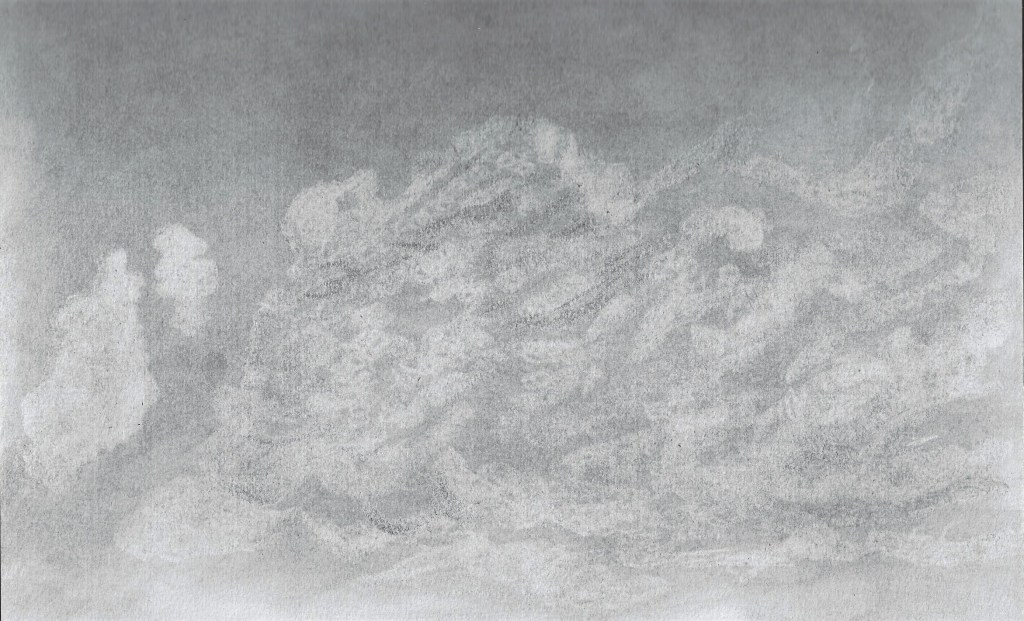
Graphite and eraser, from a photograph 
Oil pastel
Drawn outdoors
Exercise 2 – Sketchbook walk
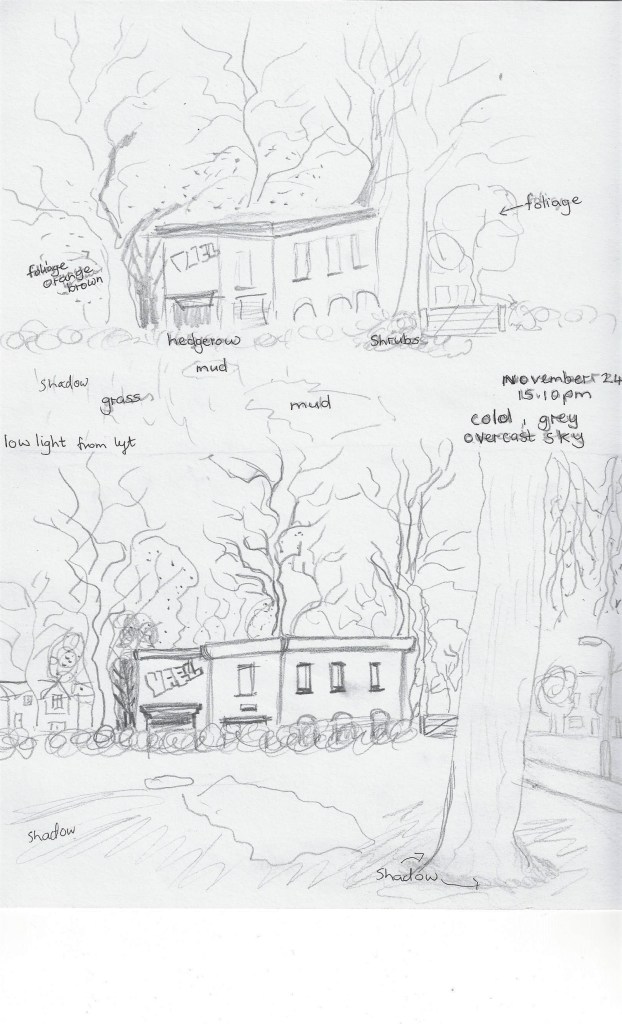
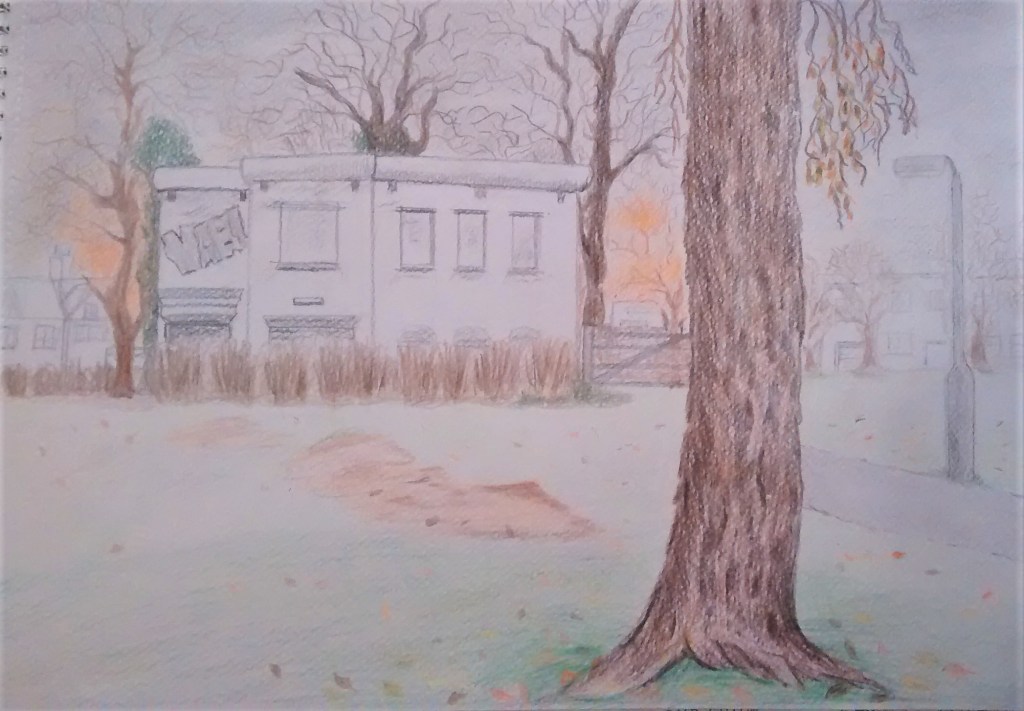
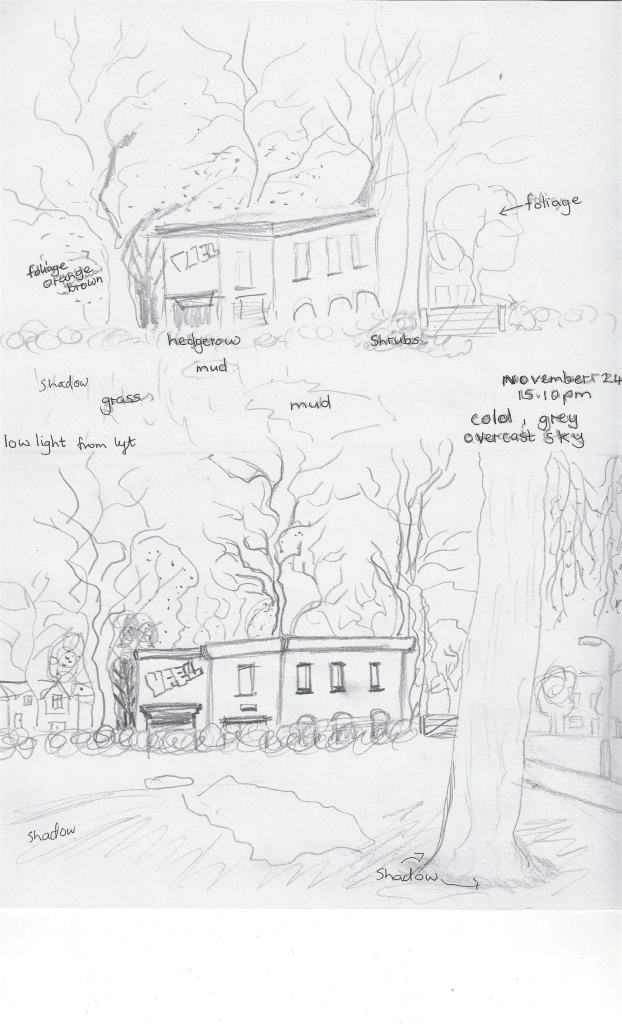
I sketched 2 drawings of this scene, I did the top one first and then took a few steps back for the bottom sketch as I preferred the view with the larger tree in the foreground and the path with lamp- post giving more depth to the scene. 4B pencil on cartridge paper – Main point of interest is the disused building
Foreground – larger tree, grass and patch of mud, middle ground – building and hedgerow and gate,
background- trees and houses and sky.
Hedgerow patterns are squiggles and swirls. foliage is stippled, lines for bark pattern, several rectangles and arches on buildings, wavy lines for branches, distant trees outline shapes, block letters for grafitti. Dark tones mostly on the left by the corner of the building and around the windows.
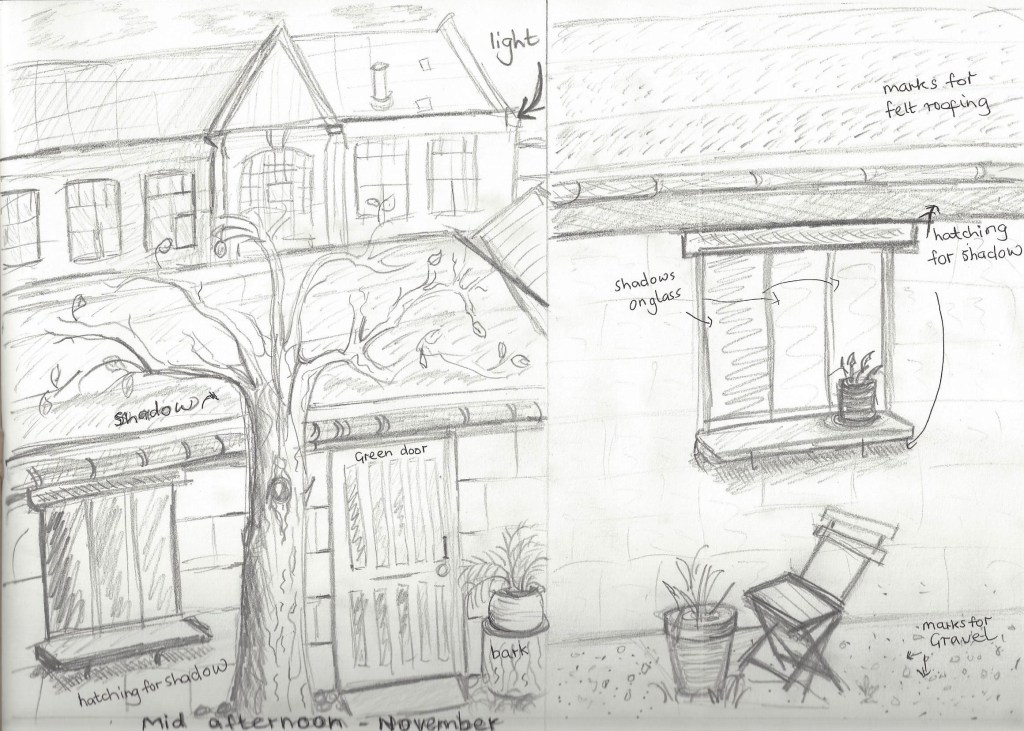
My main point of interest for the left sketch is the pear tree in the foreground, the door in the middle ground and the factory in the background. Lots of rectangles here for the windows and door. Bark patterns on the tree and the tree stump on the bottom right of the picture.
The right-hand sketch main focus is the window in the middle ground, the chair was difficult to get in perspective in the foreground and I don’t like the roof markings. Not sure here where the background really lies. Darker tones mostly underneath window ledges on both pictures and the negative space beneath the left-hand branches.
Exercise 3 360` studies
We were asked to choose a landscape where there is an open view in all directions- north, south,east and west. Then to use a viewfinder to help find a focal point and complete the 4 views in 15 minutes each. It was a very cold day and I chose a local park, this exercise enabled me to see the park in a different way and appreciate some beauty in an urban environment. Here are the 4 drawings below:


RESEARCH POINT – Some artists I have looked at who have painted in series with the landscape –
As suggested in the exercises I looked at Nicholas Herbert’s work of landscapes and was amazed by the amount of different scenes drawn in the same location. I like the choice of media used ( graphite, colour pencil, soluble crayon, acrylic and pastel ) and will experiment in a similar way in my own work in the future.


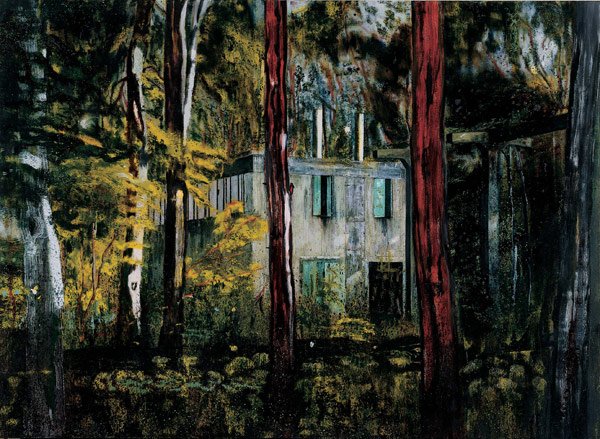
I really like the striking contrast of tones in the pictures above and below, the light draws the viewer in to look beyond the trees.
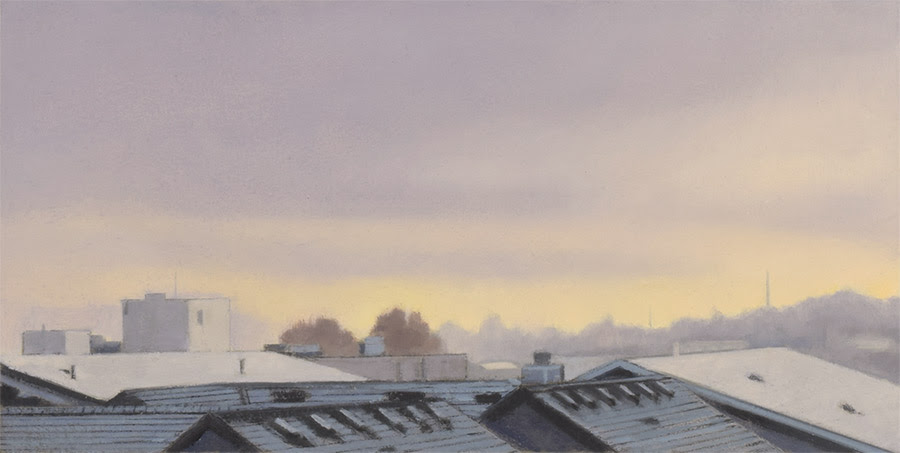
Whilst researching ‘series in landscape’ I came across the artist Mitchell Albala. I contacted him to ask permission to use some of his work titled ‘Rooftops series’ in my learning log. Mitchell got back to me with this quote –
‘ The inspiration for this series was found in my own “backyard” — the view out my studio window. For many years I didn’t consider it a “paintable” view because during daylight hours, all the shapes were an undifferentiated mass of similar values. Then one winter, a light snowfall accentuated the perspective formed by the rooftops. I began painting the scene in the late afternoon or dusk, when this perspective was most apparent, and now those rooftops serve as the foundation of each composition. Each piece reflects a different moment in time, a different color of light.’ (Albala, 2019) https://mitchalbala.com/rooftops/
14 
15 
16

I enjoy looking at this painting by John Constable as there is so much to see as your eye is drawn up and down the river.
PROJECT 3 Composition
Exercise 1 Developing your studies
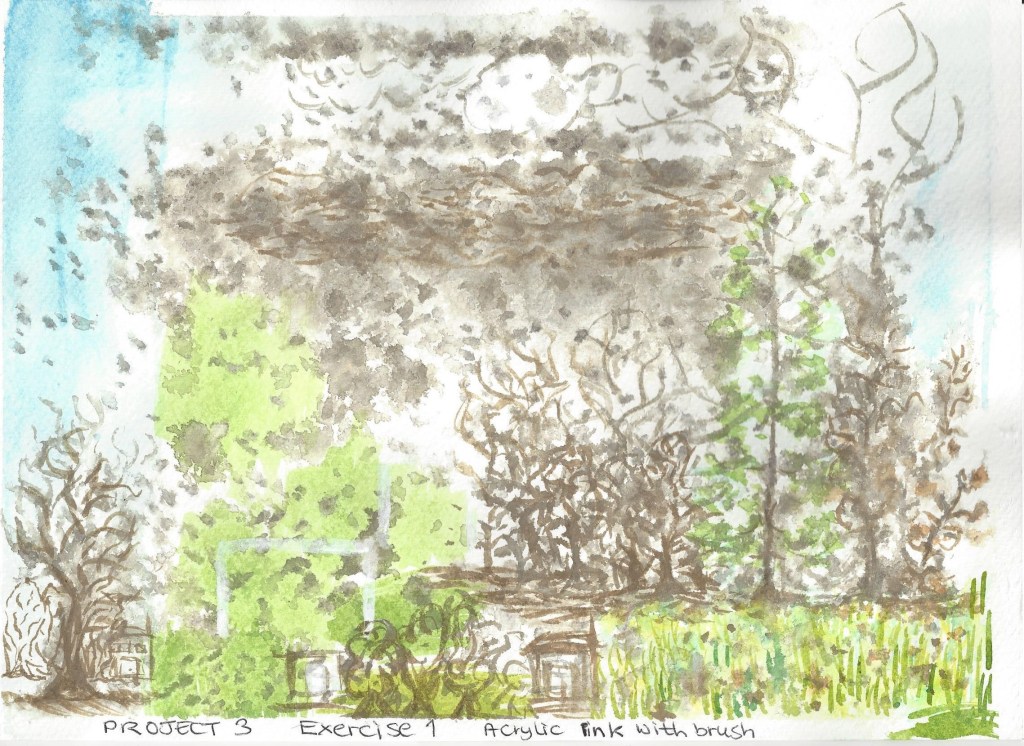
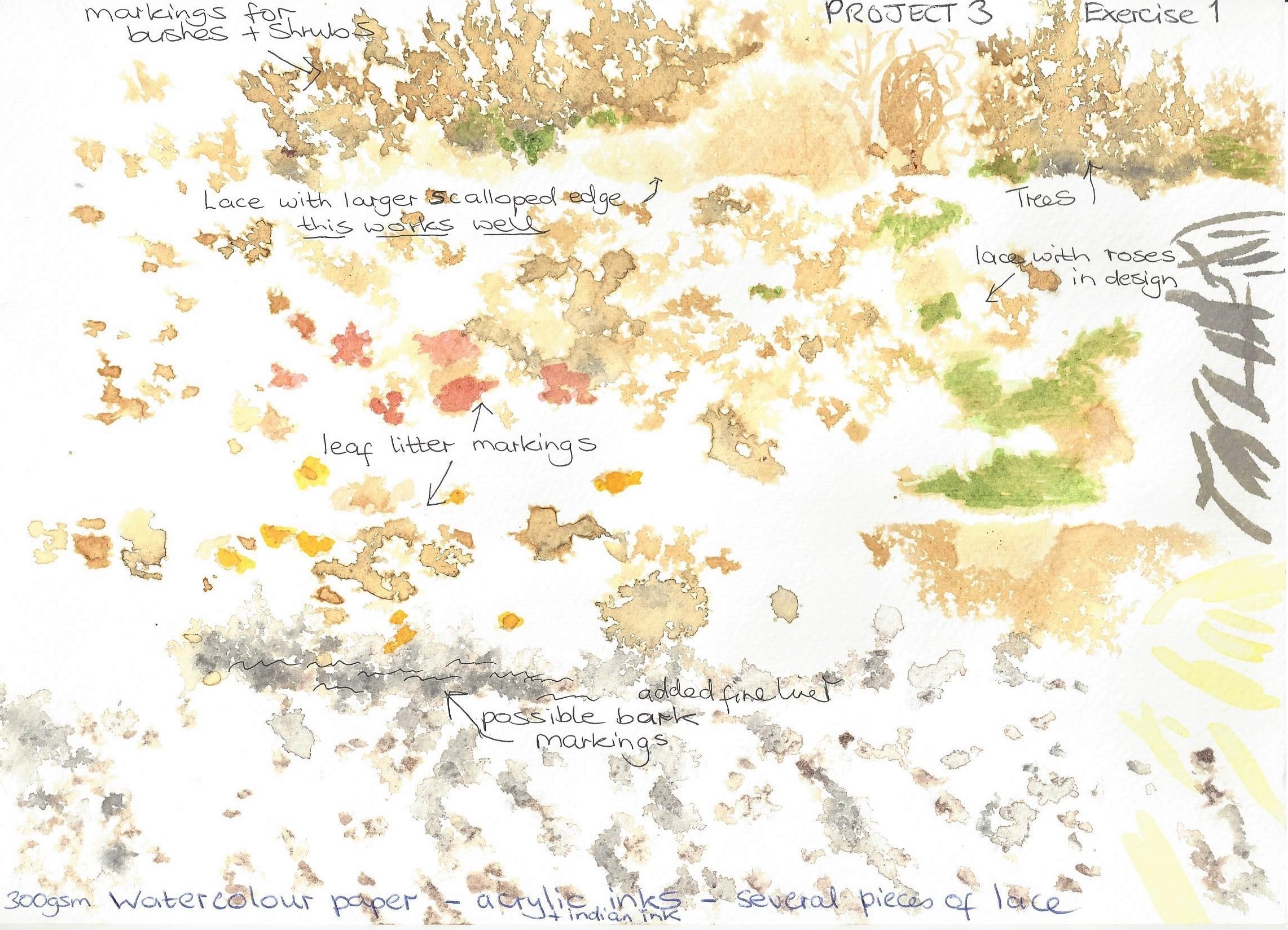
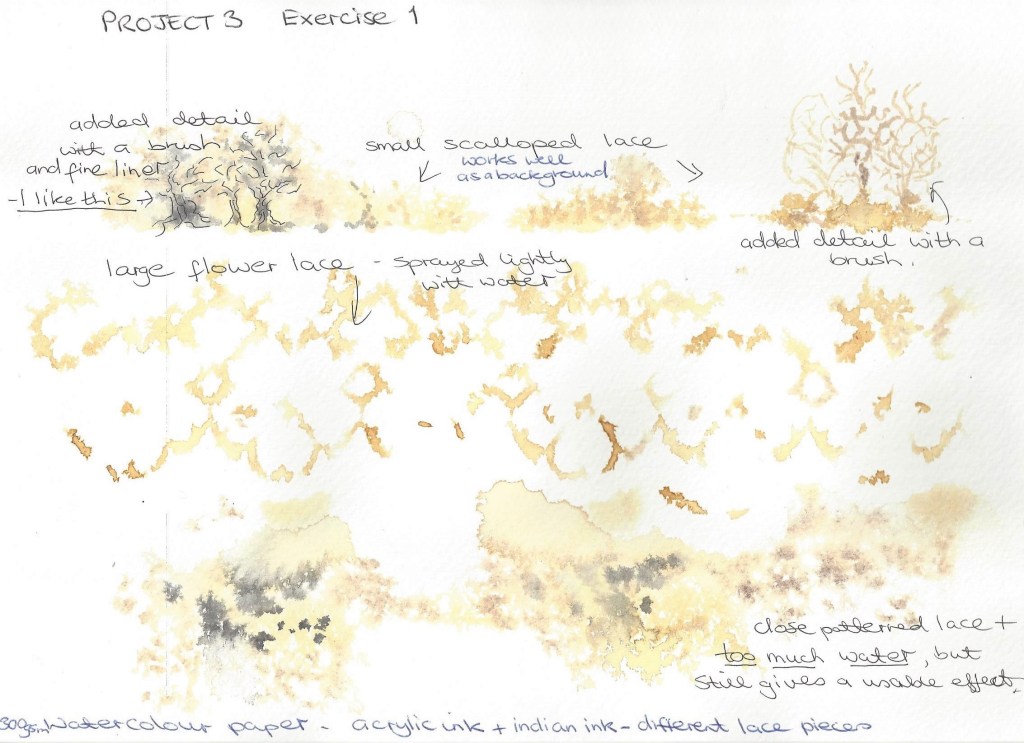
Mark making experiments – I attended a study day in Oxford where Katy Taylor talked about her work and demonstrated a technique used her textile work . Below is a sample of what I did in her workshop which I thoroughly enjoyed and can see how I could incorporate this into my artwork. We place pieces of open lace onto watercolour paper and then sprayed over with water lightly, the lace was then carefully removed and whilst still wet we dropped Indian ink into small areas around the page. I like the effect a lot , it could be used for landscape – trees, plants, paths, sky etc.


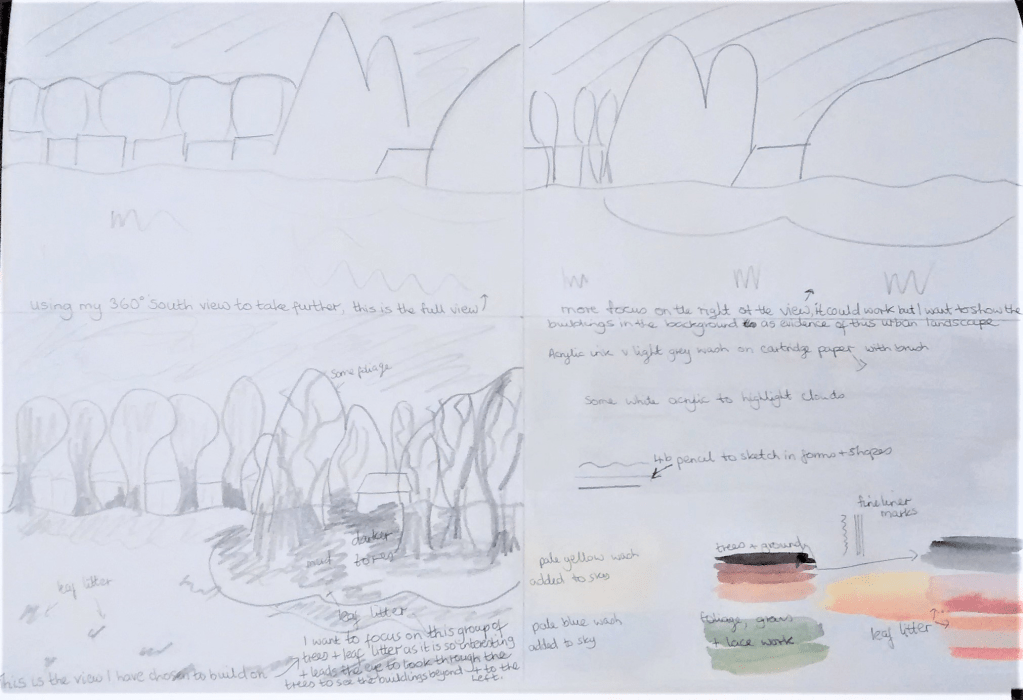
I reviewed some of my preparatory drawings from project 2 and selected from the 360 degree studies a sketch to develop into a further drawing. Below is the planning for this :

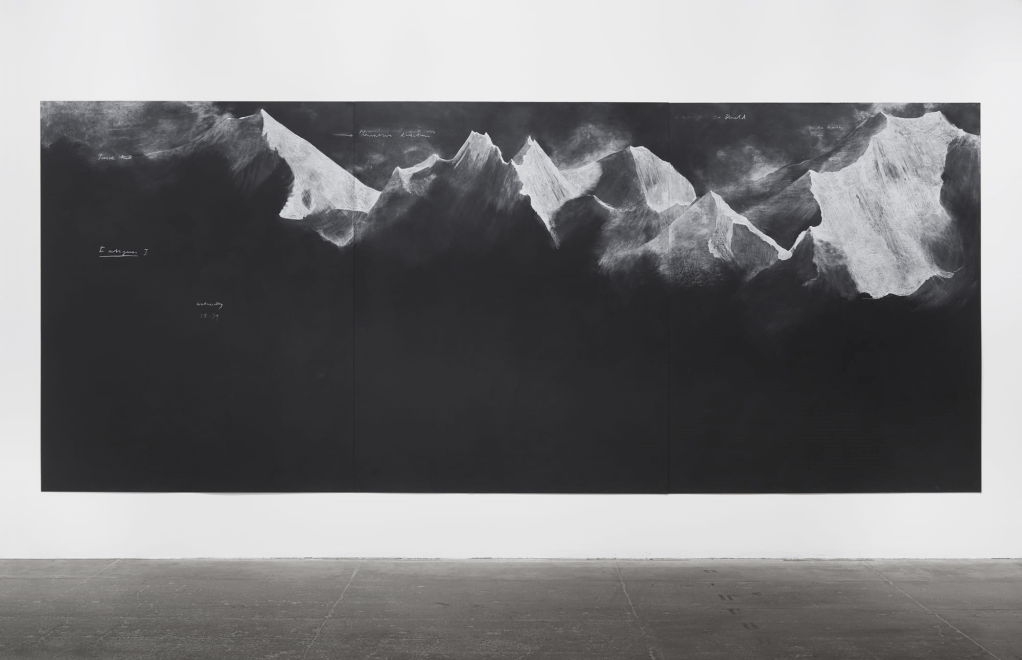
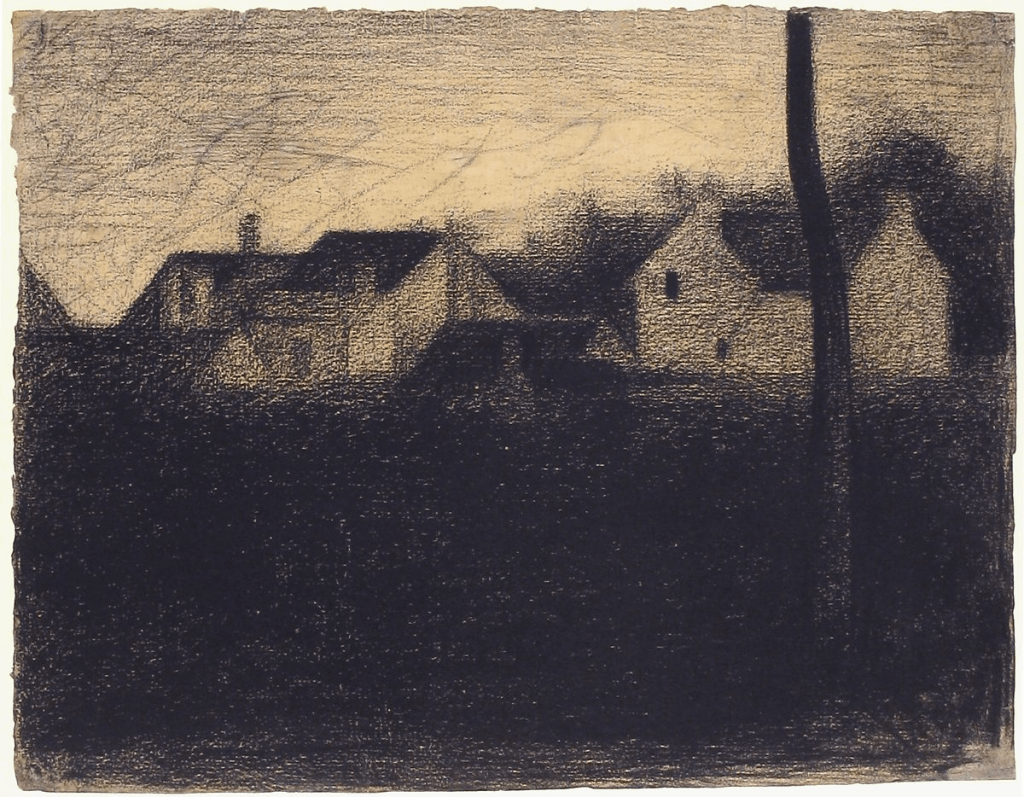
Research point – Similarities – differences Looking at contemporary artists and who work with landscape and a range of viewpoints and comparing their approaches with those of earlier artists. Tacita Dean has some drawings on blackboard which look very dramatic and atmospheric as also does Seurat’s Landscape with houses below, both use light and dark to contrast and create depth. The most obvious difference between them is the viewpoint, Tacita’s mountains are immense and almost overwhelming. Seurat’s is more focused on what most people see around us.
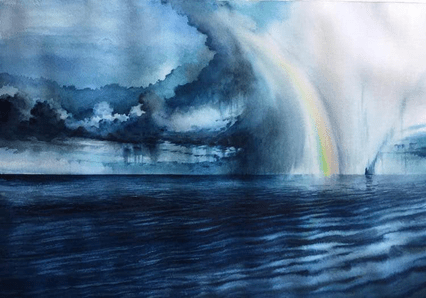
Whilst researching for contemporary landscape artists I came across Adem Potas who is based in Istanbul. This painting is done in watercolour (it does not have a title or date that I can find.) Fig.20 2019
The skies here are particularly dramatic and portray a sense of power and fast changing beauty similar to Thomas Cole’s painting below of the sky after a thunderstorm. Both artists use light and dark contrasts and reflection to take our eye around the paintings. There is also the similar use of aerial perspective – Adem paints the distant clouds on the left in a light tone and smaller shapes, Thomas depicts the distant hills in pale violet with not much detail.
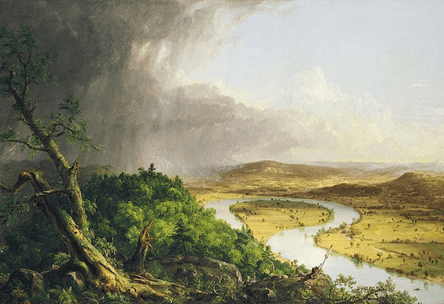
The difference between them is Adem paints in a more impressionist style whilst Thomas paints in a naturalistic way, almost like a photograph of the view. Both these paintings capture the thrilling and striking nature of the sky.
Fig.21 View from Mount Holyoke, Northampton, massachusetts, after a thunderstorm – The oxbow (1836)
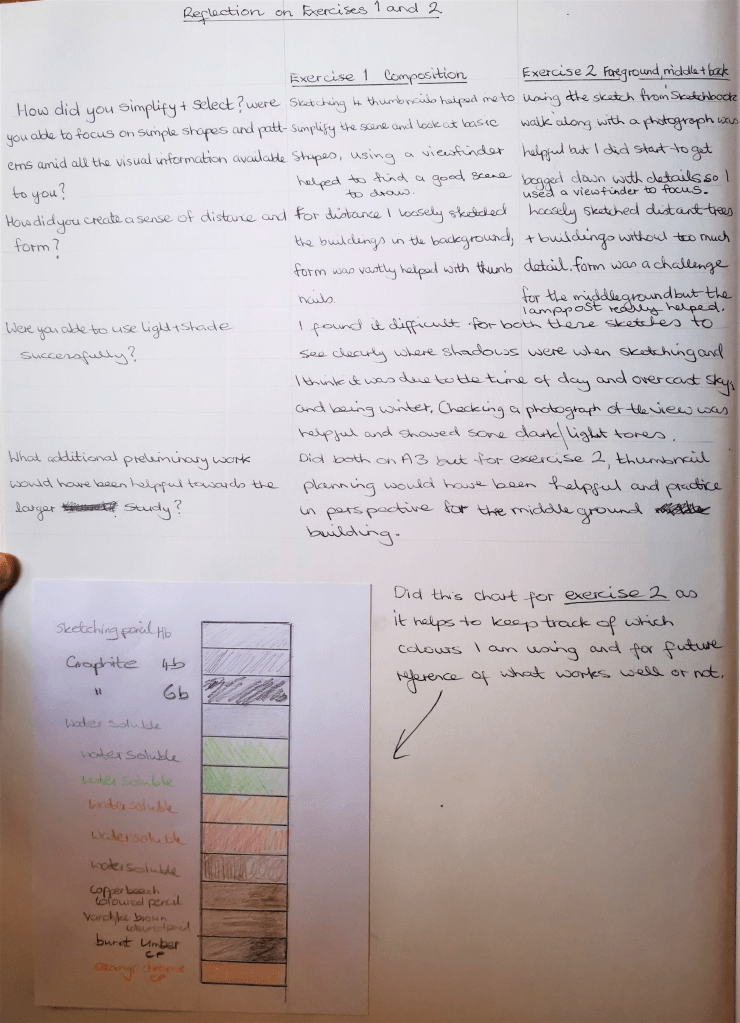
Exercise 2 Foreground, middle ground, background Using the sketches below from sketchbook walk ( project 2 exercise 2 ) I wanted to develop them into a drawing to show Foreground, middle ground and background – see the image on the right. I worked with pencil, graphite, coloured pencils and water soluble pencils on watercolour paper. I used marks from previous experiments for the bark of the foreground tree and leaf litter. Adding detail to the bark helped to show that it was closer and leaf litter was larger in the foreground.
Project 4 – Perspective
Linear
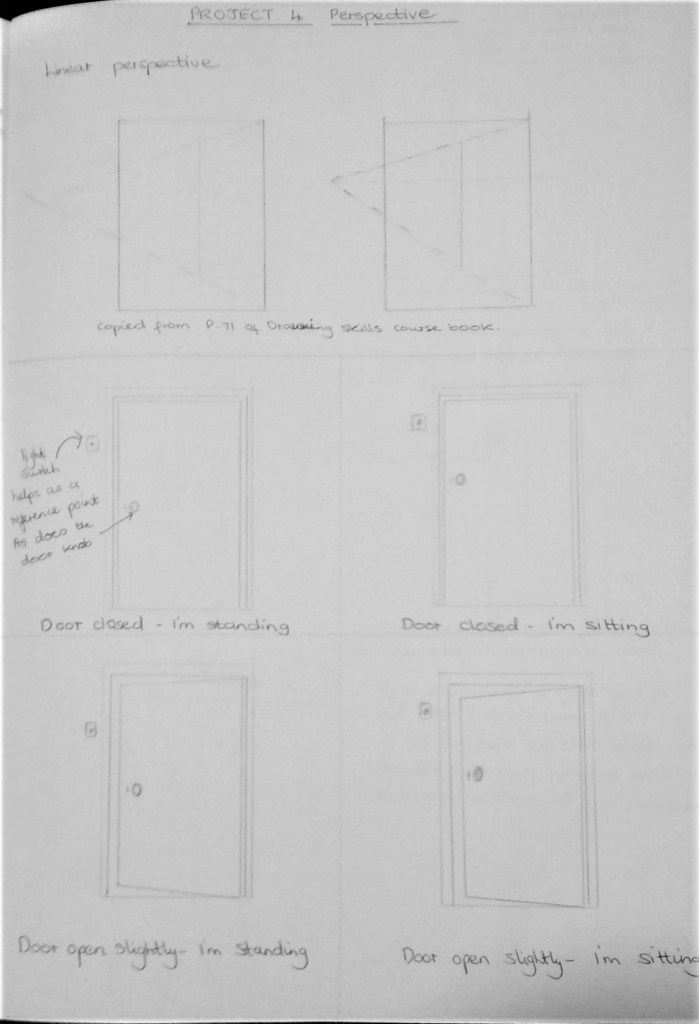

Exercise 1 Parallel perspective


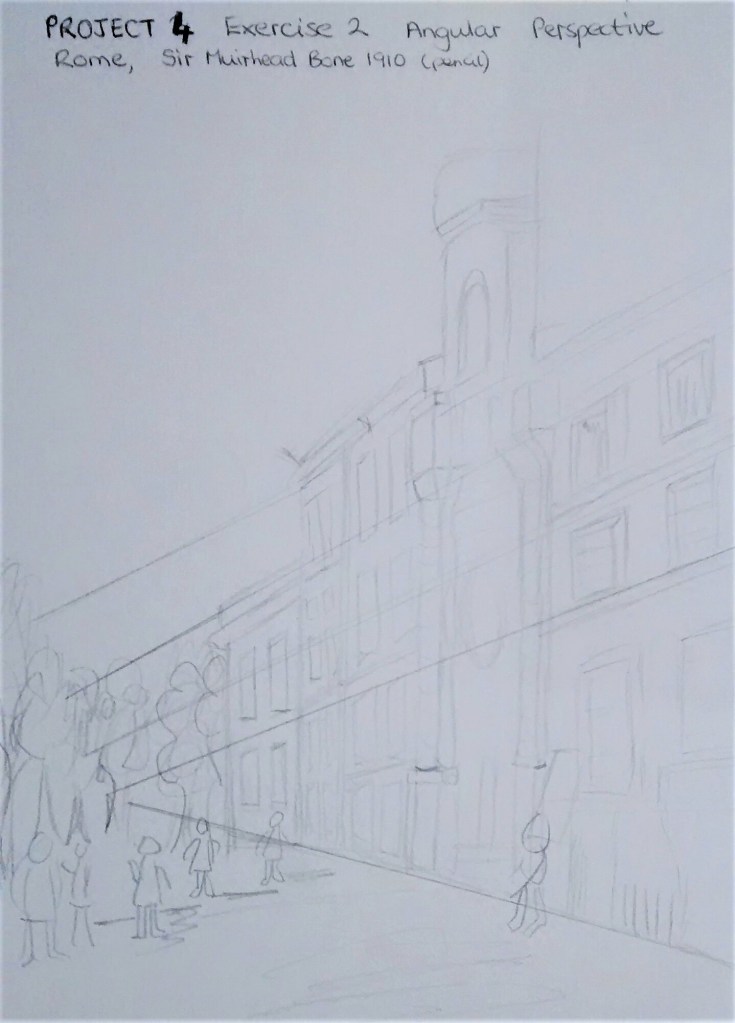
Exercise 2 Angular perspective

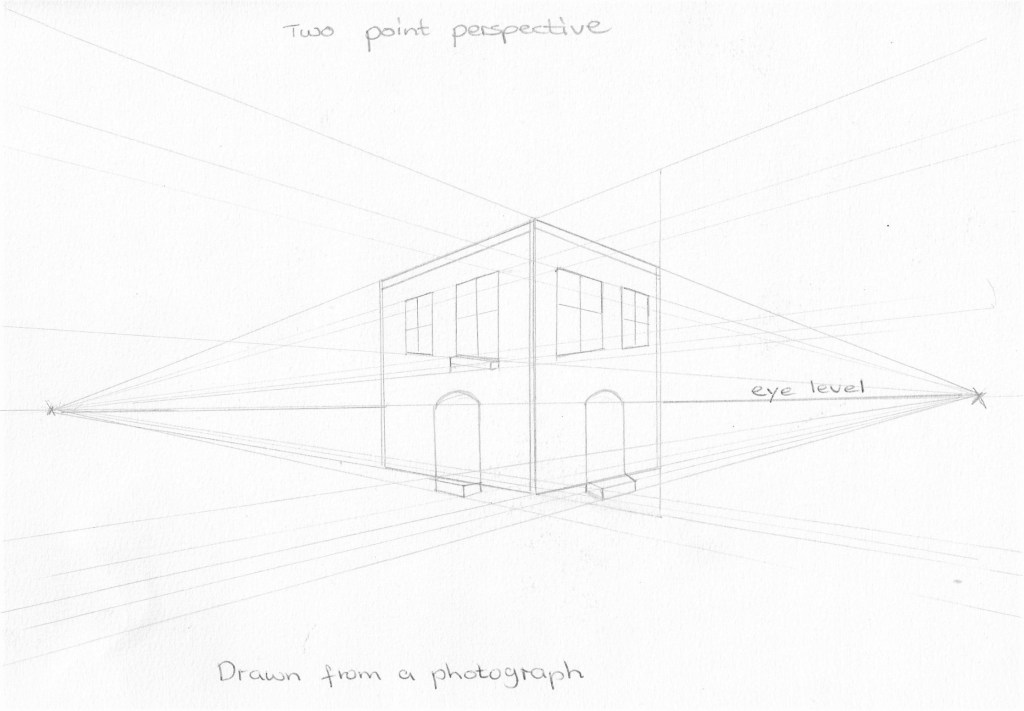
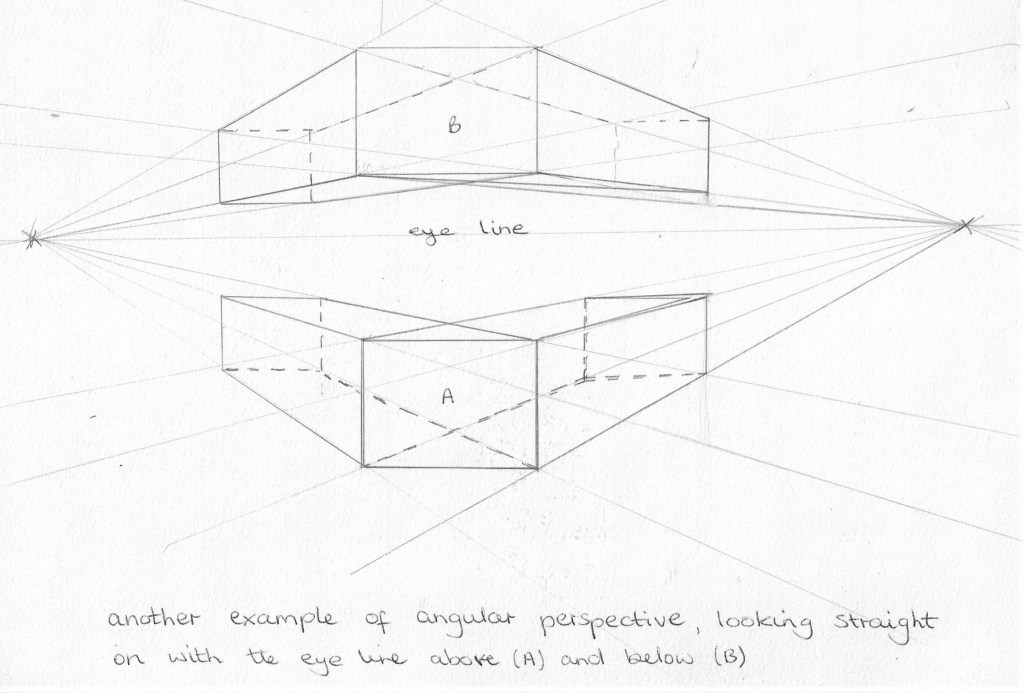
Exercise 3 Aerial or atmospheric perspective


Project 5 Townscapes
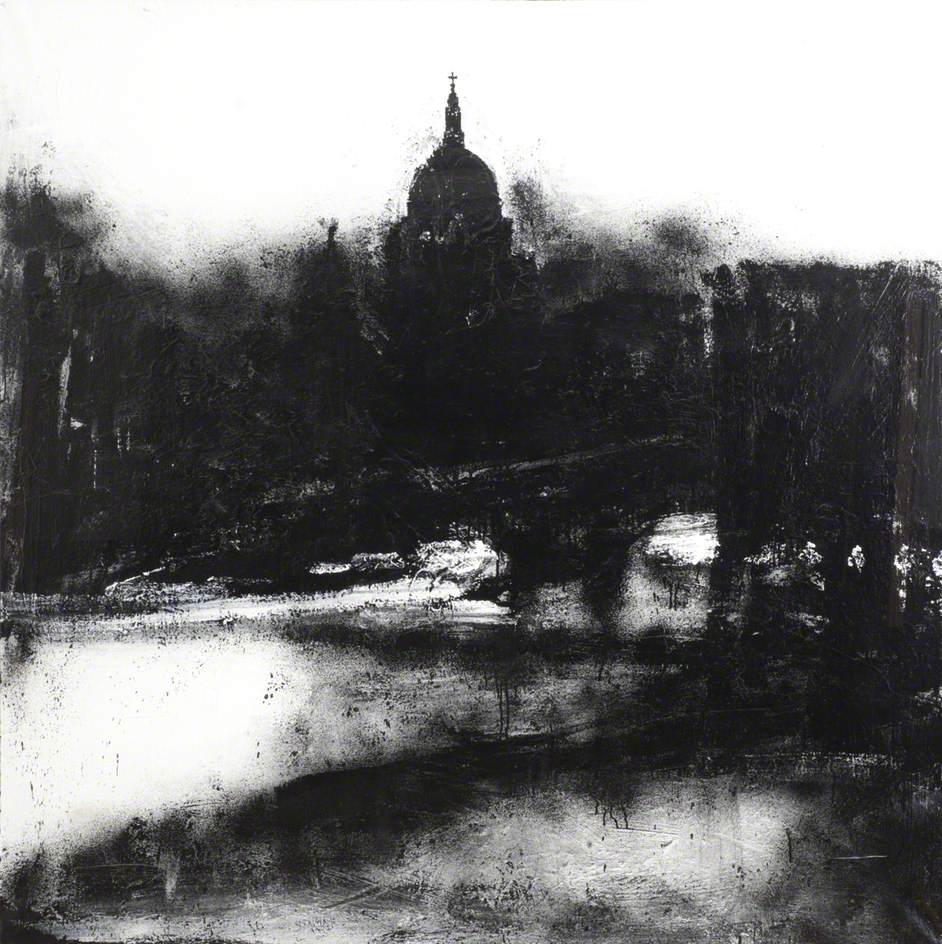
Exercise 1 Sketchbook of townscape drawings
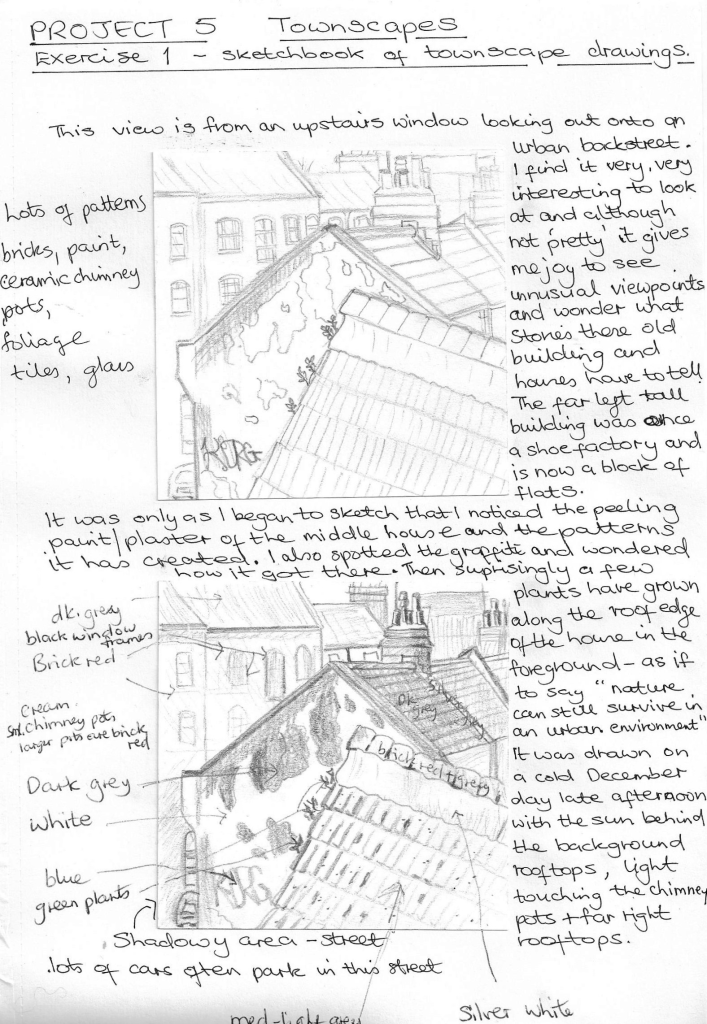

After using a viewfinder I chose what I feel is the most interesting view for the final composition. I gathered all the preliminary sketches and photographs around me. I also looked out at the view again and drew on the window pane in dry wipe pen and traced some of the outlines of the roofs onto the glass to see if it would help me with the perspective. I’m not sure that it helped to then translate that onto paper as I still had to think hard about positioning everything. I drew the main shapes in 3b pencil onto A2 rough brown wrapping paper using thumb and pencil method to measure the lengths and widths, this was helpful. I used a ruler for the straight edges as I don’t feel confident doing a large drawing in freehand. I used soft pastels and conte sticks building up the layers of several colours and then blending with a soft cloth.

Exercise 2 Study of a townscape using line. We are asked to make a preliminary drawing using two sketchbook pages. I went to the town centre close to where I live and found an interesting view of some old town houses that have been restored. It was a cold day in December so I took photographs to be able to complete the sketch at home. The sun was shining but not very brightly as it was hidden behind the buildings. I often prefer to draw scenes that show plenty of light and shadow. The focal point for me is the smallest lamp-stand so I centred this in the middle of the page. Ideally for me there were three lamp-stands which provided background, middle and foreground. I tried to provide enough detail to give information for the final working which seemed to be taking me a long time so I chose to detail only one or two windows in pencil to inform the later pen and ink drawing. Below is the preliminary sketch –
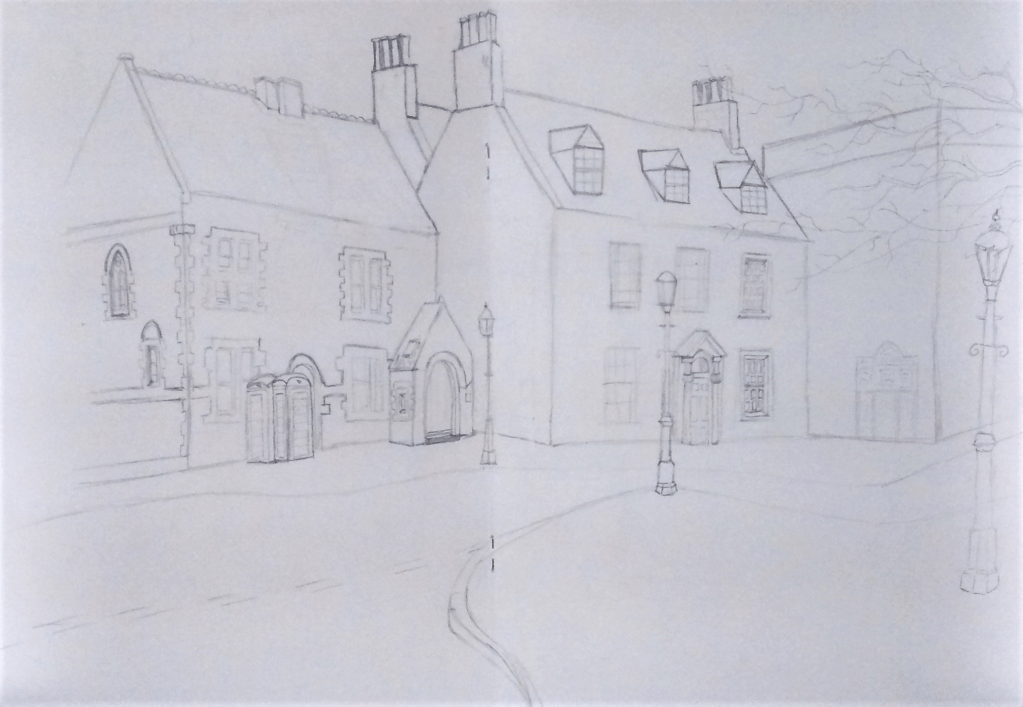


Exercise 3 A limited palette Using your sketches from the previous exercise, select a drawing to develop in colour. I chose to use conte sticks in 3 colours – grey, black and bistre- these were my middle and darkest values, the paper is the lightest. I also decided to experiment using smooth A2 cartridge paper. I wanted to work quickly and not get bogged down by too much detail consequently I missed out one of the chimney stacks! It was difficult to work with conte sticks to draw detail and also the smooth paper did not ‘hold’ the colour well. When I began the drawing I wasn’t feeling inspired by it at all, as it progressed and started to take shape I felt a little more confident. What I really like are the lamp-stands are their positions in the back,middle and foreground, also the swirling road/pathway. Were you able to create a sense of depth with your limited colour palette? I created some sense of depth by layering the colours to give more hues. I think I rely a lot on the dark tones to show depth and sometimes forget the middle ones. I used layers of grey for the roadway to try to show mid tones and layered it with black for the roofs.

Exercise 4 Statues


List of Illustrations
Figure. 1 Crome J (1812) Three trees [drawing for etching]At: https://www.metmuseum.org/art/collection/search#!?showOnly=openAccess&material=Drawings&offset=60&pageSize=0&perPage=20&searchField=All&sortBy=Relevance (Accessed on 26.10.2019)
Figure.2 Lorrain C (1674) Perseus and the origin of coral [ Pen and brown ink, brush with grey and blue washes, heightened with white on blue paper] At: https://www.google.com/url?sa=i&source=images&cd=&ved=2ahUKEwjFluSr5vjlAhURuRoKHSFbDSwQjRx6BAgBEAQ&url=https%3A%2F%2Fwww.britishmuseum.org%2Fresearch%2Fcollection_online%2Fcollection_object_details%2Fcollection_image_gallery.aspx%3FassetId%3D256605001%26objectId%3D722737%26partId%3D1&psig=AOvVaw2BxKPt_v4k75tWPh9YM2f9&ust=1574339589616341 ( Accessed 20.11.2019)
Figure. 3 Duerer A (1495-97) The Watermill[pen & ink, gouache and w/c on paper]At:Bibliotheque Nationale, Paris, France / Bridgeman Images https://www-bridgemaneducation-com.ucreative.idm.oclc.org/en/asset/198414/summary?context=%7B%22route%22%3A%22assets_search%22%2C%22routeParameters%22%3A%7B%22_format%22%3A%22html%22%2C%22_locale%22%3A%22en%22%2C%22filter_text%22%3A%22albrecht+durer+landscape%22%7D%7D (Accessed 11.2019)
Figure. 4 Dürer A (1495) Road in the Alps [gouache & w/c on paper]At: / Monasterio del Escorial, Madrid, Spain / Bridgeman Images ://www-bridgemaneducation-com.ucreative.idm.oclc.org/en/asset/387385/summary?context=%7B%22route%22%3A%22assets_search%22%2C%22routeParameters%22%3A%7B%22_format%22%3A%22html%22%2C%22_locale%22%3A%22en%22%2C%22filter_text%22%3A%22albrecht+durer+landscape%22%7D%7D (Accessed 11.2019)
Figure.5 Lowry L.S (1930) Coming from the mill [ Oil on canvas ] At:http://blog.flametreepublishing.com/art-of-fine-gifts/the-developing-style-of-ls-lowry ( Accessed 20.11.2019 17.10 pm )
Figure.6 Shaw G (2004-2005) Ash Wednesday 7.00am At: https://news.yale.edu/2018/10/30/humbrol-hometown-ycba-exhibits-oeuvre-english-painter-george-shaw (Accessed 21.11.2019)
Figure.7 Woodfine S Somewhere (2007)
[pencil on paper in perspex box] At: http://www.daniellearnaud.com/exhibitions/exhibition-privateparadise.html (Accessed 21.11.2019)
Figure. 8 Turner JMW (1834) The Golden Bough [ Oil on canvas ] At: [https://www.tate.org.uk/art/artworks/turner-the-golden-bough-n00371 (Accessed 21.11.2019)
Fig.9 Lear E (1858) Petra [ Pen and brown ink over pencil with watercolour and gouache on blue paper.] Master Drawings – Close-up by Julian Brooks Page 85 The British Museum 2010 ISBN 978 0 7141 2673 9
Figure.10 Herbert N (2016) Clearing below Sharpenhoe [ Mixed media: graphite, colour pencil, soluble crayon, acrylic and pastel on white paper ] At: https://nicholasherbert.wordpress.com/2016/10/17/landscape-l950-sharpenhoe-series-clearing-below-sharpenhoe-the-chiltern-hills/ (Accessed 29.11.2019)
Figure. 11 Virtue J (1999-2000) Landscape No 624 [ Black ink and emulsion on canvas ] At: https://www.tate.org.uk/art/artworks/virtue-landscape-no-624-t07915 (Accessed 21.11.2019)
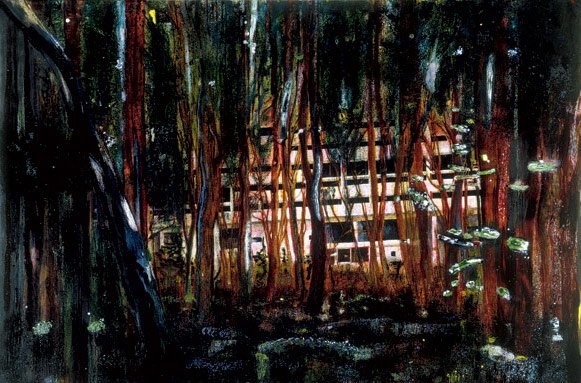
Figure. 12 Doig P (1994) Boiler House [Oil on canvas] At: https://www.tate.org.uk/whats-on/tate-britain/exhibition/peter-doig/peter-doig-explore-exhibition-room-1/peter-doig-0 (Accessed 21.11.2019)
Figure.13 Doig P (1994) Cabin Essence [Oil on canvas] At: https://www.tate.org.uk/whats-on/tate-britain/exhibition/peter-doig/peter-doig-explore-exhibition-room-1/peter-doig-0 (Accessed 21.11.2019)
Figure.14 Albala M (2019) Rooftops 59th Street, Winter Dusk, [ oil on paper ] https://mitchalbala.com/rooftops/ (Accessed 01.12.2019)
Figure.15 Albala M (2019) Rooftops 59th Street, Last Light, [ oil on paper ] https://mitchalbala.com/rooftops/ (Accessed 01.12.2019)
Figure. 16 Albala M (2019) Rooftops 59th Street, Cobalt Dusk, [ oil on paper ] https://mitchalbala.com/rooftops/ (Accessed 01.12.2019)
Figure .17 Constable J (1821) ‘View on the Stour, near Dedham’ [Oil on canvas] 51 x 73 in (129.4 x 185.3 cm). (Accessed 01.12.2019) Near Dedham’, John Constable, RA (East Bergholt 1776-1837 London), Sketch for ‘View on the Stour, Near Dedham’, Circa 1821-22. [Oil on canvas] 51 x 73 in (129.4 x 185.3 cm). (Accessed 01.12.2019)
Figure 18 Dean T (2012) Fatigues [chalk on blackboard ] Marian goodman Gallery (Accessed 05.01. 2020) https://www.mariangoodman.com/artists/39-tacita-dean/works/28967-tacita-dean-fatigues-2012/
Figure 19 Seurat G (1881 – 1882) Landscape with houses [conte crayon] https://www.metmuseum.org/art/collection/search/337676 (Accessed on 09.01.2020)
Figure 20 Potas A [watercolour] https://mymodernmet.com/contemporary-landscape-painting/(accessed 12.01.2020)
Figure 21 Cole T (1836) View from Mount Holyoke, Northampton, massachusetts, after a thunderstorm – The oxbow [oil on canvas] https://mymodernmet.com/contemporary-landscape-painting/ (accessed 12.01.2020)
Figure 22 Virtue J(2005) landscape No.739 [shellac, black ink and white paint] https://artuk.org/discover/artworks/landscape-no-739-219454 (accessed 12.01.2020)
Bibliography –
Georgina Palffy – senior editor Artists drawing techniques Dorling Kindersley limited 2017 ISBN -0-2412-5598-8 Pages 106-107, 256-257
Julian Brooks Master Drawings – Close-up by The British Museum 2010 ISBN 978 0 7141 2673 9

 Art Journal